

2nd Lieutenant BASIL VOKES
41, Western Road, Winchester (12, Cheriton Road today)
Family Background
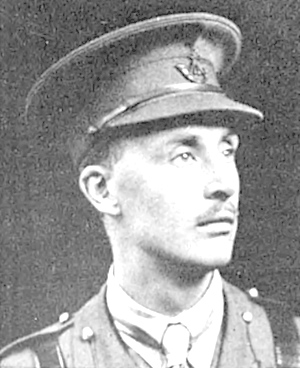
Lieutenant Basil Vokes
Basil Vokes (above) was the second son of James and Lavinia Vokes who had married in 1879. They moved to the newly-built 1, Greenhill Road in Fulflood where their first son, Harold, was born in 1880. Basil was born two years later on 4 July 1883.
In the 1881 Census James was recorded as a ‘Stonemason Journeyman’ – meaning that he was learning his trade. By 1891 he was a fully qualified stonemason while Basil himself and brother Harold were both at school. Although it is not known which primary school they attended, the National Schools Admissions Register shows Basil was admitted to St Thomas National Church of England Boys’ School in 1893. Years later, he would return there as a trainee teacher.
By 1901 the Vokes family were living at 3, Clifton Terrace, Winchester, a spacious home spread over five floors. Harold, aged 25, had qualified as a Post Office clerk and Basil was a pupil-teacher at St Thomas School. Basil’s position as a pupil-teacher meant that he had shown promise in class and had been invited by his school to stay on beyond the normal leaving date. Pupil-teachers had to be at least 15 years old and had to pass a medical and a written examination. At the end of their period of service pupil-teachers sat a scholarship exam which Basil passed. In 1902, aged 19, he enrolled at Winchester Diocesan Training College. Today, the college buildings form part of the University of Winchester.
The year 1902 was also an important one for Basil’s father. An advertisement in the Hampshire Chronicle of 6 September 1902 reveals that he had gone into business as a stonemason in Fulflood. The firm, Vokes & Beck, operated from premises on Stockbridge Road. It carried out all types of stonework, but the advertisement makes special mention of tombs and headstones. Over the following century, Vokes & Beck would go on to become part of the fabric of life in Fulflood. The firm still operates today, but from premises in Kings Worthy.
As his father ventured into business, Basil Vokes began his three years of teacher training. Part of this involved visiting local schools. Basil also seems to have been involved in college sporting events – especially football and cricket – although usually as referee or umpire. It is likely that Basil joined the college’s Volunteer Company, part of the Winchester-based Hampshire Regiment. This meant that he was a part-time soldier.
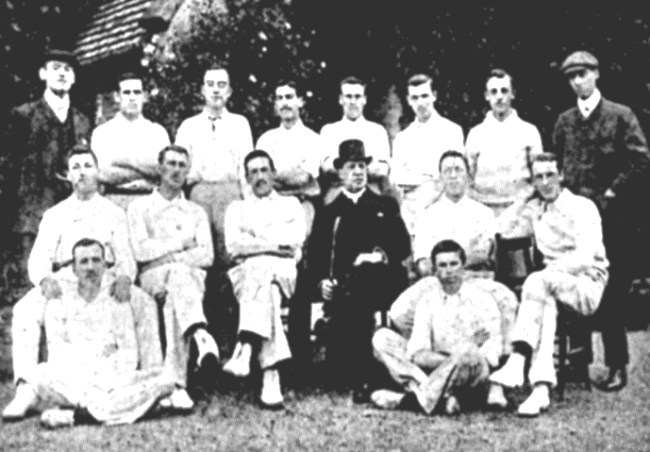
Basil Vokes, back row, right (in cap), with the Winchester Diocesan Training College cricket team
Basil took up his first teaching position at St James’s School, Weybridge, Surrey in 1905, the same year that his brother Harold died, aged just 25. Three years later his mother passed away at the age of 54. Besides his teaching duties, Basil enjoyed a busy social life in Weybridge. He sang with Weybridge Choral Society, joined the Freemasons, was elected secretary of the local bowling club and became Secretary of Weybridge Football Club. He also became a non-commissioned officer in the local Volunteer Company (later reorganised into the Territorial Force).
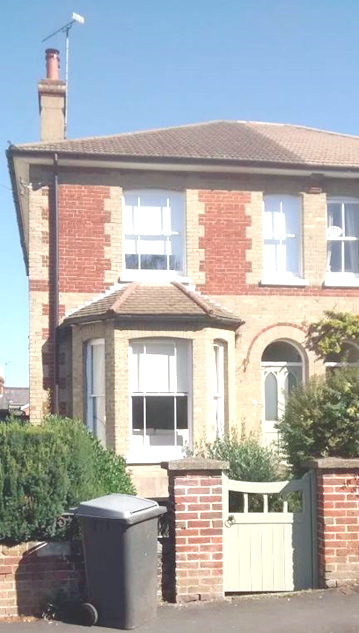
12, Cheriton Road, Winchester – this was 41, Western Road
when Basil Vokes’s father lived in the house. Although Basil lived and
worked in Surrey, he would have visited his father here
Back in Winchester, Basil’s father had moved to 41, Western Road (later renumbered 12, Cheriton Road) but in 1913 he died, aged 61. His business partner, Mr Beck, continued to run the firm. With his father’s death, Basil no longer had any living immediate relatives. He continued to teach at St James’s School after the Great War had started and only enlisted with the 28th Battalion, The London Regiment (Artists Rifles) in November 1915.
Great War Record
The Artists Rifles had been founded in 1860 by a group of painters, sculptors, architects, poets and actors who feared a possible French invasion of Britain. Early members included the textile designer William Morris. During the early part of the Great War, artists such as Paul Nash, poet Wilfred Owen and the playwright Noel Coward joined the Artists Rifles which produced more than 10,000 officers for service in other regiments between 1914 and 1918.
Basil’s Army medical report reveals that he was 6ft tall, weighed 11 stone and had a 36in chest. He was promoted to lance-corporal in November 1915 and then to corporal in March 1916. He probably did his officer training in Romford, Essex, where the Artists Rifles had their own Officer Training Corps. Here, he may have met Wilfred Owen who was completing his training at around the same time.
In September 1916 Basil was transferred to the Oxfordshire & Buckinghamshire Light Infantry. He was posted to France towards the end of the Battle of the Somme and served in the trenches during the bitter winter of 1916/17 when many soldiers suffered frostbite and illness.
On 15 February 1917 Basil’s battalion came under heavy German artillery fire while in trenches on the Somme. Basil was killed when a shell exploded close to where he was sheltering. He was 33 years old.
2nd Lieutenant Basil Vokes was entitled to the British War Medal and the Victory Medal. He was buried at Hem Farm Military Cemetery, Hem-Monacu, Somme, France. Basil’s name appears on the memorials at St Matthew’s and St Paul’s churches, the St Thomas School Memorial, now held at Kings School, Winchester, and the King Alfred’s College Memorial, Winchester.
Activities: Find out more about Wilfred Owen and his war poetry and the war paintings of Paul Nash. What do they tell us about the experiences of soldiers in the Great War?