

Stoker 1st Class WILLIAM ERNEST HERBERT NEWBY
1, Ashley Terrace, Winchester (no longer stands)
Family Background
William Ernest Herbert Newby – known to family and friends as Bert - was the youngest child of John and Annie Newby. He was born at Kilmeston, near Cheriton, Hampshire, on 12 July 1892. His father, a Londoner, worked variously as a labourer and an engine driver. Bert’s mother was from Sherborne St John, near Basingstoke. Bert had three older siblings: Edward, Elizabeth and Maria. The family moved around Hampshire as John Newby looked for work and by 1895 they were living at 40, Wharf Street, Winchester. This property was demolished in 1974 to make way for the residential development of Wharf Mill. By 1899, the Newbys had moved to 33, Eastgate Street, Winchester. This property has also been demolished.
It is not known where Bert Newby went to school, but he would have left at around the age of 13 to go to work. His sister Elizabeth died in 1903, aged just 25, leaving a young daughter. His father passed away the following year at the age of 52. By 1906 Bert’s mother Annie was living at 10, Sussex Street, Winchester (No.19 today), presumably with Bert. By 1911 Annie had remarried. Her new husband, Charles Goodenough, lived at 22, Nuns Road, Hyde, Winchester, and this was where Bert was recorded living in that year’s census.
Early Military Career
Bert enlisted with the Royal Navy as a stoker on 9 October 1912. He gave his occupation as a whitesmith, a person who makes and repairs items made of tin. His motives for joining up will never be known. Perhaps it was the practical side that appealed to him or a desire to and see the world?
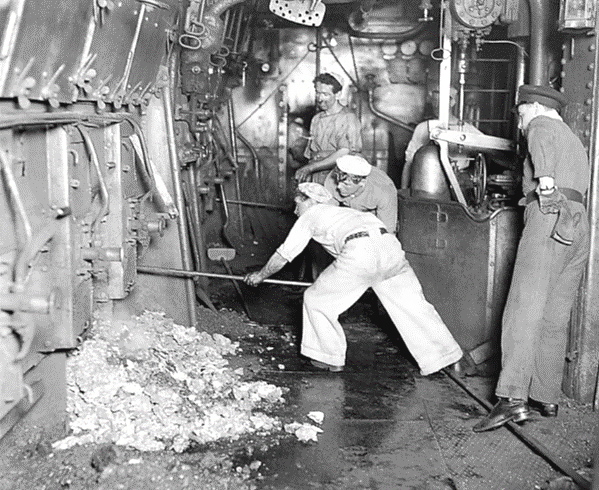
Royal Navy stokers at work – they appear to be emptying ash from a furnace.
This would have been a familiar task for Bert Newby
Stokers were regarded within the Navy as uneducated and ill-disciplined men. They were, however, slightly better paid than ordinary seaman, a recognition by the Navy that without stokers its ships would have been unable to move. Work condition were hot, gloomy, filthy and dangerous. Stokers also had to contribute to their living costs if they wanted to eat adequately and be clothed ‘safely’ in items such as wooden clogs (leather soles melted) and fireproof woollen trousers.
Bert Newby became a Stoker 2nd Class. His Navy records state that he was 5ft 6¾ins tall with a 34ins chest, brown hair and grey eyes. He also had tattoos on both forearms. Bert was around average height and build for the time which may have been a disadvantage when working in cramped spaces such as a ship’s boiler when it needed cleaning, one of the most unpopular tasks amongst stokers.
Bert Newby joined the Navy a week before Charles Winter who was also from the Winchester area. Charles died in the Great War on the same ship as Bert and is also listed on the parish memorials.
Bert spent a month at a stokers’ training ship based at Portsmouth before being posted to other vessels there. He was promoted to Stoker 1st Class in August 1913. Around this time, his mother and stepfather moved from Nuns Road to 1, Ashley Terrace, off Gladstone Street, Winchester. (Ashley Terrace was a row of houses between Gladstone Street and the railway station. It was demolished in the 1960s.)
Great War Record
In March 1914 Bert Newby was posted to the battle-cruiser HMS Queen Mary. This huge warship was attached to the First Battle-Cruiser Squadron, part of the British Grand Fleet. The fleet spent the entire Great War operating in the North Sea, keeping the German fleet in port and defending the British coast and the Atlantic trade routes. On arriving on HMS Queen Mary, Bert would have met up with Charles Winter, who had been on the ship since November 1913 and was now also a Stoker 1st Class. Bert and Charles first saw action in the Great War in August 1914 at the Battle of Heligoland Bight when their squadron sank several German ships. Further skirmishes followed in the winter of 1914-15, including an attempt to intercept a German squadron on its way back from shelling the port towns of Scarborough, Hartlepool and Whitby.
Bert Newby and Charles Winter were killed on 31 May 1916 at the Battle of Jutland. The battle took place in the North Sea, off the coast of Denmark. That afternoon, HMS Queen Mary was hit by a salvo of shells fired from two German ships. An eyewitness reported that a dazzling flashing red flame erupted from where the shells had landed followed by a large explosion which broke the ship into two. Clouds of black debris shot hundreds of feet into the air. The ship sank quickly with the bow plunging downwards, the propellers still slowly turning.
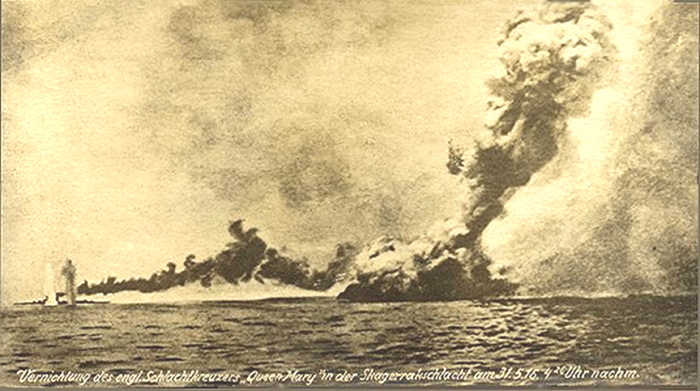
A pillar of smoke belches from HMS Queen Mary after she was hit by German
shells and exploded at the Battle of Jutland on 31 May 1916. Bert Newby and
Charles Winter were among the 1,266 men who went down with the ship
Bert Newby and Charles Winter were among the 1,266 men who went down with HMS Queen Mary. The wreck of the ship was discovered in 1991, resting in pieces on the floor of the North Sea. Today, it is designated as a protected place under the Protection of Military Remains Act 1986.
Family after the Great War
In June 1917, on the first anniversary of Bert’s death, an In-Memoriam notice appeared in the Hampshire Chronicle immediately below those for William Mitchell. It is only from this entry that we know that that William Ernest Herbert Newby was known simply as Bert:
‘Newby, Bert
Missed by Ethel and friends
At 11, Greenhill Road’
In 1917, the householder at 11, Greenhill Road was a Charles Meacher. According to the 1911 Census, his youngest child was called Ethel. She would have been about 20 in 1917 and it is tempting to think that she may have been Bert Newby’s sweetheart. Bert’s mother Annie and her second husband Charles remained at 1, Ashley Terrace after the war. Annie died in 1933, aged 76.
William Ernest Herbert Newby was entitled to the 1914 Star, the British War Medal and the Victory Medal. His final resting place, HMS Queen Mary, is a protected war grave. He is listed on the Naval Memorial on Southsea Common in Portsmouth and on the memorials at St Paul’s and St Matthew’s churches, Winchester.
Activities: Why do you think Bert Newby joined the Navy? Why did he enlist as a stoker? Why was the Royal Navy so important to Britain? Visit the Naval Memorial at Southsea and look for the names of Bert Newby and Charles Winter.