

Brigadier-General RONALD CAMPBELL MACLACHLAN
Langhouse, Chilbolton Avenue, Weeke (no longer stands)
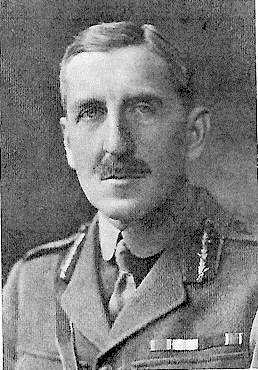
General Ronald Campbell Maclachlan
Family Background
Brigadier-General Ronald Campbell Maclachlan (above) is the highest-ranking name on the Fulflood and Weeke church memorials. He was born on 24 July 1872 in Newton Valence, Hampshire, and was the seventh of nine children born to the Reverend Archibald Maclachlan, vicar of the parish, and his wife Mary. Although his father was a clergyman, many of Ronald’s other male relatives had been Army officers.
The Maclachlans lived in The Vicarage, a large 19-room house, where they employed three servants and a groom-gardener. In 1871, however, the family were living in Southampton because of a diphtheria outbreak in Newton Valence - one family alone six children.
Ronald attended Cheam Preparatory School (situated between Basingstoke and Newbury) before going on to Eton College. The family was very wealthy. When Ronald’s father died in June 1891 his Great Western Railway shares alone were worth nearly £6 million.
Early Military Career
After leaving Eton, Ronald followed his two elder brothers into the Army. In 1893 he became a 2nd Lieutenant in the Winchester-based Rifle Brigade. He quickly won promotion. In 1895 his brother Lachlan was killed in a polo accident while serving with the Army in India.
In September 1899 Ronald was sent to South Africa to fight in the Second Boer War. His young brother Alexander, who had also joined the Army, followed him shortly afterwards. Both men received medals for bravery during the campaign. By 1902 Ronald had been promoted to Captain. He was posted to India and then served in Tibet, winning further medals in the process.
On 7 January 1908 Ronald, then aged 35, married Elinor Trench, a 37-year-old widow, in London. A few weeks later, he was appointed to a new post, training Oxford University students to become Army officers. Around this time a second brother, Neil, was killed while serving in India.
Ronald remained at Oxford until September 1911 when he returned to the Rifle Brigade. He was promoted to Colonel and in early 1914 moved to Winchester with his wife, apparently to take command of the Rifle Brigade Depot (now Peninsular Barracks). Ronald and Elinor went to live at a property called Langhouse in Chilbolton Avenue. It no longer stands.
Great War Record
However, Ronald never became Depot commander. Instead, in June 1914, he returned to Oxford and over the following three months trained 500 officers. Shortly after the outbreak of war, Ronald took command of a newly-formed Rifle Brigade battalion which was posted to France in May 1915. Ronald’s men were in the British front-line trenches in Flanders (part of Belgium) on 19 July when they came under attack from German flamethrowers, the first time the weapon had been used in warfare. It was a terrifying experience.
Ronald was wounded in December 1915 and was out of action for nine months. In June 1916, while still recuperating, he received the Distinguished Service Order. He then returned to France in time to take part in the Battle of the Somme. At the end of 1916, Ronald was promoted to Brigadier-General in charge of around 4,000 infantry soldiers. But despite his rank he did not shy away from danger and continued to inspire his men from the front in battle.
Ronald was shot and killed by a German sniper on 11 August 1917, aged 45. He was one of more than 200 British generals killed in action in the Great War. The official historian of the Rifle Brigade wrote:
In the Regiment he was universally beloved: an exceedingly smart adjutant, a good sportsman, a charming companion and a master of his profession, there was no height to which he could not have risen had he been spared. But what distinguished Ronnie Mac above all else was that amazing personality which enabled him to get the best out of all with whom he came into contact. It is unlikely the Regiment will ever again see his equal in character: his superior – never.
Ronald’s death must have come as a dreadful blow to his mother, Mary. Further bad news followed in March 1918 when Lieutenant-Colonel Alexander Maclachlan, the fourth and last surviving Army brother, was killed in action on the Western Front. At the end of the year, Ivor, the youngest brother, died at the age of about 40, becoming the sixth of Mary Maclachlan’s nine children to predecease her. Ronald’s widow continued to live at Langhouse immediately following his death but by 1920 had moved to Kings Somborne. She died in 1949.
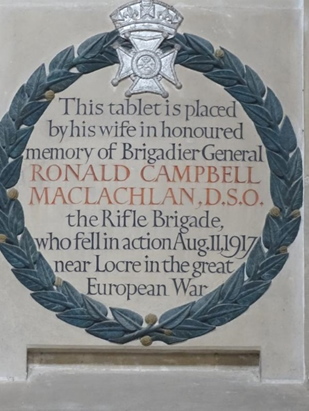
The stone tablet to Ronald in Winchester Cathedral,
placed there by his widow, Elinor
Brigadier-General Ronald Campbell Maclachlan was buried at Locre Hospice Cemetery, West Flanders, Belgium. In addition to the medals mentioned above, he was entitled to the 1914-15 Star, the British War Medal and the Victory Medal. Ronald is remembered on the memorials at St Paul’s and St Matthew’s churches, Winchester. He is commemorated on a stone tablet in Winchester Cathedral, placed there by his wife Elinor, and also on the Rifle Brigade Roll of Honour in the same building.
Activities: Visit the Rifles Museum in Winchester. Visit Winchester Cathedral and see the stone tablet to Ronald Maclachlan and see his name on the Rifle Brigade Roll of Honour. Learn more about the British Empire. Why was India so important to the British?