

Company Quarter Master Sergeant ANDREW WILLIAM BOGIE
2, St Paul’s Terrace, Winchester (20, St Paul’s Hill today)
Family Background
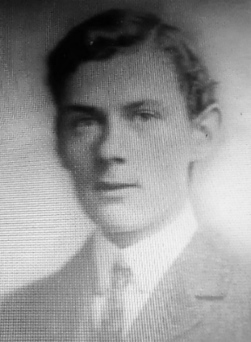
Andrew William Bogie
Andrew William Bogie (above), the son of Peter and Catherine Bogie, was born in 1882 in St Peter Port, Guernsey. Andrew’s father, a Scotsman, worked for most of his life as a gardener. Andrew’s mother, the daughter of a soldier, was born in Malta in 1857. The family moved around the country a great deal as Andrew’s father sought work.
In 1902 Andrew enrolled at the Diocesan Training College, now the University of Winchester, where he underwent two years of formal teacher training. The college magazine states that Andrew was a regular speaker at debates. He also played for the college reserves football team and served as a part-time soldier with the Volunteer Company of the Hampshire Regiment that all students were obliged to join. Andrew qualified in 1904 and became a master at St Thomas Elementary Boys’ School in Mews Lane, Winchester.
Andrew married in Great Yarmouth, Norfolk, in 1910. He moved to Winchester with his wife Florence the following year and by 1913 the couple were living at 2, St Paul’s Terrace. The house was renumbered 20, St Paul’s Hill during the Great War. On 23 February 1913 Florence gave birth to a son, Kenneth, probably in the family home. Andrew Bogie continued serving as a part-time soldier with the Hampshire Regiment and by 1914 he had reached the rank of Sergeant. When war broke out, he volunteered for service overseas and was posted to India. By the end of the year, he had been promoted to Acting Company Quarter Master Sergeant with responsibilities that included ensuring his men were supplied with food, clothing and ammunition.
Great War Record
In early 1915 Andrew was sent to Mesopotamia (modern Iraq) to fight the Ottoman Turks. In April 1916 he was captured at Kut-al-Amara when the Army garrison there surrendered to the Turks after a five-month siege. During the siege, Andrew displayed gallantry that earned him the Military Medal to go alongside his Meritorious Service Medal. He was also mentioned in dispatches.
After the surrender of the Kut garrison, Andrew and the surviving British soldiers were marched off to prisoner-of-war camps hundreds of miles away in Turkey. The conditions on the march were appalling and many men died from disease. Andrew eventually reached the POW camp at Yarbaschi, where those men fit enough worked on the construction of a railway.
On 22 September 1916 Andrew died of dysentery, aged 34, although news of his death did not reach England for more than a year. The pupils at St Thomas School were told by their headmaster that he had died.
Family after the Great War
Florence Bogie was still living at 22, St Paul’s Hill when she died in 1932. She was buried at West Hill Cemetery, Winchester. The inscription on her gravestone, which has since been removed, read: ‘In ever loving memory of Andrew William Bogie who entered the higher life at 34 when in his country’s service and of Florence his wife who re-joined him May 16, 1932, age 44 years’.
Company Quarter Master Sergeant Andrew William Bogie was entitled to the 1914-15 Star, the British War Medal and the Victory Medal. After the war, his body was disinterred and reburied at Baghdad War Cemetery in Iraq. Andrew’s name appears on the memorials at St Paul’s and St Matthew’s churches as well as those in the Winton Memorial Room at the University of Winchester’s King Alfred College Campus Old Chapel (the former Diocesan Training College) and the St Thomas Church of England Boys’ School Memorial, now at Kings School, Winchester.
Activities: Find Iraq (Mesopotamia) on a map. Visit the old St Thomas School in Mews Lane.