

Stoker 1st Class CHARLES JOHN WINTER
Sparsholt, Hampshire
Service number SS 1129943, Royal Navy, HMS Queen Mary
Killed in action, Battle of Jutland, 31 May 1916
Life Summary
Charles John Winter never lived in the parish of St Matthew with St Paul but his widowed mother, Sarah, had moved into the area by 1917 and she would have been responsible for getting his name on the parish memorials. Charles is one of three Royal Navy sailors listed on the memorials who died at the Battle of Jutland. He and fellow stoker Bert Newby were serving on HMS Queen Mary when it exploded after being hit by a salvo of German shells in the opening phase of the battle on 31 May 1916.
Family Background
Charles was born in Sparsholt, near Winchester, on 30 June 1890, the eldest surviving child of Henry William Winter, an agricultural labourer, and Sarah Uityciah (née Funnell). Charles’s father had been born about 1854 in Colemore, East Hampshire, where his mother, (Charles Winter’s grandmother) Ann, had also been born. Henry’s father George had been born in Cheriton.
By 1861, Henry and his parents were living in the hamlet of Dean, in the parish of Sparsholt, near Winchester. Henry was then aged seven and had two younger siblings, William and Jane. By 1871, he had left home and was lodging in Crawley at the Jolly Sportsman Inn (which used to stand just up the hill from The Fox) and working, like his father, as an agricultural labourer.
Henry married Sarah Funnell in 1885 and the marriage was registered in Winchester. Sarah came from a quite different background to Henry. She was born in 1856 in the parish of St George, Hanover Square, London, the daughter of George and Uityciah Funnell. By the 1871 Census, the Funnells were living in Grosvenor Mews and George was a domestic coachman.
By 1891, Henry and Sarah were lodging with a widow in Church Street, Sparsholt. Henry was by then a groom (an occupation that might explain the meeting of the two families) and gardener. Sarah gave birth to Charles on 30 June 1890. By 1901 Henry was a dairyman working on a farm and he and Sarah were living in Lower Deane. Charles, by then 10 years old, was presumably attending St Stephens Church of England School in Sparsholt. He had two siblings – Helen, born on 19 July 1894 and Mary Alice, born about 1898, but who died in 1904, aged six. All the children were born in the parish of Sparsholt. There was another child, but when he or she was born or died is not known.
In 1911, Charles and his parents were lodging in a four-room house in Littleton. Henry, then aged 57, was a cowman on a farm and 20-year-old Charles a domestic gardener. Charles’s sister Helen, 16, had left home and was in domestic service with a Mrs Trask and her daughter in Watley/The Cottage in Sparsholt.
Early Military Career
Charles joined the Royal Navy at Portsmouth on 16 October 1912. His reasons for enlisting are, of course, unknown but it may have been out of economic necessity - the Winter family seem to have always hovered around the breadline. Stokers were paid a little more than the equivalent rank of seaman: a Stoker 2nd Class earned 1s 8d a day plus free kit, board and lodgings. Charles may also have wanted to get away from home to see the world, enticed by the glamorous images of the recruiting poster. In fact, he visited few countries during his brief naval career. It has been suggested that those recruits with an agricultural background would have had little idea of what they were letting themselves in for as stokers.
Charles signed up to serve for five years and then to transfer to the Royal Naval Reserve for seven. This was only a week after Bert Newby, who at the time lived in Hyde, Winchester, enlisted as a stoker. If they did not know each other before they enlisted, they would certainly have met in training. Charles had to pass a basic literary test and his physical characteristics were listed: ‘Height 5ft 5ins., Chest 37 ins., Hair Brown, Eyes Hazel, Complexion Fresh’.

A recruitment poster for Royal Navy stokers from around 1910.
Despite the enticing images, the reality of a stoker’s life aboard ship
was anything but glamorous as the poem below shows
As Stoker 2nd Class 1129943, Charles was sent to HMS Victory II, a shore-based training establishment near Crystal Palace, south London. Here he would have joined Stoker 2nd Class Bert Newby for their six months training. A stoker’s life has been described more graphically in an anonymous poem entitled An Anonymous Stoker, an extract from which is printed below.
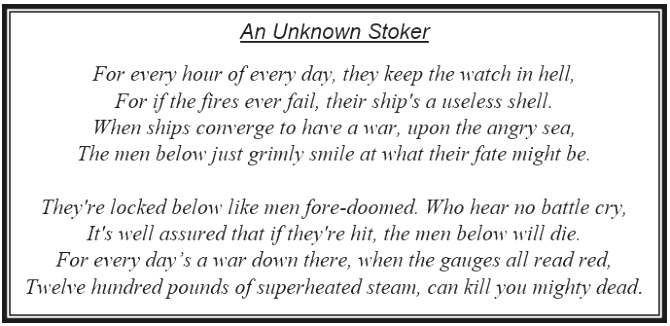
Poem about work of Stokers
After training, Charles Winter and Bert Newby were assigned to different ships. On 9 April 1913, Charles was posted to HMS Maidstone, a submarine depot ship. The role of such a ship was to service submarines and to store their supplies. The ship had only been commissioned at Portsmouth the day before Charles enlisted in 1912. For his time on HMS Maidstone, his captain was Captain Frank Brandt who was also in charge of the Eighth Submarine Flotilla. On 3 September 1913, Charles left HMS Maidstone and joined HMS Queen Mary.
A few weeks later, on 6 November, Charles was promoted to Stoker 1st Class. In all his end-of-year assessments his character was rated as ‘very good’ and his ability ‘satisfactory’. He did see a little more of the world than he had done previously on HMS Maidstone, where he had been confined to the North Sea. As part of Rear-Admiral Sir David Beatty’s First Battle Cruiser Squadron, he was part of a visit to the French naval base of Brest in February 1914. Charles would also have been with the Squadron when it visited Russia in June 1914. By then, he had been joined on board by his fellow trainee from the Winchester area, Bert Newby, also now a Stoker (1st Class). A description of HMS Queen Mary’s role in the naval war from 1914 until 1916 when it was sunk at the Battle of Jutland on 31 May is found in the biography of <Bert Newby.
Great War Record
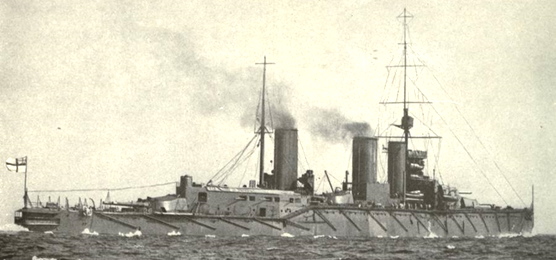
HMS Queen Mary, the ship on which he died at the Battle of Jutland on 31 May 1916

The wreck of HMS Queen Mary showing clearly that it was blown in two at Jutland.
The site, now a war grave, is the last resting place of Charles Winter and Bert Newby (Photo: Royal Navy)
On Charles’s service papers was starkly written ‘DD [Discharged Dead] Killed in Action on 31 May 1916’. His father had died in the late spring/early summer of 1915, aged about 61, so his mother Sarah had to endure the loss of a husband and son in the space of just 12 months.
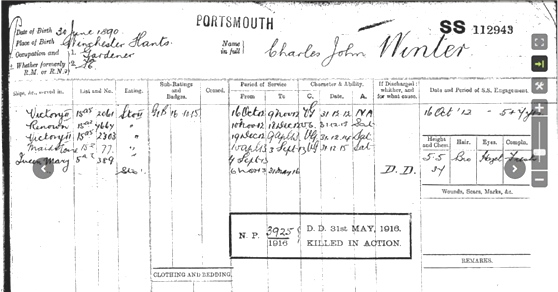
Stoker Charles Winter’s Royal Navy service record
Family after the Great War
As the next of kin, Sarah received Charles’s war gratuity in 1917. Her address was given as Pond Cottage, Weeke Without, a house that still stands on the Stockbridge Road. According to Warren’s Directories, that remained her address until 1921-22. It is not known if she lived there in 1915 and 1916 or if Charles ever visited the house. Charles Winter is listed at the address in the Winchester War Service Register (WWSR) of 1921.
In the summer of 1917, Helen Winter, Charles’s sister and the only surviving child, married Gilbert Paintin, the marriage being registered in Winchester. Gilbert was born on 29 September 1894 and is probably the Gilbert Paintin whose birth was registered at Headington, Oxfordshire. The next possible mention of him is in the 1911 Census when he was 17. This states that he was an inmate at a reformatory in Bengeo, Hertfordshire, and that he worked as a farm labourer. He is not in the WWSR although it is believed that he may have served in the Army Service Corps during the Great War as a driver.
Helen and Gilbert must have lived with Sarah Winter at Pond Cottage for a while as Gilbert Paintin is registered there in the Electoral Rolls in 1919. Their first child, Charles, seems to have been born on 9 March 1916, more than a year before they married. After 1921, there is no further mention in Winchester in either the street directories or electoral registers of Sarah Winter, her daughter and her son-in-law. However, Charles Winter’s Navy pension records lists 12, Poulsome Place (which no longer exists), Middle Brook Street, as a contact address for his mother after she had left Pond Cottage. Presumably, she was a lodger there.

Pond Cottage, Weeke - the home of Charles Winter's mother
Sarah until 1921. It is not known if he ever visited his family there
In 1925 and 1926, Sarah, Helen and Gilbert appear in the electoral registers at Lancen Farm, Lane End, Longwood, in the parish of Cheriton. (The same address appears in Charles’s pension records.) It is possible that they moved there as Sarah Winter’s father-in-law George had come from the area and there might still have been family around.
By 1927, Gilbert and Helen Paintin were living at No.18 Hutment on the Alresford Road, Winchester, but Sarah was no longer with them. The huts, which provided basic accommodation, were left over from the Army camps on Morn Hill during the Great War.
The final mention of Sarah Winter is her death in 1934 which was registered in Droxford. She was 77 years old. By the 1939 Register, Gilbert and Sarah Paintin were living at 4, The Grange, Westbourne, near Chichester, Sussex, with Gilbert employed as a general builders’ labourer. The couple had had ten children in total. Charles, who was born in 1916 and who may be their eldest child, was still living with them, aged 22 and was an agricultural labourer. Gilbert died in 1958 and Helen in 1961, aged 66. Both deaths were registered in Chichester.
Medals and Memorials for Charles John Winter

Portsmouth Naval Memorial on Southsea Common
Stoker 1st Class Charles John Winter was entitled to the 1914-15 Star, the British War Medal and the Victory Medal. He is not in the Winchester War Service Register of 1921 as he never lived in Winchester, but he is commemorated on the Portsmouth Naval Memorial (Panel 20) on Southsea Common for those with no known grave. His name appears on the memorials at St Paul’s and St Mathew’s churches, Winchester, but not on the Sparsholt War Memorial.
Additional sources
- Chamberlain, Terry. Stokers – The Lowest of the Low? A Social History of Royal Navy Stokers 1850-1950. PhD thesis, University of Exeter, 2013. https://ore.exeter.ac.uk/repository/handle/10871/13844
- Corbett, Sir Julian. Official History Naval Operations Great War, Vol. III (Longmans, 1923). http://www.naval-history.net/xDKCas1916-05May-Jutland1.htm