

Lieutenant CLARENCE ERNEST WAND-TETLEY
The Lodge, Bereweeke Road, Winchester (no longer stands)
9th (Service) Battalion, The Lancashire Fusiliers
Killed in action, Gallipoli, 21 August 1915
Life Summary
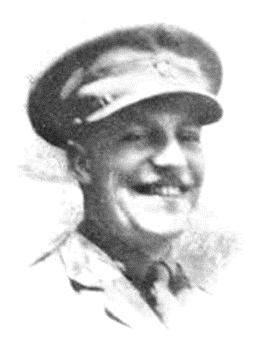
Lieutenant Clarence Ernest Wand-Tetley
Clarence Ernest Wand was born on 22 July 1889, the eldest child of Ernest Wand, a commercial traveller and his wife Emily. He acquired the surname Wand-Tetley after his parents divorced and Emily married into the wealthy Tetley tea family. Clarence had only superficial links to Winchester – his mother and stepfather moved to Weeke only in 1915, the year of his death at Gallipoli. A talented sportsman, Clarence was an Oxford hockey Half Blue and played rugby for Harlequins.
Family Background
Clarence Wand’s father Ernest was born in Grantham, Lincolnshire, in October 1865. Ernest’s father, Charles (1821-1887), worked as a butcher in Grantham. At the age of 15, Ernest Wand was an apprentice printer in the town, but by 1887 he had become a commercial traveller based in London. Clarence’s mother had been born Emily Jane Lawes Harrison in Marlborough, Wiltshire, on 8 June 1864 but by the mid-1880s she and her family had moved to Paignton, Devon, where her father, Thomas, owned and ran the Esplanade Hotel.
Ernest Wand may have met Emily while travelling in the West Country on business. The couple married on 6 October 1888 at St John’s Church in Paignton and Ernest’s address on the marriage certificate was given as 11, Burton Crescent, St Pancras, London. The newlyweds settled down to married life in Paignton. After Clarence’s birth there in 1889, Emily and Ernest had another son, Thomas, in 1890 followed by a daughter, Winifred, in 1894 and finally a third son, Joseph, in 1898.
By 1891 Thomas Harrison had handed over the running of the Esplanade Hotel to Ernest Wand. That year’s census also revealed that Emily was helping with the book-keeping. The Esplanade, one of the two principal hotels in the town at the time, was also home for the Wand family. The building, minus its central tower, still stands and is trading as The Inn on the Green, with self-catering apartments.
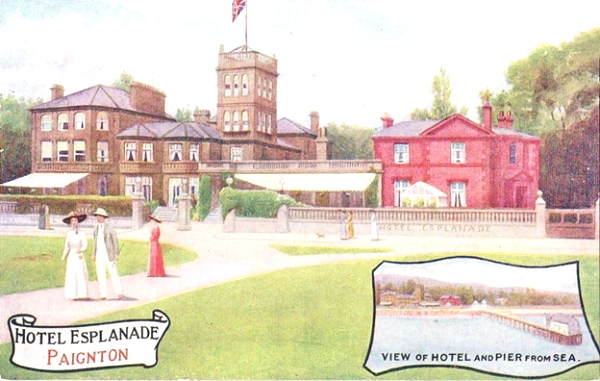
The Esplanade Hotel in Paignton, Devon, where Clarence Wand spent
his childhood. It still as operates today as The Inn on the Green
The Wand family’s circumstances had changed significantly by 1901. That year’s census revealed that Emily was proprietor of the hotel; there was no mention of Ernest Wand in connection with the family – indeed, to date, no trace has been found of him in the census. Emily was living at the hotel with her two younger children while her two elder sons, Clarence, aged 11, and ten-year-old Thomas were boarders at Newton Abbot School, near Bovey Tracey, Devon, which was run by a clergyman/schoolmaster.
In 1903 Ernest and Emily Wand divorced - an unusual and expensive occurrence in those days – and the Esplanade Hotel was sold. Around the same time, Clarence and Thomas Wand left Newton Abbot School and were sent to Eastbourne College in Sussex. The rest of the family also moved to Eastbourne because from 1907-08 Clarence and Thomas were home boarders. Both brothers excelled at sport and Clarence won college colours for rugby.
At some stage, Emily met Joseph Tetley, the man who would become her second husband. Joseph had been born in Huddersfield, Yorkshire, in around 1850 and was the son of one of the founders of the Tetley tea company. He entered the family business in 1871 and, on the death of his father in 1889, took over the running of the company. The 1901 Census showed Joseph, then aged 51, living in Parrock Wood, Hartfield, Sussex. His nephew, William, who later inherited the tea business, was also living in the house, but Joseph’s wife, Florence, whom he had married in 1878, was residing in a hotel in Brighton. This may have been for health reasons because on 9 January 1909 she died after a long illness.
Within three months Emily and Joseph were married in Eastbourne. This was remarkably quick: according to the social convention of the time, a spouse would normally wait at least a year before remarrying. The reason for the haste is not known; it does not appear to have been because Emily was pregnant as she was 46 at the time and there is no record of her having any more children.
The previous year, 1908, Clarence Wand had gone up to Oriel College, Oxford, where his sporting prowess again came to the fore. Clarence gained a hockey Half Blue and also played rugby at university as well as for Harlequins between 1909 and 1912.
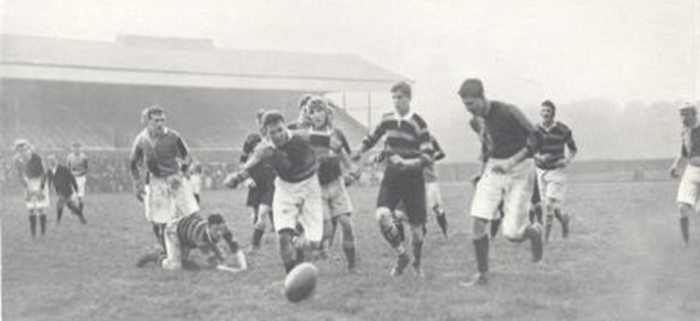
Harlequins (in the plain tops) take on Richmond on 2 October 1909 in the first ever
match at Twickenham Stadium. It is possible that Clarence Wand represented Harlequins in the game
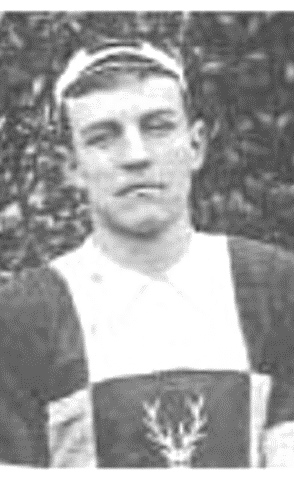
Clarence in his Eastbourne College rugby kit
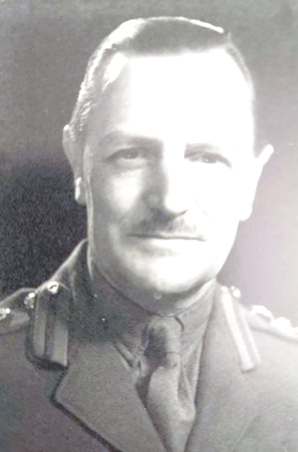
Clarence's brother Thomas who was a POW in Germany
for much of the war and who went on to enjoy
a distinguished Army career
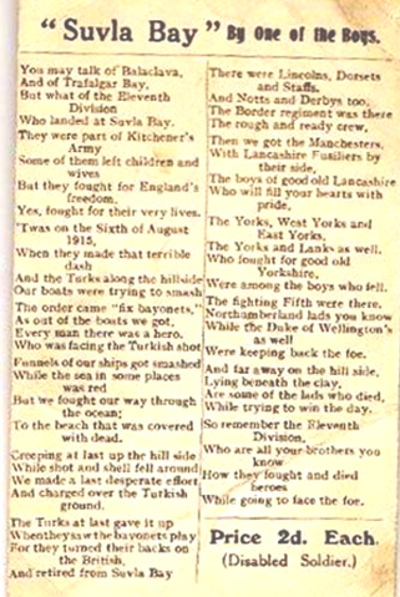
A soldier’s poem recalls the bloody events of
6 August 1915 when 11th Division landed at
Suvla Bay on the Gallipoli Peninsula
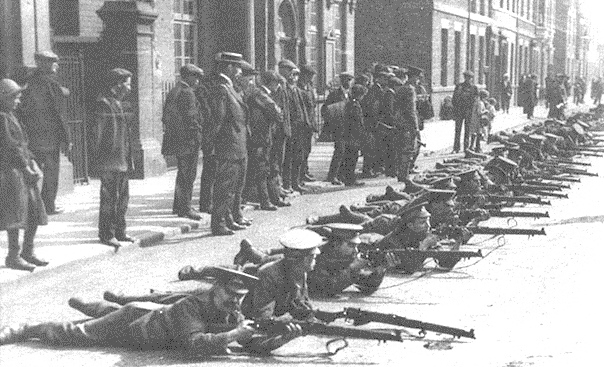
Members of the public watch the 9th Lancashire Fusiliers in training
in December 1914 before the battalion’s posting to Gallipoli the following year
By 1911 Joseph and Emily Tetley were living at Wildwood, Clay Hill, near Enfield, Middlesex, with the two youngest Wand-Tetley siblings. Clarence, although still at Oxford, was also at the house on the night of that year’s census. Joseph and Emily’s first recorded link with Winchester was in the 1915 Warren’s Directory when they were listed living at The Lodge, Bereweeke Road.
This property, which no longer stands, was situated close to the southern corner of Bereweeke Road and Andover Road. It was later incorporated into Peter Symonds School and renamed Varley after the first headmaster. It appears that between 1918 and 1919 the Tetleys were not actually living at The Lodge, as that is the address in Warren’s for George and Emily Dennistoun, the parents of James Dennistoun, whose name is also on the parish war memorials (See James Dennistoun's biography). There may have been a connection between the Tetley and Dennistoun families as both gave The Lodge as the address in the Winchester War Service Register for their sons who fought between 1914-18.
Great War Record
It is not known what Clarence did between leaving Oxford in 1912 and the outbreak of the Great War but on 22 August 1914 he enlisted in the Army before being commissioned into the 9th (Service) Battalion, The Lancashire Fusiliers as a 2nd Lieutenant. He was made a temporary Lieutenant in December the same year. The 9th Lancashire Fusiliers, one of the first battalions raised for Kitchener’s New Armies, were formed in Bury on 31 August 1914 and came under orders of 34th Brigade in 11th (Northern) Division. After initial training at the regimental depots, the infantry moved to Belton Park, near Grantham, and then, in April 1915, to Witley Camp, near Godalming, Surrey, for final training. At the end of July, the battalion sailed from Liverpool for Gallipoli, stopping at Alexandria in Egypt and the eastern Mediterranean island of Imbros on the way.
The Gallipoli campaign took place on Turkey’s Gallipoli peninsula between 17 February 1915 and 9 January 1916. Among its principal architects was Britain’s First Lord of the Admiralty Winston Churchill who argued that an operation against the Ottoman Turks would allow Britain to make full use of its powerful Navy and avoid the bloody stalemate of the Western Front. The Ottoman Empire was widely regarded to be crumbling and the initial plan was for the British and French fleets to take control of the Dardanelles Straits that provided a supply route to Russia. When this failed an alternative plan was hatched for an amphibious landing on the Gallipoli peninsula to capture the Ottoman capital of Constantinople and knock Turkey out of the war.
The amphibious attacks, launched by the Allied Mediterranean Expeditionary Force under General Sir Ian Hamilton, began on 25 April 1915 but quickly bogged down in the face of unexpectedly strong Turkish resistance. Further attacks in June also faltered before Hamilton made a final attempt to break the deadlock on the night of 6 August when British troops, including Lieutenant Clarence Wand-Tetley, landed at Suvla Bay at the start of a new offensive known as the Battle of Sari Bair.
The assault by 34th Brigade, including 9th Lancashire Fusiliers, went awry from the start. The destroyers conveying the brigade anchored 1,000 yards from their intended position and two lighters ran aground on reefs. Consequently, the 9th Lancashire Fusiliers had to wade ashore in the darkness up to their necks in water. Once on dry land they were pinned down by sniper fire and shelling. Their Commanding Officer was shot in the head around dawn and the battalion lost another six officers killed and seven wounded.
The Suvla Bay landings descended into chaos, due largely to the lethargic leadership of Lieutenant-General Sir Frederick Stopford, commander of IX Corps (of which 11th Division was a part). Stopford proved reluctant to order his troops to seize the high ground overlooking the bay and was eventually sacked. On 21 August his temporary replacement, Major-General Beauvoir De Lisle, ordered a fresh attack by 11th Division on the W Hills surrounding Suvla Bay. However, this also collapsed in confusion when the assaulting troops came under fire from Turkish artillery who, unlike their British counterparts, had a clear view of the entire Suvla battlefield.
Clarence Wand-Tetley was officially listed as missing on 22 August, although it is possible that he was killed in the previous day’s fighting and his body never found. Aged just 26, he was one of 5,300 British casualties in the Suvla Bay attacks of 21 August. Clarence was mentioned in one of Sir Ian Hamilton’s final dispatches dated 28 January 1916 by which time the British and their allies had withdrawn from Gallipoli. The campaign, characterised by trench warfare and massed infantry attacks similar to the Western Front, cost the British some 250,000 men killed, wounded and missing.
Family after the Great War
Clarence’s stepfather Joseph Tetley died on 16 May 1935. He had two listed addresses at the time of his death - 49, Mansell Street, London, and The Lodge, Winchester. He was buried at Magdalen Hill Cemetery, Winchester, on 20 May 1935 and left effects valued at £74,528 5s 9d (some £5 million today). Joseph’s nephew William Tetley-Jones inherited the tea business but died the following year and his son, Tetley Ironside Tetley-Jones, took over the company until his death in 1990.
Emily Tetley, Clarence’s mother, was listed as the householder for The Lodge in the Warren’s Directories for 1936 and 1937, but by 1938 she had left Winchester. In the 1939 Register, she was living in Hastings, East Sussex, at the Albany Hotel, a large boarding house for the wealthy elderly or retired. Emily died on 22 June 1948 in Ealing, west London, leaving nearly £25,000 in her will, a considerable sum.
What became of Clarence’s father, Ernest Wand? In the 1911 Census, an Ernest Wand, aged 45 and born in Grantham, Lincolnshire (as Clarence’s father had been) was listed as a single man, boarding at 94, Clarence Gate Gardens, Marylebone, London. Intriguingly, given who his ex-wife had married, he was employed as a manager of a wholesale tea dealer. In July 1922, Ernest Wand appears to have been living in Watford, Hertfordshire. At the National Archives at Kew, there is an envelope (possibly dated 11 July 1922) addressed to an ‘E. Wand, Esq., 10, Clifton Road, Watford, Herts.’, which contains his son Charles [sic] Ernest Wand-Tetley’s medal records. ‘Charles’ was a ‘Lieut. in Lancs. Fus. dated 1915, KIA 22/8/15’.
From about 1929, Ernest Wand was a resident at Park End, Deacons Hill, Oxhey, Hertfordshire. He died from a heart attack on Oxhey golf course on 1 October 1938, aged 74. Ernest left £13,003 5s 2d in his will (more than £1 million today) so he did not die a poor man!
Clarence Wand-Tetley’s two brothers also served in the Great War. Joseph Wand-Tetley was commissioned into the Northamptonshire Regiment in 1916 even though he was under-age. He served in France and was wounded in October 1918, the same year that he won the Military Cross. Joseph ended the war as a Lieutenant and later turned his hand to farming; in September 1921 he was living at Park Farm, Lurgashall, near Petworth, Sussex. He married Mabel Miles at East Ashford, Kent, in 1923 and the couple had a son. Joseph was still farming in 1939 while also serving as a volunteer Air Raid Warden. He died in Kent on 25 September 1988, aged about 90.
Clarence’s other brother Thomas had a long and distinguished military career. In 1910 he was commissioned into the 1st Battalion, The Wiltshire Regiment and by 1912 had been promoted to Captain. In August 1914 he was sent to the Western Front where he was taken prisoner on 27 October. He suffered a severe neck wound before being captured and was subsequently mentioned in British Commander-in-Chief Sir John French’s dispatches for gallant conduct on the field of battle. In 1917 Thomas was listed as a PoW at Holzminden, Germany, a prison camp for determined escapees.
Like Clarence, Thomas was a gifted sportsman and during his time as a PoW he came to realise the importance of physical fitness to morale. His work in this field resulted in a further mention in dispatches in September 1919 for valuable services rendered whilst a prisoner of war. In 1920, he received a third mention in dispatches for ‘gallant conduct and determination displayed in escaping or attempting to escape from captivity’. He clearly succeeded in escaping as he was interned in Holland (a neutral country in the Great War) from 24 February 1918. On 29 August 1918 Thomas married Cecile Florence Tatham at St John’s and St Philip’s, the English Church in The Hague with the reception held at the British Legation. Cecile had been born in Natal, South Africa, on 20 September 1894.
On 19 November 1918, Thomas was repatriated to England. He devoted the rest of his Army career to improving fitness levels in the service and his expertise in this area was increasingly recognised. He also pursued his own sporting interests and in 1920 represented Great Britain in the modern pentathlon and fencing at the Olympic Games in Antwerp. Thomas also played hockey for the Army and Great Britain and was actively involved in amateur boxing.
On 2 February 1920 Cecile gave birth to a son, Peter, in Farnham, Surrey, followed by John, who was born near Fleet on 4 May 1922. In September 1923 Thomas moved to South Africa for nine months to train the physical instructors in the defence forces there. His family accompanied him and a third son, Nigel, was born there on 8 February 1924. After returning to England they lived mainly in London.
Thomas was awarded an OBE in June 1929. By 1938 he had been made a Colonel and was working at the War Office in the department of the Chief of the Imperial General Staff with responsibility for Army Physical Training. He retired in 1944 with the rank of Honorary Brigadier, but remained on the reserve list and was still in ‘active service’ as an Air Raid Warden.
After the war, Thomas advised the Ministry of Health on the physical rehabilitation of servicemen. He died on Jersey on 4 February 1956, aged 65. His obituary in The Times stressed his pivotal role in raising standards of physical fitness in the Army and his sporting achievements, but also stated that ‘he will long be remembered for his charm and modesty’. His wife Cecile died on Jersey on 9 January 1980.
Thomas and Cecile’s eldest son Peter was an early recruit into the SAS during the Second World War. He served behind enemy lines in Greece and received the Military Cross. Peter died in Wiltshire on 16 March 2003, aged 83. His biography, Special Forces Commander - The Life and Wars of Peter Wand-Tetley, OBE, MC, Commando, SAS, SOE and Paratrooper, by Col. Michael Scott, was published in 2011.
The middle son, John Wand-Tetley, worked as a hospital physician. He died suddenly at his home near Amersham, Buckinghamshire, on 28 December 1974, aged 52. He had a son, David, by his first marriage.
Nigel Wand-Tetley, Thomas and Cecile’s youngest son, joined the Royal Navy in 1942 and retired as a Lieutenant-Commander in 1969, by which time he was known just as Nigel Tetley. The previous year he had competed in the Sunday Times Golden Globe single-handed, non-stop, round-the-world yacht race. Nigel was leading the event when his trimaran Victress broke up some 1,200 miles from the finish and he had to be rescued. It was said that he had pushed his boat too hard as he thought fellow competitor Donald Crowhurst was ‘on his heels’. In the event it transpired that Crowhurst had falsified his radio record and logbook to make it appear that he had gone round the world. His abandoned boat was found in July 1969 in the Atlantic, an ocean it had never left. Crowhurst is believed to have committed suicide because he could not face the consequences of his deception if discovered. In 1970 Nigel Tetley wrote an account of his voyage, Trimaran Solo: The Story of Victress’s Circumnavigation and Last Voyage. Tragically, Nigel was found dead in February 1972 near Dover. He was 47 and was survived by his wife, Eve, and three children.
Clarence sister Winifred married John Davidson in Winchester in 1919, probably at St Matthew’s Church, Weeke. In 1939 she was living in Penarth, Glamorgan, with her husband, an agricultural officer with Glamorgan County Council. Winifred died in South Glamorgan in 1983, aged 89.
Clarence Wand-Tetley and his brothers Joseph and Thomas are both listed in the Winchester War Service Register where their surname is spelt Waud Tetley.
Medals and Memorials for Clarence Ernest Wand-Tetley
Lieutenant Clarence Ernest Wand-Tetley was entitled to the 1914-15 Star, the British War Medal and the Victory Medal. His name appears on the memorials at St Matthew’s and St Paul’s Churches, Winchester, and on the Helles Memorial, near Sedd el Bahr, on the Gallipoli Peninsula (Panel 59-72 or 218-219). Clarence is also commemorated on both Eastbourne College War Memorials – one in the chapel (1924), the other in the hallway of the base of the tower of the Memorial Building (1930) – as well as on the Oriel College Memorial, Oxford and the Harlequins Rugby Club War Memorial.
Additional sources
- Eastbourne College Roll of Honour.
https://www.eastbourne-college.co.uk/wp-content/uploads/2018/08/esorg-roll-of-honour-2018-08-15.pdf November 2019, Clarence is listed as Charles on this website. This has been acknowledged as an error. - Tatham Family Tree. https://www.saxonlodge.net/getperson.php?personID=I1373&tree=Tatham
- History of Tetley tea company and Tetley family tree. https://www.thegenealogist.co.uk/featuredarticles/2012/let-the-flavour-flood-out-42/