

Lieutenant JAMES ROBERT DENNISTOUN
The Lodge, Bereweeke Road, Winchester (no longer stands)
2nd North Irish Horse (attached to 23rd Squadron, Royal Flying Corps)
Died of wounds while a prisoner of war, Germany, 9 August 1916
Life Summary
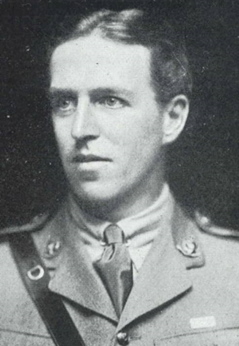
James Robert Dennistoun
The derring-do exploits of James Robert Dennistoun make him one of the most colourful of the men listed on the memorials at St Matthew’s and St Paul’s churches. His parents married in Winchester and then emigrated to run a sheep station in New Zealand where James was born in 1883. He loved the outdoor life and became a keen adventurer and mountaineer. Between 1911 and 1912 he took part in Captain Scott’s ill-fated Terra Nova Expedition to Antarctica. On the outbreak of war in 1914, James returned to England and joined the Army before transferring to the Royal Flying Corps in 1916. He was shot down on his first mission and died of his wounds in a hospital in Germany a few weeks later.
Family Background
James Dennistoun was born in Peel Forest, South Island, New Zealand on 7 March 1883, the son of George (1848-1921) and Emily (1852-1937) Dennistoun. George, who came from an old Scottish family, was born in Glasgow. His own father died when he was very young and by 1851 he was living at Admanton, a large country property owned by his aunt in Monkton, Ayrshire. (Today the house is a country hotel on the edge of Glasgow). George’s mother, Barbara (1822-1910), was living off an annuity so the family was clearly wealthy. By 1861 George was a naval cadet aboard HMS Britannia.
James’s mother was born Emily Russell, the daughter of Lieutenant-Colonel Andrew Hamilton Russell (1812-1900) and his wife Eliza (1815-1891). Colonel Russell had a glittering Army career and he and Eliza had three children together. Two were born in Ireland where, presumably, their father was posted.
In 1879 George Dennistoun married Emily Russell at St Bartholomew’s Church, Hyde, Winchester. The Reverend Stephen Bridge, a member of the Russell family, officiated at the wedding. At the time, Emily’s parents were living at Hyde Lodge, Worthy Lane, Winchester, where they remained until moving to Newton Abbot, Devon, sometime after 1881.
George and Emily Dennistoun moved to New Zealand shortly after marrying to take over a sheep station at Peel Forest, north of the town of Geraldine on South Island. It was here that James was born in 1883 and his brother, George Jnr, the following year. In 1896 James and George Jnr were admitted to Wanganui Collegiate, a boys’ boarding school on North Island. Two years later, James travelled to England to become a pupil at Malvern College, Worcestershire. He remained at the school until 1901 when he returned to New Zealand to help run Peel Forest. His brother, meanwhile, had enlisted as a cadet with the Royal Navy in 1899 and he remained with the service for more than 20 years.
Once home, James took up mountaineering and in 1910 he became the first non-Maori to climb Mitre Peak, which rises 5,550ft above Milford Sound, today one of New Zealand’s most famous tourist destinations. His notebooks and diaries from this period were published in 1999 as The Peaks and Passes of JRD.
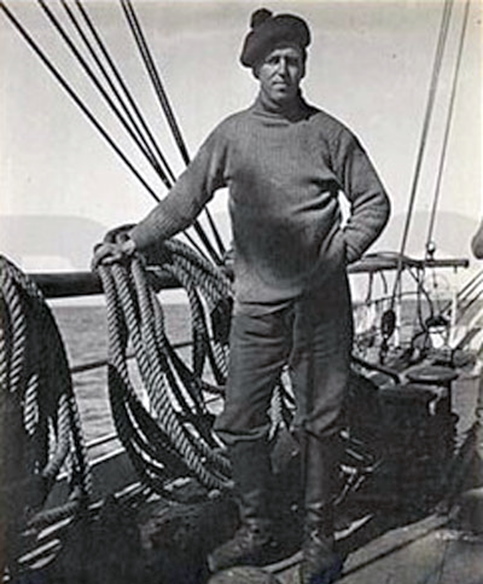
James Denniston aboard Terra Nova on
Captain Scott’s South Pole expedition of 1911-12
In 1911, James accompanied Captain Robert Scott on his Terra Nova Expedition to the South Pole and was put in charge of the mules. The same year he received the King's Antarctica Medal and the Royal Geographical Society Medal. In 1912 he was made a member of the Alpine Club.
Great War Record
James did not immediately volunteer for military service after the outbreak of war in August 1914. Instead, he waited some seven months before sailing to England to enlist. He arrived on 14 April 1915 and went to stay with relatives in Winchester. James initially considered the Argyll and Sutherland Highlanders, but eventually he travelled to County Antrim where, on 14 May, he obtained a commission as a 2nd Lieutenant with the North Irish Horse, part of the elite Household Cavalry regiment.
James was assigned to the 2nd North Irish Horse and sent for training at the cavalry school at Netheravon, Wiltshire, where he also visited the nearby flying school. James returned to his regiment and sailed for France with his squadron on 18 November 1915, the same day that he was promoted to Lieutenant.
After spending some months as an Intelligence Officer in the 33rd Division – of which the North Irish Horse were part – James was attached to 23rd Squadron the Royal Flying Corps on 8 June 1916. His cousin, Lieutenant Herbert (‘Herbie’) Russell, was already serving as a pilot with the squadron which operated two-seater FE2b biplanes from an airfield at Izel-le-Hameau, west of Arras. On 26 June, James took off on a bombing raid, his first - and last – RFC operation. Herbert was piloting the FE2b and James was in the observer’s seat when they were shot down. Herbert wrote later:
When the machine was wheeled out, I noticed it had no bomb-racks or bomb sights fitted … I pointed this out to the CO. He replied, ‘Never mind, let Dennistoun take them up in his arms and throw them over when you think you are about right; you’ve had enough experience by now!’
James and Herbert were heading for home when three German aircraft attacked their plane over the town of Biache St Vaast. James took three machine-gun bullets to the stomach and Herbert was shot in the lungs. Their aircraft caught fire, and both were burned as it crashed landed behind German lines. Although seriously wounded, James survived the landing and he and Herbert were taken prisoner. James was admitted to hospital in Hamblain the same day and operated on. He remained there until 28 July when he was moved to another hospital at Douai before being sent to a prisoner-of-war camp at Ohrdruf in Thuringia, Central Germany, on 3 August.
On the 29 June, nurse Lili Eidam, who was caring for James, wrote to his mother saying they expected him to pull through. However, she had not reckoned on the terrible 36-hour train journey to Ohrdruf. For the first 19 hours, James had to lie on a rough wooden stretcher, with no blankets or food. Crucially, his wounds were never dressed during the entire journey. James arrived at Ohrdruf on 6 August and three days later had another operation. He did regain consciousness but died the same day, aged 33.
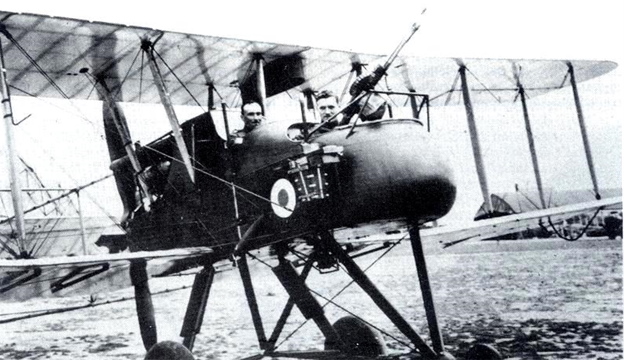
An FE2b biplane of the Royal Flying Corps like that in which James Dennistoun
and his cousin Lieutenant Herbert Russell were shot down over German lines
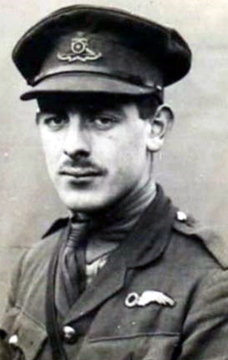
Lieutenant Herbert Russell,
cousin of James Dennistoun
Herbert Russell recovered from his wounds. He was transferred to Switzerland on 9 December 1917 and repatriated to England on 24 March 1918. During the Second World War he was made Acting Air Vice-Marshal and became Air Vice-Marshal on 8 May 1949. Herbert died on 9 May 1963, aged 68.
Family after the Great War
James’s parents returned to England in 1918 and went to live at The Lodge in Bereweeke Road, Winchester. They would have ensured that James’s name appeared on the memorial at St Paul’s church and in the Winchester War Service Register. In 1920 the Dennistouns moved to Torquay, Devon where George died on 7 May 1921, aged 73.
James’s brother George served in the Royal Navy during the war and took part in its first naval engagement on Lake Nyasa (Lake Malawi) in Central Africa in August 1914. He was awarded the Distinguished Service Order in 1916 and made a Commander in December 1918. He retired from the Navy in 1922 and returned to Peel Forest. During the Second World War, George served as commanding officer of a naval training establishment at Lyttleton, near Christchurch, and was awarded the OBE. He died in New Zealand in 1977, aged 93.
Medals and Memorials for James Robert Dennistoun
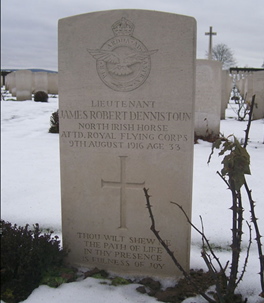
Niederzwehren Cemetery, Kassel, Germany
Lieutenant James Robert Dennistoun was entitled to the 1914-15 Star, the British War Medal and the Victory Medal. He is buried in the Niederzwehren Cemetery (grave right), Kassel, Germany, Hesse (GR. IV. H. 2.) and the inscription on his headstone reads:
THOU WILT SHEW ME THE PATH OF LIFE IN THY PRESENCE IS FULNESS OF JOY.
His name (spelt Dennistown) appears on the memorials at St Matthew’s and St Paul’s churches. There is also a memorial window to James Robert Denniston [sic], Terra Nova Expedition, at St Stephen's Church, Peel Forest, South Canterbury, New Zealand.
Additional sources
- http://www.antarctic-circle.org/llag.church.htm
- http://navymuseum.co.nz/worldwar1/people/captain-george-hamilton-dennistoun-dso-obe/
- http://www.rafweb.org/Biographies/Russell_HB.htm