

Sergeant GEORGE STROUD
7, Western Road, Winchester
Service number 432686. 49th Battalion (Edmonton Regiment), Canadian Corps
Killed in action, France, 8 October 1916
Life Summary
George Stroud, the son of Richard and Margaret Stroud, was born in Sherborne St John, near Basingstoke, on 9 April 1887. George emigrated to Canada in 1910 but fought in the Great War after joining the Canadian Corps in 1915. He was killed at the Battle of the Somme in 1916, two days before his brother Bertram. The Stroud family’s story up to the time that George emigrated can be found in Bertram Stroud’s biography).
Life in Canada
On 5 August 1910 George Stroud sailed from Liverpool for Quebec City. He arrived on 11 August and made his way to Edmonton in the province of Alberta. By 1911 George was lodging in a boarding house in the city and working as a house painter. In that year’s census he gave his nationality as Canadian.
George met and then married Scottish-born Christina Furlough of Fort McMurray, Alberta, and the couple lived at 438, 18th Street, Edmonton. Their son Hugh was born there in 1915.
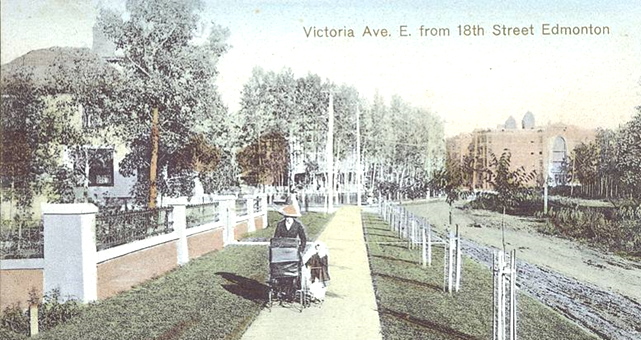
The area around 18th Street, Edmonton – George Stroud lived
near here from 1911 after emigrating to Canada
Great War Record
On 11 January 1915, five months after the start of the Great War, George Stroud joined the 49th Battalion (Edmonton Regiment) with the service number was 432686. The battalion, which formed part of the Canadian Expeditionary Force, recruited and mobilized in Edmonton. Most of its troops were British-born volunteers - conscription was not introduced in Canada until the end of the war.
On 3 June 1915 the 49th Battalion left Montreal on the SS Metagama bound for England. George was almost certainly on board. After arriving in England, the battalion celebrated Dominion Day in Folkestone on 1 July 1915 and then deployed to France on 9 October 1915. There it came under orders of 7th Infantry Brigade, part of the 3rd Canadian Division.
The 3rd Canadian Division first saw action in Flanders at the Battle of Mount Sorrel (2-13 June 1916). To divert British resources from the build-up for the Somme Offensive, German forces attacked an arc of high ground positions defended by the Canadian Corps, including the 3rd Division. The Germans captured the heights at Mount Sorrel and Hill 62 which the Allies immediately set about retaking. After an artillery bombardment lasting several days, three Divisions, including two Canadian, attacked on 13 June and recaptured most of their former positions. The battle cost the Canadians and British some 8,000 casualties, including the Canadian 3rd Division commander Major-General Malcolm Mercer.
George Stroud, who had probably been promoted to Sergeant by this time, fought next at the Battle of Flers-Courcelette (15-22 September 1916) during the Somme Offensive. George’s brother Bertram fought in the same battle.
The Canadian 7th Brigade was involved in attacks aimed at capturing Regina Trench – one of the longest trench systems on the Somme battlefield - to the west of the German-held village of Courcelette. Progress was slow in the face of stiff German resistance and George would have seen desperate close-quarter fighting.
As September turned to October the weather worsened, turning the Somme battlefield into a sea of mud. On 1 October, the British launched the Battle of the Ancre Heights. Regina Trench, still in German hands, was an objective on the opening day but that attack, too, failed. Seven days later the British tried again.
George Stroud is believed to have been killed during the attack on Regina Trench by Canadian 3rd Division on 8 October 1916. The Canadians fought bravely but could not crack the German defences. Small parties of troops did manage to break into sections of the trench but were never seen again. The 49th Battalion found their way into a trench blocked by newly laid barbed wire and suffered heavy losses from German machine-gun fire. It is possible that George Stroud was killed here. He was 29 years old.
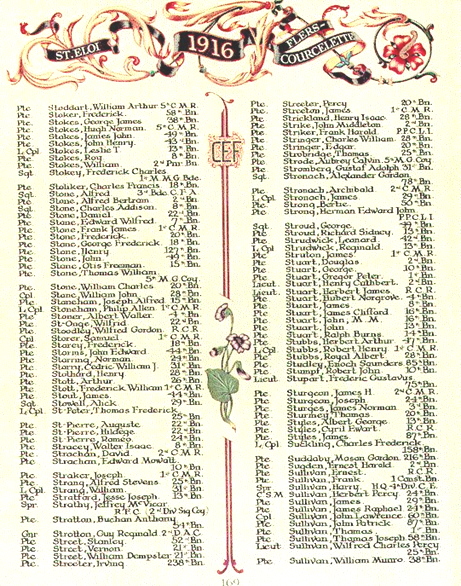
The Canadian Expeditionary Force’s Great War Book of Remembrance
showing George Stroud’s name
Two days later, on 10 October, George’s brother Bertram, who was serving with the 18th King’s Royal Rifle Corps, was killed in action at the Battle of Le Transloy. The battlefield on which he died was just a few miles from where George was killed. Neither brother’s body was ever found.
Family after the Great War
After George’s death, his widow Christina continued to live at 18th Street in Edmonton. According to the 1921 Canadian Census she was living there with their son Hugh and listed as a housekeeper.
George Stroud, like his brother Bertram, is not listed in the Winchester War Service Register.
Medals and Memorials for George Stroud
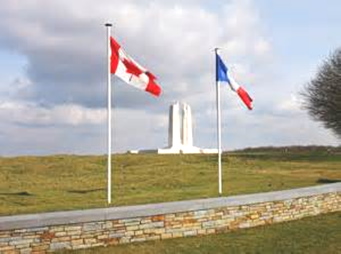
Canadian National Vimy Memorial at Vimy Ridge,
Pas de Calais, France
Sergeant George Stroud was entitled to the British War Medal and the Victory Medal. He is commemorated (above) on the Canadian National Vimy Memorial at Vimy Ridge (right), Pas de Calais, France, and in the Canadian Expeditionary Force’s Great War Book of Remembrance. He is also remembered on the memorials at St Matthew’s and St Paul’s churches, Winchester.
Additional sources
- http://www.albertagenealogy-research.ca/LER/Nominal_Roles/49thBnCEF.pdf
- http://www.albertagenealogy-research.ca/Admin/MilitaryEdmontonArticles.htm