

Sergeant BERTRAM EDWARD STROUD
7, Western Road, Winchester, and 80, Stockbridge Road (No. 27 today)
Service number R/13747, 18th (Service) Battalion, King’s Royal Rifle Corps
Killed in action, France, 10 October 1916
Life Summary
Bertram Edward Stroud was born in January 1886, in Newbridge, County Kildare, Ireland, the sixth of eight children. His father served in the Royal Artillery and the family moved around the country before settling in Winchester. Bertram served in the Merchant Navy but joined the King’s Royal Rifle Corps (KRRC) in 1915. He reached the rank of Sergeant before being killed at the Battle of the Somme in October 1916 within a few days of his brother George (see George Stroud's biography).
Family Background
Bertram’s father, Richard, was born in Bramley, near Basingstoke, in 1847, the son of agricultural labourer Barzillai Stroud and his wife Sarah. Barzillai had been born in Silchester, near Basingstoke, in around 1818 and Sarah in the nearby village of Tadley in 1820.
In 1865 Richard Stroud enlisted with the Royal Artillery for 12 years. He met Margaret Jones (1852-1930), who had been born in Cornwall or Devon, and they married in Exeter in 1874. Margaret gave birth to four children in quick succession: Alice in Woolwich, south London, in 1874, and Florence (August 1876), Richard Jnr (September 1878) and Alfred (March 1880), all in Christchurch, Dorset.
By 1881, Richard was still serving with the Royal Artillery and living with Margaret and their four children at 37, New Street, St. John’s Wood, north London. Another son, Arthur, was born in London the following year and then Bertram in Ireland in 1886.
Richard Stroud left the Army in February 1886, a month after Bertram’s birth, and by 1891 he was working as a groom. He and Margaret had moved to Lower Lyeway, Ropley, near Alresford, and had two more children – George, born in Sherborne, near Basingstoke, in 1887 and Hetty, born in 1888 in Ropley. The two elder daughters, Florence and Alice were domestic servants and the other children at school.
By 1894 the Strouds had moved to Winchester and were living at 4, Greenhill Avenue. We know this because Bertram’s cousin Albert had come to live with the family and was attending St Thomas Church of England Boys’ School. Albert entered the school, aged eight, on 24 October 1894 after having previously been at Highcliffe School. The St Thomas School records reveal that his guardian was Richard Stroud of Greenhill Avenue. The reason behind this arrangement is unclear. Albert was the youngest son of Richard Stroud Snr’s brother William who ran a grocer’s store in Pamber, near Basingstoke. William remarried shortly afterwards and by 1901 had a baby son, named Barzillai after his grandfather.
Where Bertram went to school is not known, but by 1901 he was working as a plumber and living with his family at 4, Greenhill Road, Fulflood. His father was a jobbing gardener and younger brother George a house painter. Sister Hetty was still at school, but the other siblings had left home. In 1910 George emigrated to Canada.
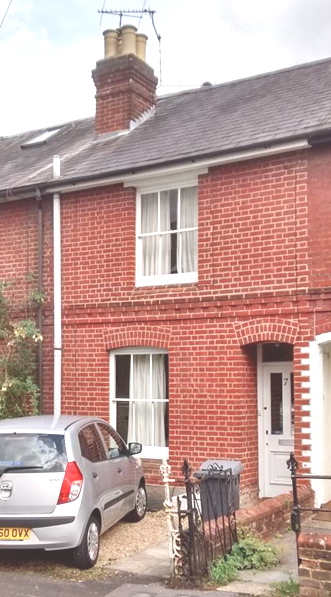
7, Western Road, Winchester – Bertram Stroud’s parents moved
here shortly before the Great War
There is no mention of Bertram Stroud in the 1911 Census in which his parents were recorded living at 7, Western Road, Winchester (the address then and now). However, Bertram’s Army records from 1915 state that he was a merchant seaman when he enlisted so he was probably not living in Winchester at the time of the census. Intriguingly, on the same enlistment papers Bertram gave his address as 80, Upper Stockbridge Road (27, Stockbridge Road today), the home of Ernest and Laura Page. The papers also reveal that after Bertram’s death the Army was requested to send his effects and medals to Ernest and Laura’s daughter, Dorothy. Although Bertram was some 14 years older than Dorothy, there is just a hint here that the pair may have been romantically involved. (Dorothy’s mother, Laura, was the stepsister of William Mitchell whose name also appears on the parish memorials. See William Mitchell's biography).
Great War Record
Richard Stroud, Bertram’s father, died in Winchester in the first quarter of 1915. Bertram left the merchant navy shortly afterwards and on 31 May he enlisted (service number R/13747) with the KRRC in Poplar, east London. From there he was posted to the Rifles depot at Winchester. Many of his Army papers have survived and these enable us to paint a more rounded picture of Bertram, both as a man and a soldier. They reveal that he was 5ft 6ins tall, weighed 9st 4lbs and had a 37in chest. His rapid rise through the Army ranks is also charted. On 12 August 1915 he was promoted to Corporal, two days before being posted to the 18th (Service) Battalion (Arts and Crafts) KRRC which had been raised in early June at Gidea Park, Romford Essex. Just two months later, on 22 October, Bertram was promoted again, to Lance-Sergeant, and then to Acting Sergeant on 27 November.
Clearly Bertram possessed qualities that marked him out as a leader of men, qualities which probably had much to do with his age and previous experience of life at sea. At 28 he would have been older than many of his fellow volunteers in the battalion while his years in the merchant navy would have familiarised him with the importance of discipline and perhaps instilled a degree of self-assurance and confidence that caught the eye of his Army superiors.
The records contain other fascinating snippets of information. In August 1915 Bertram underwent dental treatment in Winchester to have no fewer than 12 ‘stumps’ (presumably rotten teeth) removed, two teeth filled, and then upper and lower dentures fitted at a total cost of £3. It is possible that this was the first time that Bertram had ever visited a dentist - it would be another 33 years before the creation of the NHS introduced free health to all, not just those who could afford to pay for it.
The records also reveal one blip in Bertram’s rise up the Army ladder. In February 1916, while the battalion was undergoing training at Aldershot, he was reprimanded for ‘irregular conduct’ and giving a false name to the Military Police in Guildford. It did not affect his career prospects, however, because on 3 May 1916, the day that the 18th KRRC transferred to France, he was made full Sergeant.
Bertram first saw action at the Battle of Flers-Courcelette (15-22 September 1916) during the Somme Offensive. The battle, which is best remembered for the first use of tanks in warfare, started badly for the 18th KRRC when a shell killed the battalion’s Commanding Officer and three other officers a few minutes after Zero Hour. Only 15 tanks were used in the battle, but they caused panic among the German troops, many of whom threw down their weapons and fled. However, the tanks were slow and prone to mechanical failure and the German gunners, once over their initial shock, put several out of action.
A spotter plane flying over the battlefield sent the following message: ‘Tank seen in main street Flers. Going on with large numbers of troops following it.’ Such good news was rare during the Somme Offensive and these famous words were soon making headlines in newspapers across Britain. Although the Allies failed to achieve their initial objectives, they did capture the villages of Courcelette, Martinpuich and Flers as well as High Wood, which had been a thorn in the side for over two months.
Bertram Stroud was in action again at the Battle of Le Transloy (1-18 October 1916) which aimed to build on the successes of the previous month. However, rain, fog and mud thwarted the best efforts of British troops. The 122nd Brigade went into the line on 3 October, about one and a half miles north of Flers. On 7 October the 18th KRRC took part in a failed attack on Bayonet Trench West, suffering heavy casualties in the process. The following day, 41st Division was withdrawn from the line, a process that took three days because of the appalling state of the battlefield. According to his Army papers, Bertram Stroud was killed between 3 and 10 October although most official records give the 10th. Bertram was 30 years old and his body was never found.
Family after the Great War
Bertram’s brother George, who was serving with the 49th Battalion (Edmonton Regiment) Canadian Expeditionary Force, also fought on the Somme. He was killed two days before Bertram at the Battle of the Ancre Heights (1-18 October), just a few miles from the Le Transloy battlefield. Neither brother is listed in the Winchester War Service Register, presumably because they were not living in the city at the outbreak of war.
Bertram’s mother Margaret continued to live at 7, Western Road until 1917 when she moved a short distance to 21, Elm Road, the home of her son Alfred. She died in Winchester in 1930. Alfred continued to live in Winchester until his death in March 1966, aged 86. Bertram’s other surviving brother, Richard, is believed to have married in 1902 but no trace can be found of him after that date.
All three of Bertram’s sisters married. The eldest, Alice (later Barnes) went to live in Shirley, Southampton, and had at least three children. She died in the New Forest in February 1953, aged 74. Florence (later Welch) lived at 14, Cheriton Road, Fulflood. She is known to have had one child and died in Winchester in March 1939 at the age of 62. Hetty (later Gale) moved to Southsea after marrying. She died in Basingstoke in September 1967, aged 77.
Finally, what of Dorothy Page, who may have been Bertram’s girlfriend in Winchester? In 1919 she married 22-year-old Londoner George Pheby who had served with the London Regiment during the Great War. George died less than four years later in February 1923. Dorothy tried unsuccessfully to secure a widow’s pension from the Army authorities, suggesting that George’s death may have been related to an injury sustained while on active service. Dorothy never remarried. In 1939 she was recorded living with her mother at 27, Stockbridge Road and doing domestic work. She died in Southsea in July 1983, aged 83.
Medals and Memorials for Bertram Edward Stroud

Commemoration on the Thiepval Memorial, Somme, France
Sergeant Bertram Edward Stroud was entitled to the British War Medal and the Victory Medal. His body was never found and he is commemorated (above) on the Thiepval Memorial, Somme, France, (PR. 13A & 13B, Pier & Face). Bertram is also mentioned on the memorials at St Paul’s and St Matthew’s churches, Winchester.