

Private CHARLES FRANCIS GOODWIN
Address unknown
Service number 3/3129. 1st Battalion, The Hampshire Regiment
Killed in action, Belgium, 15 May 1915
Life Summary
The biography of Charles Francis Goodwin proved difficult to research. Although his name appears on the memorials at the parish churches of St Matthew’s and St Paul’s, it does not feature in the Winchester War Service Register. In fact, Charles does not appear to have had any Winchester connection, except for one possible, albeit speculative, link that is discussed below. Records for his parents and siblings are scarce and with so many ‘dead ends’ his life remains shrouded in mystery.
Family Background
The Soldiers Died in the Great War (SDGW) records give Charles Goodwin’s place of birth as St Andrew’s, Plymouth. The UK Registration of Births Index shows that a Francis Charles Goodwin was born in Plymouth on 18 July 1893. He was christened at Christ Church, Plymouth, on 24 August the same year and the baptism certificate states that his parents, George and Frances, lived at 10, York Place, Plymouth. George’s occupation was given as tailor.
Eight years earlier, the 1881 Census had recorded a George and Frances Goodwin living at 7, St Peter Street in the London parish of St James. Both were aged 27. Significantly, George was working as a tailor which suggests that he and Frances are the same couple recorded living in Plymouth in 1893 following Charles Goodwin’s birth. In 1881 the couple had two daughters - Emma, aged five, and three-year-old Sophie. Also living in the house were Frances’s father, 64-year-old Francis Cunneford, and her sister Sophie, aged 17.
The 1881 Census shows George and Frances as already being married. However, just over two years later, on 17 December 1883, George and Frances Goodwin are recorded marrying at St Philip’s Church, Lambeth, south London. Both were 30 years old and were living together at 7, St Peter Street, London. Frances’s father is given as Francis Cunneford, a salesman. George’s father is listed as engineer William Robert Goodwin, deceased. George Goodwin gave his birthplace as St George, Middlesex, and his occupation as tailor. Frances’s birthplace is recorded as St Pancras, Middlesex, while the daughters were born in St James (probably in the family home).
Clearly, the George and Frances Goodwin on the census are the same people as the couple recorded marrying two years later. They may have lied about their marital status on the census to conceal the fact that their daughters were illegitimate.
After 1893, the year that Charles Goodwin was born, the trail of records for the family goes cold. There is one showing that a Charles Goodwin, aged six, was admitted to the Fulham Road Workhouse in Westminster, London, on 24 May 1899, but it is not known whether this was George and Frances’s son. If it was, then the family had moved back to London from Plymouth. It also suggests that the Goodwins had fallen on hard times and would help to explain why they disappear from the official records. (An interesting aside is that Francis Cunneford, Frances Goodwin’s father, was also briefly admitted to Fulham Road Workhouse in 1886. The record lists his occupation as ‘hawker’, rather than the grander sounding ‘salesman’ on his daughter’s marriage certificate!).
To date, the only other reliable information about Charles Goodwin has been gleaned from his Army records. It shows that he enlisted in Winchester and the prefix 3 on his service number (3/3129) indicates that he was a Special Reservist with the 3rd Battalion, The Hampshire Regiment. A Special Reservist was a part-time soldier, like a Territorial. A man would enlist in the Special Reserve for six years and was liable for call-up in the event of war. His service period started with six months’ full-time training on the same pay as a Regular soldier. He then returned to civilian life, but still had to complete three to four weeks’ military training each year.
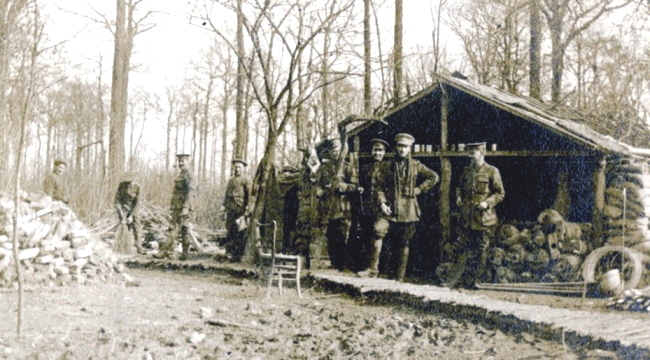
Soldiers of the 1st Battalion, The Hampshire Regiment in Ploegsteert Wood during
the winter of 1914-15. Charles Goodwin was among those who had to
endure flooded trenches which led to dozens of cases of trench foot
(Photo: Royal Hampshire Regiment Museum)
Soldiers of the 1st Battalion, The Hampshire Regiment in Ploegsteert Wood during the winter of 1914-15. Charles Goodwin was among those who had to endure
flooded trenches which led to dozens of cases of trench foot (Photo: Royal Hampshire Regiment Museum)
Although his name appears on the St Matthew’s and St Paul’s memorials, there is no record of Charles Goodwin living in Weeke or Fulflood. However, Warren’s Winchester Directory for 1914 does show a W. Goodwin living at 38, Greenhill Road. He cannot be found in any other year at that address, or anywhere else in Winchester. Nor is there a W. Goodwin on the burgess roll or voting lists. One possibility, albeit a remote one, is that this W. Goodwin was related to Charles. If so, then he may have lived briefly in Winchester and allowed Charles to lodge with him.
Great War Record
As a Special Reservist, Charles Goodwin was called up for military service when Britain declared war on Germany on 4 August 1914. He would probably have made his way to the Hampshire Regimental Depot in Winchester where he would have joined hundreds of other Reservists from the Hampshires and the two Rifles regiments also based in the city. After several weeks in Winchester, Charles was sent to join the 1st Battalion, The Hampshire Regiment on the Western Front.
Charles’s Medal Index Card records that he entered a theatre of war on 12 November 1914. The War Diary of the 1st Hampshires states that 260 men from the 3rd Battalion arrived as reinforcements on 21 November – Charles Goodwin was almost certainly among them. The 1st Hampshires, one of the regiment’s two Regular battalions, had already seen three months of fierce fighting as the initial war of movement on the Western Front gave way to stalemate in the trenches.
Also serving with the 1st Hampshires when Charles joined the battalion was George Goodridge, another soldier whose name features on the memorials at St Matthew’s and St Paul’s. George and Charles fought together for five months before both were killed within a day of each other at the Second Battle of Ypres. George’s biography contains an account of the 1st Battalion’s actions between November 1914 and mid-May 1915 see George Goodridge.
Charles Goodwin is recorded as being killed in action on 15 May, the day after George Goodridge. Given that neither man’s body was ever found, and that the 1st Hampshires had been pulled out of the line on 14 May, it is possible that both men died in the German artillery bombardment of the battalion’s position on 13 May. However, there is no firm evidence to support this, so the dates of death used here are those recorded by the Commonwealth War Graves Commission.

Charles Goodwin’s Army pension record showing his mother Frances as the claimant
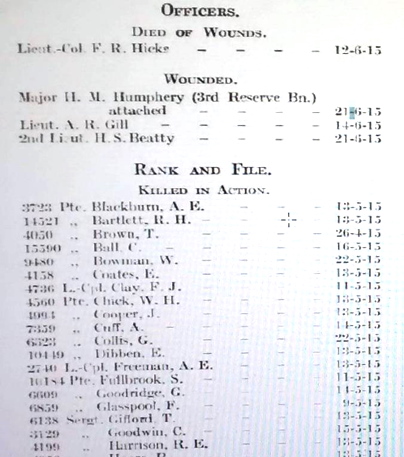
An extract from the Hampshire Regimental Journal of July 1915
showing some of the 1st Battalion casualties at the Second Battle of Ypres.
Charles Goodwin and George Goodridge are among those listed as killed in action
Family after the Great War
Above: Charles Goodwin’s Army pension record showing his mother Frances as the claimant. Above: An extract from the Hampshire Regimental Journal of July 1915 showing some of the 1st Battalion casualties at the Second Battle of Ypres. Charles Goodwin and George Goodridge are among those listed as killed in action Charles was 21 years old when he died. Army records show that on 8 October 1915, the sum of £5 9s 11d was paid to his father George, probably in respect of his personal effects.
After the war, Charles’s mother Frances claimed an Army war pension in respect of her son. Records held by the Western Front Association show that she received regular pension payments up to her death at the end of 1931. Her address on the pension records is 23, Wybert Street, NW1, a short distance from Regent’s Park, and in the same area that the Goodwins were recorded living in 1881. It is not known when Charles’s father died or what became of his sisters Emma and Rose.
Medals and Memorials for Charles Francis Goodwin
Private Charles Francis Goodwin was entitled to the 1914 (Mons) Star, the British War Medal and the Victory Medal. He is commemorated on the Menin Gate Memorial (Panel 35), Ypres, West Flanders, Belgium. His name also appears on the memorials at St Matthew’s and St Paul’s churches, Winchester.