

Private ALBERT EDWARD FRANCIS
15, Andover Road, Winchester
Service numbers 2275 and 205506. Hampshire Carabiniers Yeomanry and 15th (Service) Battalion, The Hampshire Regiment
Killed in action, France, 25 March 1918
Life Summary
Albert Edward Francis was born in Putney, south-west London, in 1880 or 1881. One of eight children, he served as a professional soldier in the early 1900s before marrying in Winchester where he became a policeman. In 1916 he joined the Hampshire Carabiniers Yeomanry, a cavalry unit which amalgamated with the 15th Battalion, The Hampshire Regiment in 1917. He was killed in action during the German Spring Offensive the following year.
Family Background
Albert’s father, John Francis (1837-1902), was born in Westhampnett, Chichester, Sussex, the son of Charles (1786-1871) and Martha (1786-1864) Francis. One of ten children, John suffered great hardship in his early years. The 1851 Census recorded him living as a pauper in the Westhampnett workhouse despite being just 13 years old. Why Albert’s father should have been abandoned by his family to such a miserable existence is unclear but, interestingly, both his parents later died in the same workhouse.
Sometime in the late 1850s or early 1860s, John Francis enlisted in the Grenadier Guards. Joining the Army was a common means of escaping poverty in the Victorian period and it would have provided John with a regular wage and a roof over his head. On Christmas Eve 1862 he married Emma Gerrish at St Mary’s Church, Lambeth, south London. Emma had been born in North Bradley, near Westbury, Wiltshire, in 1838. Her father John, also from North Bradley, worked as an agricultural labourer. Her mother Hannah had been born in Beckington, Somerset, in 1821.
John and Emma Francis soon started a family. Their first son, Alfred, was born in Lambeth in 1864 followed four years later by a daughter, Edith, born in Putney. By 1871 John had left the Army to work as a railway porter and he and Emma were living with their two children in Harris Yard, Putney. The couple had a second son, Henry, in 1874 and a third, William, in 1878.
Albert Francis was just a few months old by the time of the 1881 Census when the Francis family were still in Putney and John was working as a carman. By 1891 they had moved to 34, College Street, Winchester. Albert’s father was still working as a carman and his eldest brother Alfred was a gardener.
We know nothing of Albert Francis’s education, but he would probably have left school aged 12 or 13 having received basic schooling. On 9 April 1898, aged 18, he joined the Army as a gunner with the Royal Horse Artillery (RHA). By April 1901 he was based at barracks in Aldershot. Albert served with Y Battery in the RHA and spent a total of seven years in the Army (plus five in the Reserve) before leaving in 1905. On 7 September the same year, he joined the City of Winchester Police Force as a Constable 3rd Class on a starting wage of 23 shillings a week. According to the Force Staff Register he was 25 years old when he joined which confirms Albert’s year of birth as 1880 or 1881, not 1876 as stated in some sources.
On 29 January 1906 Albert married Mary Gilbert in Winchester. One of seven children, Mary was the daughter of agricultural labourer George Gilbert (1851-1935) and had been born in the hamlet of Newton Stacey, near Winchester in 1879. Her mother was born Elizabeth Waters (1852-1934) in nearby Barton Stacey. In 1901, 21-year-old Mary was working as a cook and domestic servant for playwright David Jones and his wife Caroline, a music teacher, at their house in Putney.
On 30 March 1907 Mary gave birth to a son, also called Albert, followed by a daughter, Winifred, on 1 August 1908. Meanwhile, Albert Snr, continued to work as a policeman, enjoying regular pay rises until by September 1909 he was earning 27 shillings per week.
However, an incident in 1908 reveals that perhaps not all was well in Albert Francis’s life. In December that year he was caught fighting with PC William Pike when off duty. Both men were reported by the Chief Constable for ‘conduct tending to bring the Police Force into disrepute’. The Winchester City Police Staff Register records that they received a severe reprimand and caution.
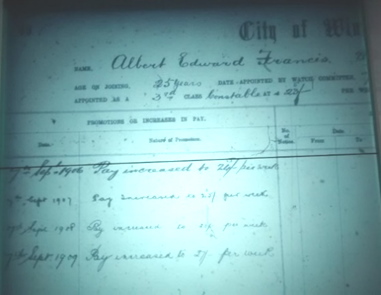
PC Albert Edwards’s police record in 1909
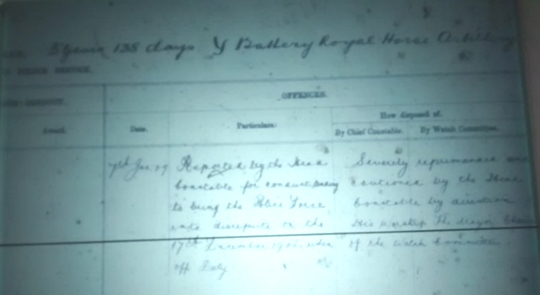
PC Albert Edwards’s police official reprimand for
‘conduct tending to bring the Police Force into disrepute’
Albert remained with the police until 26 April 1911 when he was discharged from the force on medical grounds. The Force Conduct Book states that he was suffering from neurasthenia, a condition similar to chronic fatigue syndrome with symptoms such as headaches and irritability. This must have made Albert a difficult man to live with and perhaps goes some way to explaining the incident in 1908. It is not known if Albert managed to find work after leaving the police force.
Albert and Mary appear to have lived at several addresses in Winchester. An A. Francis was first listed in Warren’s Winchester Directory in 1906, living at 22, St John’s Road. In 1911 he was at 35, Hyde Street, but by the following year, after leaving the police force, he had moved to 15, Andover Road. His address remained the same until 1917 when, oddly, there was no A. Francis listed living in Winchester. By 1918, however, Albert Francis was back and living at 11, Andover Road so the family had clearly moved. The Winchester War Service Register and most other sources give Albert’s address as 11, Andover Road, but this study uses No. 15 which is where he was living when he left to go to war in 1916.
Great War Record
When the Great War began in August 1914 Albert was no longer on the Army Reserve List so was not liable to be called up. Nor did he join the early rush to volunteer for military service. Indeed, it was not until May 1916, at the age of 35, that he joined the Hampshire Carabiniers Yeomanry, possibly as a conscript. (Conscription was extended to married men on 25 May 1916.)
Albert joined the 3/1st Hampshire Carabiniers with the service number 2275. The Carabiniers were mounted soldiers who carried a carbine (a shorter version of a rifle) and among those who had joined the unit the previous month was Tom Douse who lived a few houses away from Albert at 5, Andover Road. The Carabiniers had remained in Britain during the first two years of the war, but in 1916 several squadrons were transferred to France with the remainder following in 1917.
The Carabiniers served as Corps Cavalry for IX Corps at the Battle of Messines in June 1917 before being absorbed into the 15th (Service) Battalion, The Hampshire Regiment in October. The amalgamation took place because by this stage of the war the British Army was finding it difficult to replace those men who had been killed and wounded. One of many solutions was to convert Yeomanry units into infantry.
In November, with the new service number of 205506, Albert was sent to Italy with the 15th Battalion – a unit with close ties to Portsmouth - to help stem an Austro-German breakthrough at Caporetto in the Italian Alps. (Details of the battalion’s time in Italy can be found in Tom Douse’s biography.)
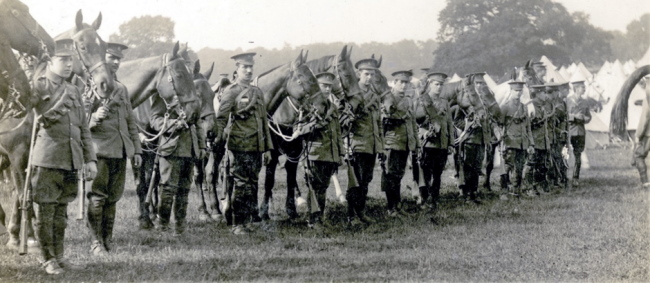
Troopers of the Hampshire Carabiniers Yeomanry in 1914 before the outbreak
of war. Albert Francis joined them from the Royal Horse Artillery in 1916
(Photo: Royal Hampshire Regiment Museum)
The 15th Hampshires returned to the Western Front in early March 1918, just as the Germans were preparing to launch their Spring Offensive. The onslaught began on 21 March and the 15th Battalion went into action the following day between Bapaume and Sapignies, north of the River Somme. In bitter fighting, the battalion courageously held their line against repeated German assaults. In his book The Royal Hampshire Regiment 1914-1918, C.T. Atkinson describes the fighting:
The [Hampshires’] line was sited on a reverse slope, and though in places the Germans got within 50 yards their corpses were piled in heaps in front of the wire and none got through.
The following days brought little respite. On 24 March, the battalion took part in a bayonet charge to halt another German attack and on the night of 25-26 March they fought a fine rearguard action as the British pulled back. Despite the intensity of the fighting, the Hampshires casualties were comparatively light but among those killed was Albert Francis. He was 37 or 38 years old.
Family after the Great War
In July 1918 Albert’s widow Mary received a payment of £7 19s 11d in respect of his effects and back pay and then, in November 1919, an £8 war gratuity. Mary continued to live in Winchester after the war and was still at 11, Andover Road in 1961. She died in 1966, aged 86. Albert and Mary’s daughter Winifred married William Hopwood in Winchester in April 1935. She died in the city in August 1908 at the age of 63. Albert Edwards Jnr died in South-East Hampshire in 1974, aged 67.
Medals and Memorials for Albert Edward Francis
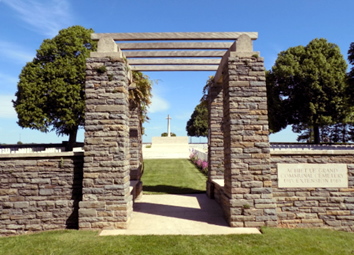
Achiet-le-Grand Communal Cemetery Extension, Somme, France
Private Albert Edward Francis was entitled to the British War Medal and the Victory Medal. He is buried in Achiet-le-Grand Communal Cemetery Extension (right), Somme, France (GR. II. I. 1.) and is mentioned on the memorials at St Matthew’s and St Paul’s churches, Winchester.
Researchers – DEREK WHITFIELD and CHERYL DAVIS