

Private CLIFFORD TOM DOUSE (DOWSE on memorials)
5, Andover Road, Winchester
Service numbers 2180 and 204744. 3/1st Hampshire Carabiniers Yeomanry
and 15th (Service) Battalion, The Hampshire Regiment
Killed in action, Belgium, 4 September 1918
Life Summary
Clifford Tom Douse was born in Winchester on 5 September 1889, the son of William and Sarah Dowse, who were then living at 55, Winnall (Wales Street). Although the family surname is spelt Dowse on the memorials at St Paul’s and St Matthew’s, it is Douse on most official documents, such as census records and the Register of Births.
Family Background
Clifford, known to family and friends as Tom, was one of seven siblings to survive into adulthood. The eldest, William Jnr, was born in 1870 followed by Mary (1871-1951), Frederick (1875-1945), Caroline Rose 1876-1942) and Eva Jane (1879-1962). After Tom’s birth another sister, Maria, arrived in 1894. Tom was the first of the Douse children to be born in Winchester, all his older siblings being born in the nearby village of Easton.
Tom’s father, William Douse, was also born in Easton, in 1842. He spent his life working as an agricultural labourer on farms in Easton and on Winchester’s eastern fringes, including the no doubt appropriately named Mud Farm on the Alresford Turnpike Road in Easton.
In 1870 William married Sarah Allen who had been born in 1851 in Kings Worthy. In 1871 the couple were living at the Bat and Ball Inn in Easton. The 1881 Census showed the family living at another pub in the village, the Chestnut Inn (today the Chestnut Horse), which stood next to the Bat and Ball.
By 1891 the Douses, including young Tom, had moved to 55, Winnall in Winchester. The family were at the same address in 1901 when Tom’s mother Sarah was supplementing the household income by working as a laundress with daughter Eva. The census also shows that William and Sarah’s two-year-old grandson, Ernest, was living with them. This was possibly the son of Mary Douse who had married in 1899.
On 27 February 1894, Tom Douse entered St John’s National Church School, Winchester, aged four. It is not known when he left.
By 1911 the Douse family had moved a short distance to 26, Colson Road, just off Wales Street, and close to the First In Last Out pub. Tom, 21, was working as a butcher’s assistant. A tribute published in the Hampshire Regimental Journal in October 1918, shortly after his death, states that he worked for Mr H. Elkington, almost certainly Howard Elkington, who was Mayor of Winchester in 1912-13.
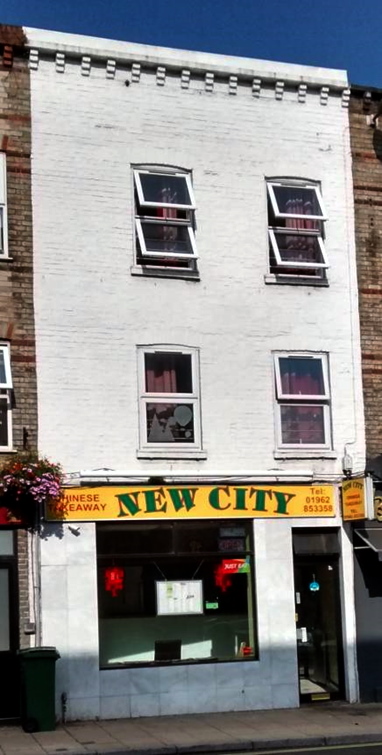
5, Andover Road, Winchester – Tom
Douse’s address in the WWSR
It is not immediately clear what connection Tom Douse had to Fulflood or Weeke. The Winchester War Service Register (WWSR) gives his address as 5, Andover Road (today a Chinese fast food business) but his name does not appear in any Warren’s Winchester Directory of the period. His parents are listed but they continued to live in Colson Road during and after the war. However, one clue can be found in the Warren’s Directory of 1915 which records a ’Butcher, Z.Z’ living at 5, Andover Road. In the directories of 1916 and 1917 the address is marked ‘void’. Given that Tom was a butcher’s assistant, it is possible that he was running a branch of Mr Elkington’s business from there and living over the shop. Or he may have been renting the property from Elkington. Certainly, the initials Z.Z are highly unusual while it seems more than coincidental that the address became void the year that Tom went off to war. By 1918, when he was dead, the house was occupied once more.
Although old enough to volunteer for military service on the outbreak of war in August 1914, Tom Douse was not swept up in the ‘rush to the colours’ This was probably due to the nature of his work; as a butcher he would have been kept busy supplying the Army camps which sprang up around Winchester in 1914 and 1915. With labour in short supply, Mr Elkington would have been reluctant to lose him.
Late 1915 was a momentous time for Tom. Not only is he believed to have volunteered for military service, but he became a husband and a father. Tom married Lillian Russell (known as Lily to family and friends) on 29 December 1915 at All Saints Church, Banstead, Surrey. The wedding certificate shows that the couple were living at 6, Canon Lane, Burgh Heath, Surrey. Tom’s profession is listed as butcher. The couple already had a son, Ernest, who had been born in Epsom on 7 September 1915. It is unclear why Tom and Lily had moved to Surrey in mid to late 1915, but it is possible that it was to escape the opprobrium that may have surrounded Lily’s pregnancy.
One of seven surviving siblings, Lily had been born in Willesden, north London, on 3 February 1885. Her father, John Thomas Russell, was born in 1862 in Brightling, Sussex, and her mother, Elizabeth, in Kilburn, north London, in about 1864. In 1891 the family was recorded living at 6, Deanery Villas, Godalming, Surrey, with John’s occupation given as former professional cricketer.
By 1901 the Russells had moved to Winchester and were living at 6, Ilex Terrace. Lily, then 16, was working as a laundry maid and her father as the cricket professional at West Downs School, Winchester. In 1911 the family were living at 1, Highland Terrace, West Hill, Romsey Road, Winchester, with Lily and her sister Jessie both working as laundresses.
Great War Summary
It is believed that Tom attested for military service in late 1915 and was then called up the following April. He joined the 3/1st Hampshire Carabiniers Yeomanry with the service number 2180. This cavalry unit had remained in Britain during the first two years of the war, but in 1916 several squadrons were transferred to France with the remainder following in 1917.
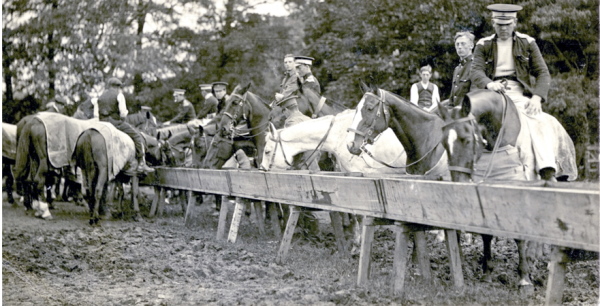
Troopers of the Hampshire Carabiniers Yeomanry at their summer camp in 1915.
Tom Douse grew up on farms and would have been comfortable working
with horses (Photo: Royal Hampshire Regiment Museum)
The Carabiniers served as Corps Cavalry for IX Corps until late July 1917, doing useful work during the attack on Messines in Flanders – patrolling, locating the enemy and carrying information. By this stage of the war, however, the Army was having difficulty finding fresh drafts of men to replace those killed and wounded. One solution was to convert Yeomanry units into infantry, and so in October 1917 Tom Douse, by then service number 204744, found himself absorbed into the 15th Battalion, The Hampshire Regiment.
The 15th Hampshires were a Service Battalion assigned to 41st Division. The battalion had a close association with Portsmouth and had been raised during the of peak of voluntary recruitment in the first year of the war. By the time Tom Douse joined it had already seen action during the Somme Offensive and at the Third Battle of Ypres, better known as Passchendaele.
Tom was fortunate to miss the fighting at Ypres. Instead, in November 1917, he found himself dispatched to Italy with the 15th Hampshires to help stem an Austro-German breakthrough at Caporetto in the Italian Alps. The five British divisions sent to Italy travelled by train from Paris, via Lyons and Marseilles to Cannes. From there they continued along the Riviera to Genoa and on to Modena and finally Mantra where they disembarked on 17 November. In his book The Royal Hampshire Regiment, 1914-1918, the historian C.T. Atkinson states:
The six-day journey had been an interesting experience, the entirely new scenes and the enthusiastic welcome received in Italy compensating for its length and cramped conditions, while everyone was glad the battalion was not returning, as had been expected, to the Ypres Salient.
The British then marched 100 miles to reach the River Piave where they hoped to stop the Italian retreat. In the event they saw little action as the enemy offensive had already run out of steam. The Italian front, however, was a world away from the mud and desolation of France and Flanders as Atkinson records:
....on the evening of November 20th the Division began the relief of the Italians in the Montello sector, NE of Montebelluno, where the Piave bends southward round a steep ridge, from which splendid observation could be enjoyed over the plains to the SE. The 15th had their first turn in the line here from December 8th to 15th. The ridge was largely covered with woods and elsewhere with vineyards and fields of maize, and with the country virtually as yet undamaged by war no greater contrast with Flanders could have been imagined.
Seeing Italy must have been a tremendous adventure to Tom Douse, but it proved short-lived. On 1 March 1918, the 15th Hampshires left Italy for the Western Front where they arrived four days later, just in time to meet the full fury of the German Spring Offensive.
The onslaught began on 21 March. The Hampshires went into action the following day between Bapaume and Sapignies, north of the River Somme. In bitter fighting, the battalion held their line against repeated assaults by the Germans whose corpses ‘were piled in heaps in front of the wire’. The following days brought little respite - on 24 March the Hampshires, with some Argyll and Sutherland Highlanders, took part in a bayonet charge to halt a German attack and the following night fought a fine rearguard action as the British pulled back.
In April, the battalion was moved out of the line and transferred north to the British Second Army to the east of Ypres. Here it took part in the British withdrawal almost to the gates of Ypres itself, in the process giving up most of the ground won during the bloody Passchendaele campaign just a few months earlier.
On 9 August, as the tide of the war turned in the Allies’ favour, the 15th Hampshires were in action once more near Clytte in Flanders. The attack cost 42 men killed or missing, including three officers from the Carabiniers. Tom Douse, however, came through unscathed.
Tom was killed in action on 4 September 1918 (the WWSR incorrectly has it as the 14th), the day before his 29th birthday. His battalion was ordered at short notice to attack a strong German position near Vierstraat, south of Ypres. An artillery barrage aimed at silencing German machine-gun posts fell short of its target which meant the Hampshires came under withering fire when they advanced. Tom Douse was among those to fall, along with two company commanders and 95 other officers and men. More than 220 other men were wounded or gassed, including the battalion Commanding Officer.
An entry in the Hampshire Regimental Journal of October 1918 states:
Douse - Killed in action on September 4th, Pte T. Douse, Hampshire Regiment, son of Mr. and Mrs W. Douse, 26, Colson Road, Winnall, Winchester.
Pte. T. Douse, Hampshire Regiment, killed in action on September 4th, was the son of Mr and Mrs W. T. Douse, of 26, Colson Road, Winnall, Winchester. Before the war he was in the employment of Mr. H. Elkington as a butcher, and married the eldest daughter of Mr. J. Russell, cricket professional at West Downs, Winchester. Deceased leaves one child, a son, aged three years.
Family after the Great War
Tom’s widow Lily received £4 12s 9d from the Army authorities on 14 December 1918 in respect of his personal effects. She received an additional £3 8s 9d on 29 January 1919 and a war gratuity of £10 10s on 11 December 1919.
Less than a year after Tom’s death, Lily remarried. Her second husband was Nicholas Hankin. Lily died in Winchester in September 1973, aged 88. Ernest Douse, her son by Tom, married in Winchester in 1949. No details of his wife have yet been found, but the couple are believed to have had one child. Ernest died in the New Forest in November 2002 at the age of 87. Tom’s parents, William and Sarah Douse, died within months of each other in 1931, aged 90 and 80 respectively.
Most of Tom’s siblings had married and moved away from Winchester before the war, ending their close connections to the city. The exception was his younger sister Maria who married Charles Haines in Winchester on 29 August 1914. Charles served with the 2nd Battalion, The King’s Royal Rifle Corps and was killed on 1 July 1916, the first day of the Battle of the Somme. Maria is not believed to have remarried and she died in Winchester in April 1984, aged 89.
Tom’s elder brother, William Jnr, did have a son, Charles, who was born in Easton in 1900. Charles later married and went on to live in Surrey where he died in 1933.
Medals and Memorials for Clifford Tom Douse
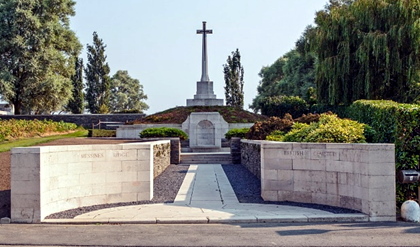
Messines Ridge British Cemetery, West-Flanders, Belgium
Private Clifford Tom Douse was entitled to the British War Medal and the Victory Medal. (These appear to have been returned to the military authorities by his family in June 1923.) He was buried at Messines Ridge British Cemetery (above), West-Flanders, Belgium (GR. III. C. 7.). His name appears on the memorials at St Matthew’s and St Paul's churches, Winchester.