

Private CHARLES EDWARD WEDGE
8, Andover Road, Winchester
Service number 7802. 2nd Battalion, The Wiltshire Regiment
Killed in action, France, 11 March 1915
Life Summary
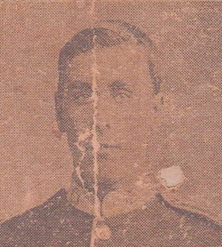
Charles Edward Wedge
Charles Edward Wedge was born in Winchester in 1891, the youngest of the nine children of James and Mary Wedge. Charles joined the Army in 1911 and was one five brothers who fought in the Great War. He was killed in action in 1915. An older brother, James Wedge, who served in the Royal Navy was killed in 1918. Charles’s father was a well-known figure in Winchester where he ran a plumbing and gas fitting business from the family home in Andover Road.
Family Background
Thanks to a local newspaper article published in late 1914 or early 1915, a great deal is known about the Wedge family. James Wedge Snr, Charles’s father, was born in Winchester in 1844. He served in the Navy from 1861-70, which included a posting to the west coast of Africa. In 1866 he took part in Dr David Livingstone’s exploration of the Congo River, travelling some 200 miles upriver with the Christian missionary on HMS Archer. After Livingstone had preached a farewell sermon on board Archer, he was rowed to his own boat by a crew which included James Wedge. Livingstone never returned from his expedition and died in 1873. James later served on the ironclad battleship HMS Bellerophon.
James Wedge married three times. In 1868 he married 18-year-old Winchester-born Abigail Mary Smith in Ringwood, Hampshire. The couple had two daughters (stepsisters to Charles Wedge) – Emily, born in Ringwood in 1869, and Mary Ann (known as Marion), who was born in May 1871 in Shoeburyness, Essex. The 1871 Census lists Abigail living in Christchurch, near Bournemouth, with her baby daughter Emily. James, however, was lodging at a house in South Molton Street, London, and working as a gas manager (his father had also been a gas worker). Abigail died at some point over the next five years although the precise date is not known.
James Wedge remarried in Marylebone, London, in 1876. His second wife, Mary Ann London, had been born in Hound, Southampton, in 1850 and she gave birth to seven children in 14 years. These were: James Charles Thomas (referred to here as James Jnr), born in Bloomsbury, London, in December 1877; Maude (sometimes spelt Maud) Eugenie, born in Marylebone in August 1879 and John William, born in March 1880 in Broseley, Shropshire. Four more children were born in Winchester – Frederick Arthur in 1884; Thomas in 1886; Daisy in June 1888; and Thomas in June 1890.
The early years of their marriage saw James and Mary Ann Wedge move around the country as James looked for work. In 1881 they were living at Madeley, near Broseley, Shropshire. Today Madeley is part of Telford new town, but at the end of the 19th Century it was a busy mining and manufacturing community where James’s skills as a gas fitter and plumber would have been in high demand.
By the time of the next census in 1891, James Wedge had moved back to Winchester and was living with his family at 1, Jubilee Villas, Kingsgate Street. He was still working as a plumber and gas fitter.
The next ten years were a time of great change for James and Mary Wedge as, one by one, their children flew the nest. Marion, who had worked as a tailoress, was the first to go when she married Southampton-born gas worker George Avery in Winchester in 1891. The couple went on to have at least two children. In 1893 James Wedge Jnr joined the Royal Navy and he remained in the service until his death in the Great War in 1918. However, he was based at Portsmouth so would no doubt have visited his family in Winchester when the opportunity arose.
In 1894, the eldest Wedge daughter, Emily, married plumber Arthur Cowling in Marylebone, London. They went on to live in London and had four children together. Maude Wedge married in Southampton in 1898. Her husband, Augustus Harris, was a coastguard with the Admiralty and they had a son, also called Augustus, in 1903. In May 1900 John Wedge, Charles’s brother, also married. His bride, Ida Lily Blaber, had been born in Walthamstow, Essex, in 1880. The couple had three children – Frederick, born in London in 1903 and Doris (1905) and Jack (1906), both born in Winchester.
These happy family events were punctuated by the death of Charles Wedge’s mother Mary in 1895, aged 45. Five years later his father James took a third wife when he married Agnes Annie (née Morgan) in Winchester. In the 1901 Census the newly-weds were living at 11, Victoria Road, Winchester, together with James’s youngest children, Daisy and Charles. Also living in the house was five-year-old Helen Parodi who had been adopted by James and Agnes.
In April 1905 Charles’s brother James married Emily Forsdick in Portsmouth. Emily had been born in Nova Scotia, Canada, in 1882.
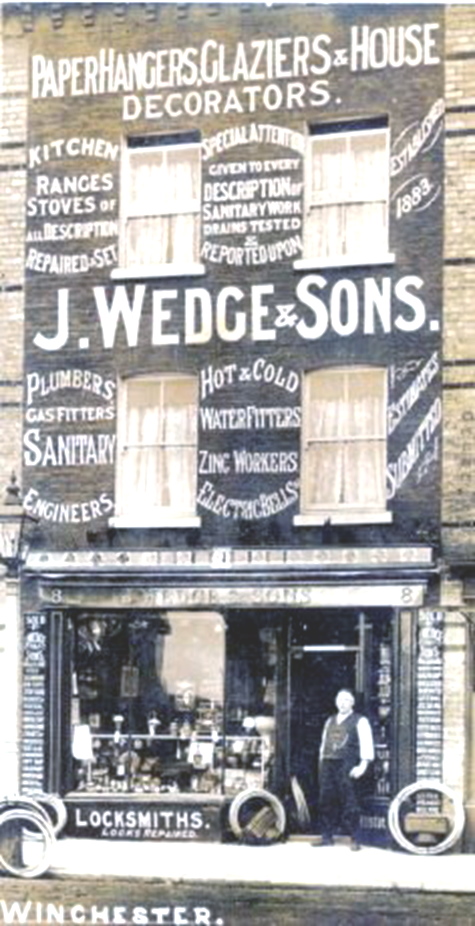
Charles Wedge's father James pictured outside the family home and
store at 8, Andover Road, Winchester, shortly before the Great War.

8 Andover Road, Winchester, today
By 1911 James and Agnes Wedge had moved to 8, Andover Road, Winchester (the address then and now). The photograph above shows the family home and store with James Wedge posing rather nonchalantly at the front door. The advertising on the front of the building indicates that he had branched out from being just a plumber and gas fitter and was involved in other aspects of building work such as glazing and decorating. Interestingly, another of the services James offered was lock repairs – by coincidence, the shop at 8, Andover Road today is Croma Locksmiths.
Great War Record
Charles Wedge joined the Army in 1911, enlisting with the Wiltshire Regiment in Portsmouth. He was assigned to the 2nd Battalion and posted to Gibraltar as part of the British garrison. When war broke out in August 1914, the Army came under pressure to supply troops for the Western Front and the 2nd Wiltshires were recalled to England. The battalion arrived at Southampton on 3 September and from there moved to Lyndhurst in the New Forest where it came under the command of 21st Brigade, part of the newly-formed 7th Division.
On 7 October 1914, the 2nd Wiltshires were sent to the Western Front, landing at Zeebrugge in Belgium. As part of 7th Division, the battalion was ordered to assist in defending the port of Antwerp but by the time that the Division arrived the city had already fallen. The 7th Division was instead tasked with holding certain important bridges and other places that would help the westward evacuation of the Belgian army.
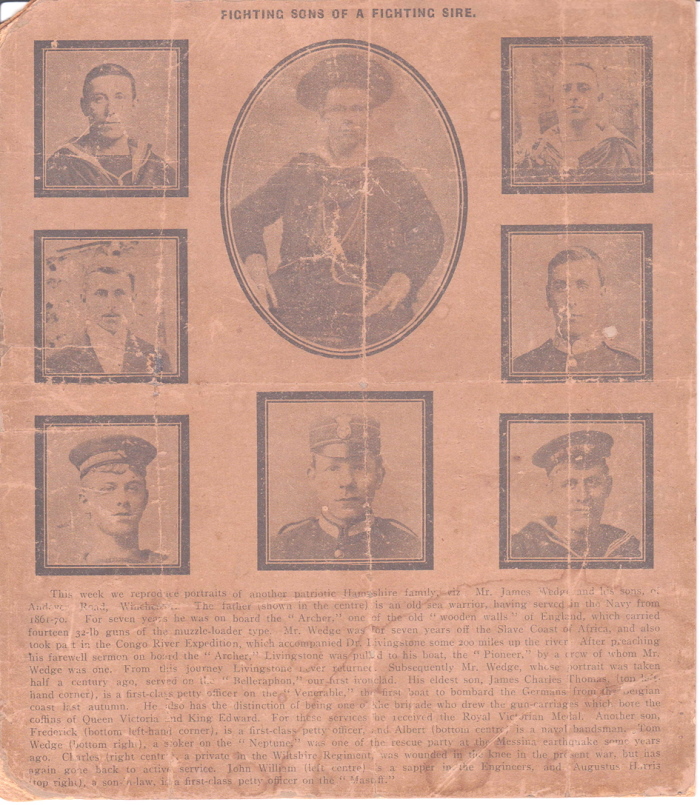
A local newspaper article from late 1914 or early 1915 about James Wedge and his
sons. The cutting was found in the personal effects of Jessie Ellen Wedge,
daughter of James Wedge Jnr, and a niece of Charles Wedge. No trace has yet been found of Albert Wedge, bottom centre
With the Belgians evacuated, 7th Division moved to Ypres in Flanders where its infantry battalions entrenched in front of the town, the first British troops to occupy an area that was to become synonymous with suffering in the Great War. The battalion suffered heavy losses at the First Battle of Ypres (19 October-22 November 1914) where Charles was wounded in the knee. He was evacuated home to England to recuperate and may have visited his father and other family members in Winchester.
In 1915 Charles returned to the Western Front in time to fight at the Battle of Neuve Chapelle (10-13 March). The battle was the first deliberately planned British offensive and its course set the pattern for attacks on the Western Front for much of the rest of the war. Tactical surprise and a break-in were achieved after careful initial planning, but the tempo of operations then slowed as communications problems led to a breakdown in command and control.
The attack, in the Artois region of northern France, was intended to rupture the German lines, enabling the British Army to rush to the Aubers Ridge and possibly as far as Lille. A French assault at Vimy Ridge was also planned to threaten the road, rail and canal junctions from the south as the British attacked from the north. However, the French part of the offensive was cancelled leaving the British to attack on their own, albeit with some French artillery support.
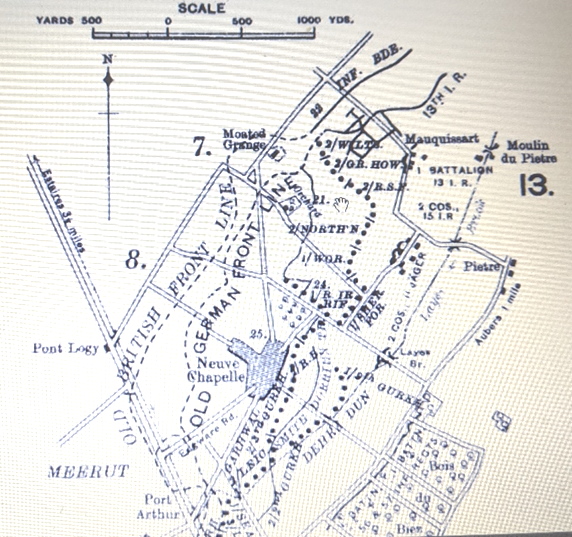
The Neuve Chapelle battlefield, 10-13 March 1915. Charles Wedge was killed
between the Moated Grange and Mauquissart on 11 March while serving with the 2nd Wiltshires
The battle opened on 10 March 1915 with attacks by British and Indian troops. By lunchtime, Neuve Chapelle village was in British hands although the further objective of Aubers Ridge had not been captured. In mid-afternoon, 21st Brigade, including the 2nd Wiltshires, was ordered to advance from positions between the Orchard and the Moated Grange towards the village of Mauquissart and then on to a mill called Moulin du Pietre (see map above). The advance began well but the troops soon came under enfilade fire and were forced to halt.
The attack resumed at 5.30pm and despite strong German resistance 21st Brigade continued to advance. As dusk fell, the 2nd Yorkshires and 2nd Royal Scots Fusiliers (the other battalions in 21st Brigade) battled their way through numerous ditches and hedgerows to assault the German lines. Lance-Corporal H. Wood of the 2nd Yorkshires later wrote:
We had to take the German trenches at the bayonet point and it ended in a glorious victory, and I will never forget it. We lost heavily, all our officers but one were killed and only a quarter of the battalion … remains. It was slaughter for the enemy in some of the trenches. We saw dead bodies piled four feet high, and we sheltered from machine-gun fire behind them.
Meanwhile, the 2nd Wiltshires, supported by bombers, worked north from the Moated Grange to penetrate German defences. They captured one officer and 180 men before being halted. That night, as stretcher bearers tried to recover the dead and wounded from the battlefield, British troops, exhausted from battle, dug makeshift trenches to provide shelter from enemy machine-gun fire.
The Germans spent the night strengthening their defences and rushing reinforcements to the area. Early the following morning (11 March) they launched a strong assault against the 2nd Wiltshires to try to capture the Orchard and the Moated Grange as well as trenches they had lost the previous day. They succeeded in capturing a section of one trench before rifle fire from the Wiltshires halted the advance. (By coincidence, Charles Wedge’s brother James was serving on the battleship HMS Venerable off the Belgian coast on 11 March when it bombarded German positions in support of the British attack at Neuve Chapelle.)
At daybreak, 21st Brigade received orders to attack from around the Moated Grange in the direction of Mauquissart with the objective of capturing Les Mottes Farm. However, the artillery bombardment which preceded the attack had little impact on German defences which had been fortified during the night. As a result, the leading waves of 21st Brigade troops were mown down as they advanced. Adding to the chaos, some British shells fell short of their targets, inflicting more casualties on the attackers. It is thought that Charles Wedge was among those killed in the assault. He was 23 or 24 years old.
Family after the Great War
In all, six Wedge brothers are believed to have served in the Great War. Charles and James Jnr were the only brothers known to have died and to be listed in the Winchester War Service Register (WWSR). James, who had joined the Navy in 1893, was killed in October 1918 when his ship struck a mine off the Belgian coast.
Frederick Wedge followed James into the Royal Navy in March 1900 (service number 209069) and the following year’s census lists him as a ‘Boy Sailor’ at Devonport. He appears to have left the Navy in 1907 but re-joined at the start of the Great War and served as a Petty Officer 1st Class. In 1916 Frederick married Amy Rose Jackson in London. After the war, the couple moved to Canada from where they emigrated to the United States in 1924. Frederick and Amy, who were also known by the surname Bishop, lived in Los Angeles where Frederick was employed as a structural iron worker and rigger. They became American citizens in 1937. In 1942, during the Second World War, Frederick was registered on the US draft list but given that by then he was 59 years old it is unlikely that he was called up. Frederick died in Los Angeles on 3 January 1957, aged 72, and is buried at Valhalla Memorial Park, North Hollywood, under the name Frederick A. Bishop.
Thomas Wedge also joined the Navy before the war and in 1908 was part of a rescue team sent to Messina on the island of Sicily after it was hit by a devastating earthquake which killed 75,000 people. During the war he served as a stoker on the dreadnought battleship HMS Neptune and is believed to have fought at the Battle of Jutland in 1916. It is not known whether Thomas ever married. He is believed to have died in Newbury in 1934, aged 49.
John Wedge was the only brother besides Charles to serve in the Army. He joined the Royal Engineers as a Sapper and reached the rank of Corporal. John returned to Winchester after the war and continued to work as a plumber. He and wife Ida lived at 11, Victoria Road, his father’s old home. John died in Winchester in 1956, aged 76. Of the couple’s three children, Doris was the only one who remained in Winchester. She married Robert Wedge (no relation) and had three children of her own. She died in Winchester in 1980 at the age of 75.
A sixth brother, Albert, is listed in the newspaper article above as having served as a naval bandsman, but no trace has yet been found of him in any record. Charles’s brother-in-law Augustus Harris, who had married Maude Wedge, served as a Petty Officer 1st Class on the destroyer HMS Mastiff which operated mainly in home waters. The last record of Maude is the 1911 Census which lists her as living with her husband and son at Stubbington Coastguard Station, near Fareham.
Daisy Wedge, Charles’s sister, married Frederick Napier, a laboratory assistant, in Marylebone, London, in 1915. It is not known if they had any children. Daisy died in Winchester in 1966, aged 78. It is not known what became of Charles’s stepsisters, Emily and Marion.
Charles Wedge’s father James died in Winchester on 24 May 1917 and his stepmother Agnes in 1925. The address given for Charles and his brother James in the WWSR of 1921 is 6, Andover Road. The electoral registers of 1920 and 1921 show that this was the house that James’s widow Emily moved to following his death, probably to be close to her mother-in-law at No. 8. Emily would almost certainly have been responsible for the names of her late husband and brother-in-law appearing in the WWSR with the address of 6, Andover Road. Likewise, she or Agnes would have ensured the brothers’ names appeared on the parish war memorials. However, as neither Charles nor James Jnr ever lived at No. 6 this biography gives the family home at 8, Andover Road as their address.
Medals and Memorials for Charles Edward Wedge
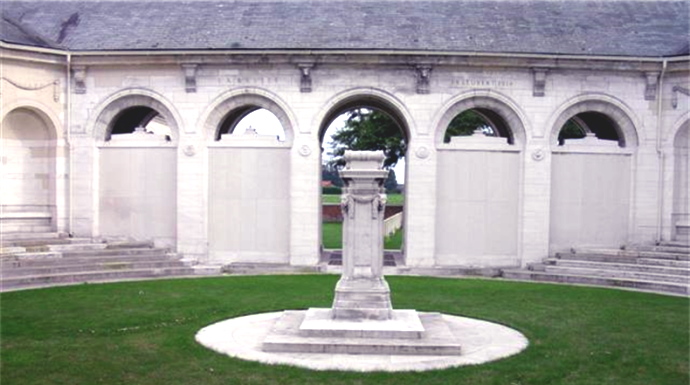
Le Touret Memorial, Pas de Calais, France
Private Charles Edward Wedge was entitled to the 1914 (Mons) Star, the British War Medal and the Victory Medal. His body was never found, and he is commemorated on the Le Touret Memorial, Pas de Calais, France, (Panel 33 and 34). He is also mentioned on the memorials at St Matthew’s and St Paul’s churches, Winchester.