

Lance-Corporal DONALD HENRY CHARLES WARD
51, Cheesehill Street, Winchester. (Family later moved to 63, Hatherley Road)
Service number 291033, 9th (Service) Battalion, The Devonshire Regiment
Killed in action, Belgium, 10 October 1917
Life Summary
Donald Henry Charles Ward was born in Winchester in 1898, the son of Charles and Caroline Ward. He was one of four children. Despite his humble background, Donald’s father built a prosperous grocery business in Cheesehill (now Chesil) Street. This enabled the family to move to Hatherley Road at the end of the Great War. Donald enlisted in the Army in 1916 and served on the Western Front with the Devonshire Regiment. He was killed at the Battle of Passchendaele the following year.
Family Background
Charles Ward, Donald’s father, was born in Winchester on 24 March 1870. According to the 1871 Census, his own father, Jesse, was working as a servant but living at 12, Cheesehill Street (No.17 today), which is where Charles is thought to have been born. Jesse Ward had been born in Sparsholt, near Winchester, in around 1842. His wife, Emma, was from Chilcomb where she had been born in 1844. Emma is believed to have died in Winchester in 1874, aged 31.
By 1881, 11-year-old Charles Ward was living with his father – by then working as a general labourer - and older brother at 81, Cheesehill Street (No. 44 today). This was the home of Charles’s 76-year-old widowed maternal grandmother, Elizabeth Burns. They shared the small house with three of Elizabeth’s unmarried children so conditions must have been very cramped. Ten years later Charles Ward, with his father and brother, had moved again and were living at 21, St John’s Road, Winchester, which was then a new development. Jesse Ward was still a labourer, as was his elder son, while Charles was working as a grocer’s assistant.
In 1895 Charles married Caroline Kirby, the daughter of agricultural labourer Henry Kirby and his wife Elizabeth. The Kirby family lived in the rural hamlet of Up Somborne, near Winchester. Caroline had been born on 5 January 1871 and was the youngest of three children. Before marrying Charles, she had worked as a housemaid in the Vicarage, Ropley Dean, near Alresford, Hampshire.
Charles and Caroline are thought to have married at Up Somborne Church after which they went to live in Winchester in St John’s Road, first at No. 28 and then at No. 43. On 4 May 1896 Caroline gave birth to a daughter, Lillian, followed two years later by Donald who was probably born at 43, St John’s Road.
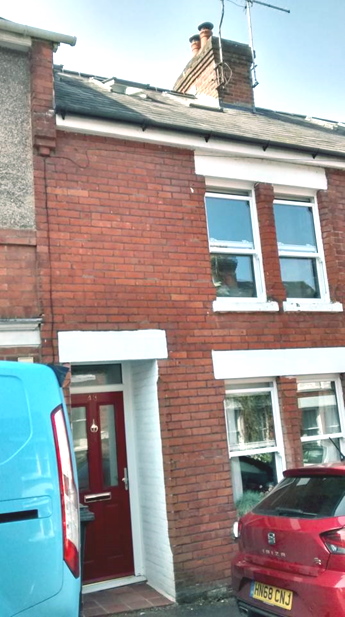
43, St John’s Road, Winchester - the house in which Donald Ward
is thought to have been born in early 1898
By 1900 the family had moved to 79, Cheesehill Street (50, Chesil Street today) and for the first time Charles Ward was listed as a grocer in Warren’s Winchester Directory. The house stands next door but one to the property where Charles spent part of his childhood with his father and his grandmother, Elizabeth Burns. It is a double-fronted property and traces of a shop window can still be seen. Until recently it was home to the East Winchester Social Club.
The Wards were still at 79, Cheesehill Street when the 1901 Census was compiled. Donald, like his father, would probably have gone to St Peter’s Cheesehill School. (The school building, St Peter’s Hall, is a private home today.) The 1901 Census also recorded Donald’s grandfather Jesse, 59, working as a farm labourer. He was living in Martyr Worthy, near Winchester, with his father, 90-year-old Charles who, remarkably, was also still working – as a labourer in a park.
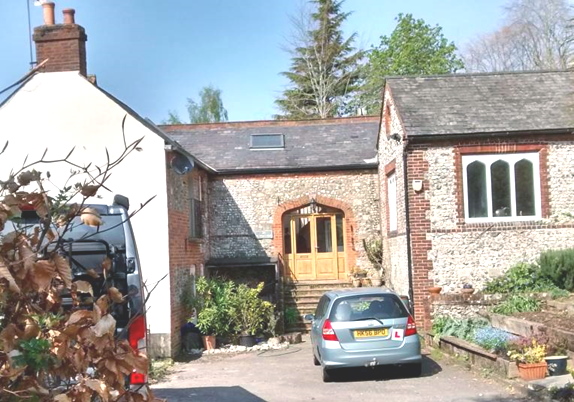
St Peter’s Hall, Winchester - a private home today. Earlier the building was
St Peter’s Cheesehill School which Donald Ward
probably attended as a young boy
On 13 May 1902 Caroline Ward gave birth to a second son, Hector Cecil – probably at 79, Cheesehill Street. A second daughter, Millicent Kitty, was born on 17 February 1909, by which time the Ward grocery business and family home had moved further down Cheesehill Street to No. 51. The row of houses and businesses of which the property formed part, backed on to the Didcot and Newbury Railway loading bay for Winchester Chesil statin, so the area would have been busy with commercial activity. The buildings were demolished by the 1950s and the area was later used as a car park for many years before becoming the site of the Chesil Lodge retirement complex.
The Wards were at 51, Cheesehill Street for the 1911 Census, by which time Charles was both a grocer and sub-postmaster, with Caroline assisting in the business. Donald, aged 13, was at school – probably All Saints Elementary which he would have attended from the age of seven.
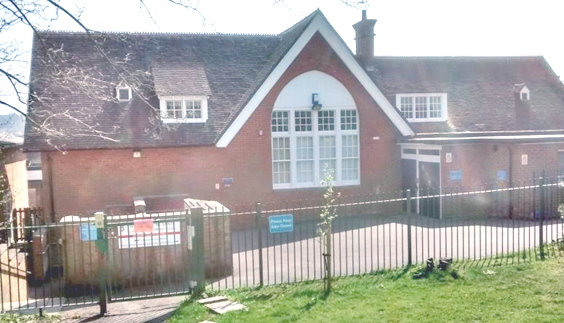
All Saints Primary School in St Catherine’s Road - Donald is thought to
have been a pupil there from 1905 to 1912 when it was known as
All Saints Elementary School
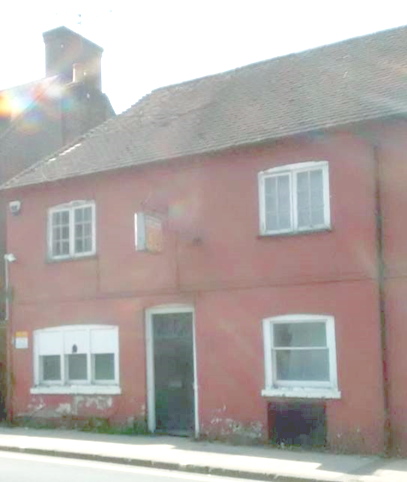
50, Chesil Street, Winchester - this was 79, Cheesehill Street
when the Wards moved here. Donald’s father ran his
grocery business from the property
Great War Record
Donald Ward was too young to volunteer for military service when war broke out in 1914. According to the Winchester War Service Register (WWSR) he joined up in September 1916, when he was 18, enlisting in Winchester with the 7th (Cyclist) Battalion, The Devonshire Regiment. Whether Donald volunteered or was conscripted is unclear. It is likely that he had helped his father with the family business by delivering groceries by bicycle so was a natural candidate for a cyclist battalion.
The 7th Devons were a Territorial unit and comprised two battalions – the 1/7th and the 2/7th. The latter had been formed in 1914 when the original battalion filled up during the ‘rush to the colours’. Neither battalion saw action overseas, but instead spent the war at various locations in England, including Kent, Suffolk, and Sussex. However, both supplied drafts for other fighting battalions in the regiment and at some stage Donald was transferred to the 9th (Service) Battalion, The Devonshire Regiment.
The precise date that Donald joined the 9th Devons is not known. However, given that he would have spent three months doing his basic training it was probably not until the late winter or early spring of 1917. Between then and his death in October 1917, Donald proved himself sufficiently on the battlefield to earn promotion to Lance-Corporal. Like his father, he appears to have been an enterprising young man.
The 9th Devons fought with 20th Brigade in 7th Division which has been described as ‘one of the greatest fighting formations Britain ever put into the field’. Formed at Exeter in September 1914, the battalion was part of Lord Kitchener’s Second New Army and carried out its initial training at Aldershot, Bisley and Haslemere before being sent to the Western Front in July 1915. The 9th Devons fought throughout the war with their sister service battalion the 8th Devons and saw action in 1915 at the Battle of Loos and in several operations during the Somme Offensive in 1916, the year that Donald Ward enlisted.
During January and February 1917, the 9th Devons were involved in continued fighting on the Somme. In that time the battalion received more than 200 reinforcements, including men from other Devon battalions. It is just possible that Donald was among them. Significantly, the 8th Devons also received large numbers of drafts in the same period, including men from the regiment’s cyclist battalion.
In March and April, the 9th Devons took part in the pursuit of the German army as it withdrew to new fortified positions on the Hindenburg Line. This period culminated in the battalion helping to capture the village of Ecoust on 2 April, a considerable feat of arms involving fierce house-to-house fighting. It cost the 9th Devons 100 men killed and wounded, numbers that were partly made up by reinforcements later in the month. Again, Donald Ward may have been one of the drafts.
Donald was almost certainly serving with the 9th Devons by the time they returned to action between 7 and 10 May at the Second Battle of Bullecourt, during the latter stages of the Arras Offensive (9 April-16 May). The Arras campaign had begun promisingly with the Canadians capturing Vimy Ridge on the opening day while the British made significant gains astride the River Scarpe. However, as German resistance stiffened it swiftly descended into a bloody, attritional confrontation reminiscent of the Somme, although 7th Division, with the 8th and 9th Devons both prominent, did gain a foothold in the ruins of Bullecourt on 7 May and subsequently linked up with previously cut-off Australian troops.
Bullecourt cost the 9th Devons 130 more casualties and when the Arras campaign finally ended, they were withdrawn from the line to enjoy a spell of comparative quiet, resting, training and providing work parties.
As the British Army absorbed the lessons of the Somme and Arras so its infantry tactics began to develop, and this was apparent in the training carried out by the 9th Devons in the early summer of 1917. The battalion war diary records how troops practised attacking in platoons (typically around 50 men) organised into four sections of specialist fighters – riflemen, Lewis gunners, bombers (who threw hand grenades) and rifle grenadiers. Each section was led by a Corporal, aided by a Lance-Corporal (Donald Ward’s rank).
From mid-June to mid-August 7th Division found itself back in the front line, holding Bullecourt and trenches to the north-west of the village. By then, however, Bullecourt was a relatively quiet zone and patrols sent out by the 9th Devons rarely met opposition. One feature of the period was the increasing use made by the Germans of concrete machine-gun posts, known as pill boxes. These would become all too familiar obstacles to the Devons, and the rest of the British Army, at the Third Battle of Ypres (or Passchendaele) later in the year.
In mid-August – with the Third Ypres campaign already underway - 7th Division was taken out of the line at Bullecourt and moved north for training near Bailleul, close to the Belgian border. On 29 August the 9th Devons moved to Proven, west of Ypres, and from there to Steenvorde. However, the battalion’s entry into fighting east of Ypres did not take place just yet. Heavy rain was holding up the progress of the offensive and throughout September the troops continued to train behind the lines at St-Martin-au-Laert. On 29 September the 9th Devons moved by train to Abeele from where they marched to camp at Dickebusch, close to the fighting zone.
By the time the Devons entered the front line on the night of 30 September/1 October, the British Second Army, under General Sir Herbert Plumer, had achieved success at the battles of the Menin Road Ridge (20-25 September) and Polygon Wood (26 September). The latter, by capturing a significant section of the Germans’ fourth defensive position, threatened their hold on Broodseinde Ridge. Over the following week the Germans launched at least 24 attacks and counter-attacks aimed at recovering the lost ground. Among the British units standing in their way were the 9th Devons who had taken over positions around Jetty Wood, on the eastern fringes of Polygon Wood. The battalion came under ferocious German artillery bombardment and was then attacked by enemy infantry, but it tenaciously clung on to its positions.
On 4 October, despite the resumption of heavy rain, Plumer sent his troops into action at the Battle of Broodseinde. The objective was to complete the British hold on the strategically important Gheluvelt Plateau by seizing Broodseinde Ridge and the Gravenstafel Spur. This would open a route to Passchendaele Ridge, the capture of which would put the British in control of much of the high ground in the Ypres Salient.
The 9th Devons were not directly involved in the Broodseinde fighting, but they were kept busy through the day, carrying supplies and bringing back the wounded. Once again, the British seized all their objectives, with 7th Division helping to secure a line between Noordenhoek and In Der Ster Cabaret (see map below).
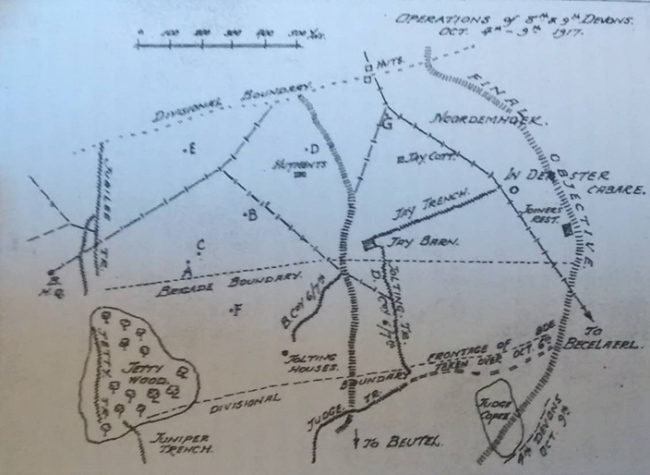
Map showing the area of operations of the 8th and 9th Devons between 4 and 9
October 1917. Noordenhoek and In Der Ster Cabaret, both captured during the
Battle of Broodseinde on 4 October, are on the right (Final Objective). Jolting
Trench, where the 9th Devons were heavily bombarded on 10 October
– the day Donald Ward was killed – is shown below Jay Barn, in the centre of the map
Broodseinde was the last successful ‘bite and hold’ attack of the Passchendaele campaign and caused senior German commanders to consider withdrawing from the salient. They were only saved by the weather which turned the battlefield into a quagmire once more and prevented the British from bringing up enough of their heavy guns quickly enough.
On 6 October, the Devons’ HQ dug-out at Hooge Crater was severely shelled and the CO so badly shaken that he had to be relieved of command. That evening orders arrived for the battalion to move up to Polygon Wood where for the next two days it came under heavy bombardment. The casualty list rose steadily but, despite its sister battalion the 8th Devons being relieved on 8 October, the 9th Devons remained in the line in support of 22nd Brigade.
The following day, with the rain still falling, Plumer – under pressure from his Commander-in-Chief Sir Douglas Haig - reluctantly ordered the start of the Battle of Poelcapelle which was intended to bring the British and Australians to within striking distance of Passchendaele. Just to the south, away from the main offensive, the 22nd Brigade also launched a series of attacks. That evening the 9th Devons took over Jolting Trench (see map on previous page) where, throughout the following day, they again came under heavy artillery bombardment. The waterlogged ground made digging to improve the trench impossible and the battalion, hopelessly pinned down, had to find what shelter they could amid the exploding shells. When they were finally relieved that evening, the 9th Devons had lost 270 officers and men killed, wounded and missing in six days of fighting. Among the dead was 19-year-old Lance-Corporal Donald Ward. His body was never found.
The WWSR gives Donald’s date of death as 7 October. However, all the other available military records state that he was killed on the 10th which is the date used in this biography. The WWSR also states that Donald was killed at Hooge. Strictly speaking this is incorrect - Hooge lies some three miles to the south-west of the spot where Donald actually died – but the village had been the scene of bloody fighting earlier in the war and was therefore a familiar name to many in England.
Family after the Great War
After the war Charles Ward continued to run his grocery shop from 51, Cheesehill Street which, by 1921, had been renamed Chesil Street. The property was renumbered 48 in the same year before becoming No.41 by 1930. However, while Chesil Street was the base for the Wards’ business interests, it was no longer the family home. Electoral records show that by the spring of 1919 Charles, Caroline and their surviving children were living at 63, Hatherley Road, Winchester, where they would remain until 1927 at least.
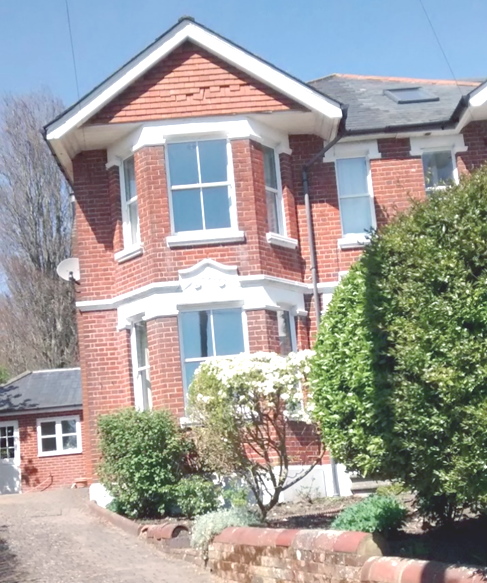
63, Hatherley Road, Winchester – Donald Ward’s family
had moved here by the spring of 1919, some 18 months after his death
Charles was also registered at 51, Chesil Street but next to his entry are printed the words ‘Abode – 63, Hatherley Road, Winchester’. The move to Hatherley Road is evidence that Charles Ward’s business had thrived during the war years. The store may have furnished the mobilisation camps on nearby Morn Hill with supplies and it would certainly have been patronised by soldiers making their way down into Winchester along the Alresford Road.
The Ward family probably worshipped at either St Paul’s or St Matthew’s following their move to Hatherley Road and they would have been responsible for Donald’s name appearing on St. Paul’s war memorial. Why they gave Donald’s address in the WWSR as 51, Cheesehill Street rather than their new home is unclear – perhaps it was because of their son’s long-standing association with the eastern end of the city. This biography also uses 51, Cheesehill Street as Donald’s address as it was from there that he went off to war in 1916.
Charles and Caroline Ward have not yet been found on the Electoral Register after 1927, although they do continue to figure in the local directories, with Charles listed in the 1928 Warren’s Directory as the householder of 63, Hatherley Road. In 1930 he was still a grocer and sub-postmaster at 41, Chesil Street, but that year’s Kelly’s Directory also lists him for 3, Chesil Street (No. 2 today), a large house that still stands alongside Station Approach, the former access to Winchester Chesil Station. The same directory also contains the first mention of Hector Ward being a cycle director at No. 3. Hector, like his older brother, was clearly a keen cyclist. It also appears that around this time the Ward family moved from Hatherley Road to live at 3, Chesil Street, with Hector running his cycle business, the Chesil Cycle Depot, from the premises.
Charles Ward sold his grocery business as a going concern towards the end of the 1930s and by 1939 he and Caroline had moved to 3, Stoney Lane, Weeke. (The property stood at the Andover Road end on the south side.) Charles was still living there when he died on 4 May 1946, aged, 76. Caroline, who by this time had been incapacitated for several years, died in Winchester on 18 September 1947. She was also 76.
Lillian Ward, Donald’s older sister, is not believed to have married. In the 1939 Register she was recorded living at 3, Stoney Lane where she was carrying out unpaid domestic duties – probably caring for her parents. Lillian is thought to have died in Bournemouth in 1992 at the age of 95.
Hector Ward was also living with his parents in 1939 and continued to run the Chesil Cycle Depot in Chesil Street. After his mother’s death he became the named householder for 3, Stoney Lane and remained there until 1961 when he moved to ‘Plaisance’, a house on Petersfield Road in east Winchester. He sold the cycle business in 1966 and left Winchester in around 1972. Hector, who is also believed to have remained single, died on 23 July 1980, aged 78. He had been living in Falmouth, Cornwall.
Donald’s younger sister Millicent married Horace Lucas in Winchester in 1933 and the couple had two children. The 1939 Register recorded Millicent living at 3, Stoney Lane where, presumably, she helped her sister Lillian look after her parents. Interestingly, there is no mention in the Register of Horace Lucas living at Stoney Lane. Millicent died in Weston Super Mare, Somerset, in 1987 at the age of 78. Horace passed away in Bristol in 2008, aged 101.
Medals and Memorials for Donald Henry Charles Ward
Lance-Corporal Donald Henry Charles Ward was entitled to the British War Medal and the Victory Medal. He is commemorated on the Tyne Cot Memorial to the Missing, Zonnebeke, West Flanders, Belgium (Panel 38-40). Donald is mentioned on the memorials at St Matthew’s and St Paul’s, Winchester (where his initials appear incorrectly as DCH) and also on those at All Saints Church and St Peter Chesil, Winchester.
Additional sources
- Atkinson, C.T. The Devonshire Regiment 1914-1918, Vols I and II. (Exeter, 1926. Reprinted by The Naval and Military Press).