

Acting Sergeant FREDERICK WILLIAM WAKE
64, Fairfield Road, Winchester
Service number 307105. 2/7th Battalion, The Hampshire Regiment
Died, Mesopotamia, 19 August 1919
Life Summary
Frederick William Wake was born in July 1885 in Medstead, near Alton, the youngest of four sons of Henry and Anne Wake. Frederick served in Mesopotamia (modern Iraq) and survived the Great War, only to die there in mysterious circumstances nine months later.
Family Background
Frederick came from a prosperous background. His father, the son of Richard and Jane Wake, was born in Medstead in around 1818 and he went on to become a local farmer and landowner. William’s mother Anne was Henry’s second wife. His first, Harriett, had been ten years older while Anne was 23 years younger.
Henry appears not to have had any children with Harriett who died sometime between 1861 and 1871. In 1872 Henry married Anne (née Hewett), then a 31-year-old ladies’ maid, in London. Anne had been born in Odiham, near Basingstoke and was the daughter of Thomas Hewett, a ‘beer retailer’ (possibly a publican), and his wife, Mary.
By 1881 Henry and Anne were living at Trinity House, Medstead, with their two elder sons, Henry Jnr, who was born in 1879, and George who arrived two years later. A third son, John, was born in 1883 and then Frederick in 1885. Nothing is known about where Frederick and his brothers were educated.
The family were still living at Trinity House in 1891, the year that Henry Wake died. Probate records show that Henry – who is described as a ‘gentleman’ in the records - left effects worth £2,3855 11s to his wife. This was a considerable sum for the time and may not have included any land or property that he owned.
By 1901 Anne Wake and her sons had moved to Towngate Farm, Medstead. Ten years later Henry Jnr had married, and he and his brother George were running Towngate Farm. George would go on to marry Marjorie Mallinson in 1916. Meanwhile, Frederick and brother John were working as clerks for Hampshire County Council, presumably in Winchester. When John married Florence Smith in 1914 the couple moved to the city, possibly with Frederick. By 1915 they were living at 64, Fairfield Road which is the address given for Frederick in the Winchester War Service Register.
Great War Record
In 1916 Frederick enlisted with the Hampshire Regiment. It is unclear whether he had volunteered for military service - perhaps under the Derby Scheme at the end of 1915 - or was one of the first men to be conscripted. He was assigned to the 2/7th Battalion which had been raised in Bournemouth in the opening weeks of the war before being sent to Secunderabad, in central southern India, early in 1915.
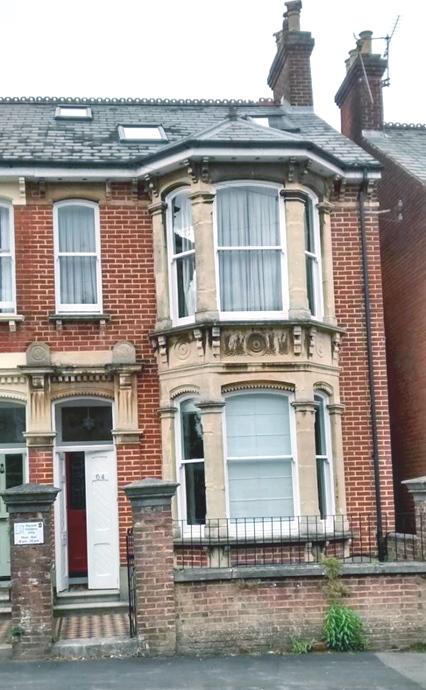
64, Fairfield Road, Winchester – Frederick Wake’s
address in the Winchester War Service Register
It is possible that Frederick completed some basic training in England before being sent out to Jabalpur in central India – to where the 2/7th Battalion had moved in March 1916 - but it is more likely that he was sent directly to the sub-continent on joining up. In that case he was in India for about a year before transferring to Mesopotamia with his battalion in the autumn of 1917. The 2/7th Hampshires had originally been expected to move to Egypt, but their destination was postponed and then changed. On 5 September 1917, a total of 23 officers and 859 other ranks, including Frederick Wake, boarded a troop ship at Bombay for the six-day voyage to Basra. From there the battalion was sent on by river and then train to the town of Azizieh.
Even for soldiers used to the heat and privations of India, Azizieh proved a miserable posting. The town stood amid flat countryside covered with liquorice scrub and disease was rife. Within weeks, the battalion’s Commanding Officer had died of heart failure and 144 men were sick in hospital. Nevertheless, the battalion was kept busy training and providing work parties as well as troops for an Azizieh Mobile Column.
However, the 2/7th Hampshires saw little in the way of fighting. In January 1918 they moved to the town of Amara and remained there until the autumn. Few incidents occurred and the men busied themselves mainly with training and working on the town’s defences. At the end of September, the battalion moved once more to the Jabal Hamrin mountain range (in the north-east of modern Iraq) where it was employed on road building until the end of the war a few weeks later.
Mystery surrounds both Frederick Wake’s death and his rank when he died. The official records variously list him as Sergeant, Acting Sergeant and Acting Corporal. This biography has opted to follow the Winchester War Service Register’s designation of Acting Sergeant. The fact that he reached the rank in such a comparatively short time indicates that Frederick excelled as a soldier.
As for the date and place of his death, this is generally agreed to have been at Basra on 19 August 1919. The 2/7th Hampshires, however, had been demobilised and returned to England in February, some six months earlier. One possible explanation is that Frederick was sick at the time of the battalion’s demobilisation and remained in hospital in Basra until his death. Interestingly, Frederick is listed on the 1919 Electoral Register, which was obviously compiled before he died. His address is given as Towngate Farm, Medstead.
Family after the Great War
It is not known whether any of the other Wake brothers served in the Great War. As farmers, Henry and George may have been exempted from military service. John almost certainly would not, but no trace can be found of a military record. John remained in Winchester after the war and by 1930 was living at 27, Cranworth Road. Nine years later, and by then an education officer for Hampshire County Council, he and his wife Florence had moved to 2, Bereweeke Close. John died in Bournemouth in 1957, aged 74. Frederick’s other brothers both died in Medstead, Henry in 1966, aged 87, and George in 1945 at the age of 64. Anne Wake, Frederick Wake’s mother, died at Medstead in 1926, aged 75.
Medals and Memorials for Frederick William Wake
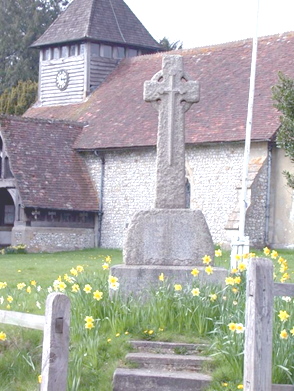
Memorial at St Andrew’s Church, Medstead
Acting Sergeant Fredrick William Wake was entitled to the British War Medal and the Victory Medal. He is buried at Basra War Cemetery, Iraq, (GR. II. E. 11) and is mentioned on the memorials at St Matthew’s and St Paul’s churches, Winchester. His name also appears on the memorial at St Andrew’s Church, Medstead (right), and on the commemorative plaque to Hampshire County Council employees who gave their lives in the Great War. This is situated on the wall just inside the main door to the authority’s Castle Hill HQ in Winchester.