

Lieutenant JOHN BEAUCLERK VANDELEUR
1, Romsey Road, Winchester
3rd Battalion, The Leicestershire Regiment
(Attached 3rd Battalion, The Worcestershire Regiment)
Killed in action, Belgium, 7 November 1914
Life Summary
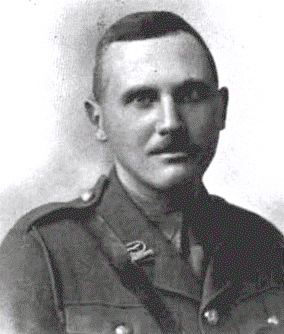
John Beauclerk Vandeleur
John Beauclerk Vandeleur was born into a family with a strong military tradition on his father’s side and aristocratic roots on his mother’s. Originally from Holland, the Vandeleurs settled in Kilrush, County Clare, in the 17th Century and became the principal landowners there. One of John’s ancestors, Major-General Sir John Ormsby Vandeleur (1763-1849), fought with Wellington at Waterloo and his father served with the Winchester-based Rifle Brigade and the Hampshire Regiment. John also joined the Army and was among the first Winchester men to see action – and die - in the Great War.
Family Background
John Beauclerk Vandeleur was born in Winchester in 1887, the only son of Colonel John Ormsby Vandeleur and his wife Frederica. Despite his Irish roots, the Colonel had been born in Dorchester, Dorset, in 1840. His own father, also called John, was a Lieutenant-Colonel in the 10th Hussars.
No trace can be found of Lieutenant-Colonel Vandeleur, his wife Alice or baby John Ormsby in the 1841 Census and it may be that they had been posted overseas or were living in Ireland. The couple are also missing from the 1851 Census, but John Ormsby was recorded as a pupil at a school in Worksop, Staffordshire.
Presumably, this was a prep school he attended prior to moving on to public school. John Ormsby eventually joined the Army and was commissioned into the Rifle Brigade as an Ensign (the Army rank that became 2nd Lieutenant from 1871) on 4 June 1858, the same year that Winchester became the regiment’s HQ. The 1861 Census recorded John Ormsby Vandeleur living at the Rifle Brigade Barracks in Winchester and on 15 November the same year he was promoted to Lieutenant.
In 1870 John Ormsby married Frederica Jane Beauclerk in Christchurch (then in Hampshire). Frederica could trace her ancestry back to Charles II and Nell Gwyn - the couple had a child who later became the 1st Duke of St Albans. Frederica had been born in late 1850, probably at Winchfield House, Winchfield, Hampshire, as this was her address in the 1851 Census compiled just three months later. She was the daughter of Charles Beauclerk who, in 1850, had inherited Winchfield House and the surrounding estate from his father, the Reverend Lord Frederick Beauclerk, a younger son of the 5th Duke of St Albans. Frederica’s mother was Penelope Hulke from nearby Yateley.
Charles Beauclerk died in 1867 and Frederica’s older brother, Frederick, inherited Winchfield House. (He was to sell the property in 1908 and it still stands today.) Charles’s widow, Penelope, then went to live in Christchurch with her other children which explains why Frederica’s marriage to John Ormsby Vandeleur took place there. At the time of the 1871 Census, John Ormsby and Frederica Vandeleur were living at 6, Wellington Terrace, Cheriton, Hythe, in Kent. The following year the couple had their first child, a daughter called Alice Caroline, born in Gravesend. On 3 July 1872, John Ormsby was promoted to Captain, but just four months later, on 13 November, he retired from the Army. Why he did so is not known but it was not to be the end of his connection with the military.
By the second half of the 1870s, the Vandeleurs were living in South Stoneham, now part of Southampton. In 1876 or 1877 Frederica gave birth to a second daughter, Marie, and then a third, Evelyn, in 1878 or 1879. On 5 January 1878 John Ormsby returned to the Army when he was appointed to the 4th Administrative Battalion of the Hampshire Rifle Volunteers with the rank of Major.
The Hampshire Rifle Volunteers had been established in response to the fears of a French invasion in 1859-60 during the reign of Napoleon III. A total of 22 infantry corps and six artillery corps were formed in the county along with a further six infantry corps on the Isle of Wight. These were grouped into four Administrative Battalions with the 4th – John Ormsby’s unit – based in Southampton. Some 20 years later, around the time John Ormsby was appointed, these loosely knit administrative battalions of independent local corps were reorganised as battalions of the Hampshire Rifle Volunteers, and in 1885 as Volunteer Battalions of The Hampshire Regiment. Thus, John Ormsby’s unit became the 4th Volunteer Battalion, The Hampshire Regiment which in 1908 became part of the Army’s Territorial Force.
Men of the Volunteer Battalions were part-time soldiers. As such, John Ormsby would not have received pay, other than for expenses, although given his and Frederica’s background it is unlikely that they were hard up. John Ormsby’s second Army career progressed steadily – in February 1880 he was promoted to Lieutenant-Colonel and then in April 1886 he was given the rank of Honorary Colonel.
John Ormsby and Frederica Vandeleur and their youngest two children, Marie and Evelyn, have not yet been found in the 1881 Census. However, their eldest daughter, Alice, was living with her grandmother, Penelope Beauclerk, in Hastings, East Sussex. Alice was to leave home permanently in 1896 when she married gentleman farmer Thomas Wodehouse in Knightsbridge, London, after which the couple went to live in Somerset.
By 1887 the Vandeleurs had moved to Winchester and were living at Hyde Abbey House, 23, Hyde Street. The move was almost certainly connected to John Ormsby’s duties with the Hampshire Volunteers who by then had been absorbed into the Winchester-based Hampshire Regiment. John Beauclerk Vandeleur was born at Hyde Abbey House on 12 March 1887. Two years later, on 20 May 1889, Frederica gave birth to a fourth daughter, Janetta, in Winchester. In 1897, John Ormsby Vandeleur was made a Companion of the Bath (CB) in Queen Victoria’s Diamond Jubilee Honours. He and Frederica also became grandparents the same year when Alice and Thomas Wodehouse had a daughter, Elinor, who was also known as Elison.
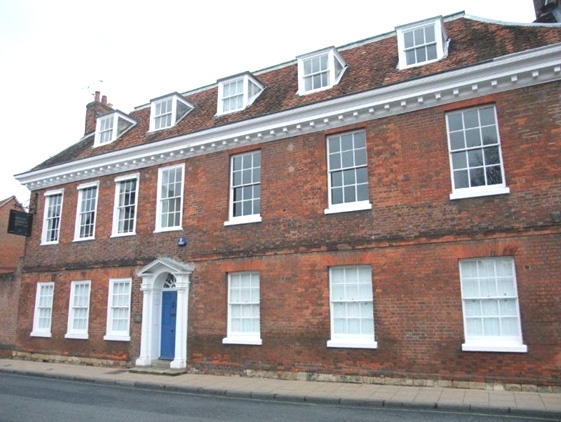
One of the Vandeleurs’ Winchester homes: Hyde Abbey House
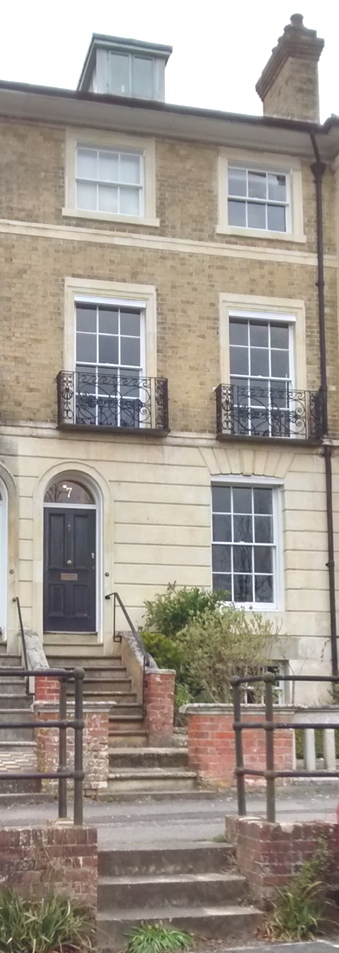
One of the Vandeleurs’ Winchester homes: 7 Clifton Terrace
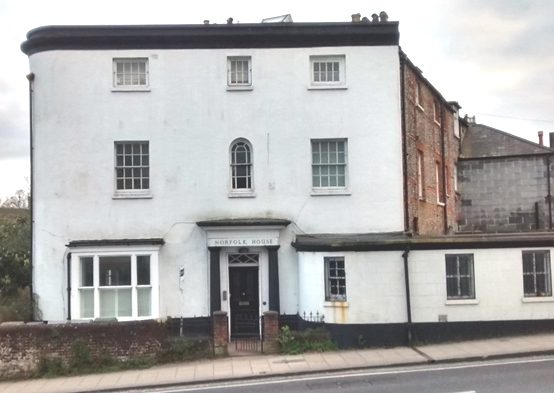
One of the Vandeleurs’ Winchester homes: 1 Romsey Road
On 9 June 1900 Colonel John Ormsby Vandeleur died at the Hampshire County Hospital, Winchester, aged 60. The cause of his death is unknown. Less than a year later, according to the 1901 Census, Frederica and her four younger children – including 14-year-old John Beauclerk – had moved from Hyde Abbey House to a new home at 7, Clifton Terrace, Winchester.
John Beauclerk Vandeleur was educated at Winton House Preparatory School, Andover Road, Winchester, under the direction of headmaster Dr E.F. Johns. There is also evidence that in 1901 he was tutored privately, along with two other boys, also possibly from military families, at Rosslyn, Hyde Park Road (now 8, Park Road, but still named Rosslyn House). In September 1901 John Beauclerk started at Wellington College where he joined Lynedoch House. He studied there for four years and was almost certainly a member of the College’s Officer Training Corps.
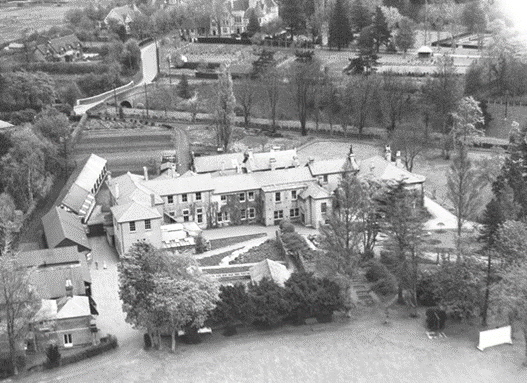
Winton House Preparatory School, Andover Road, Winchester,
where John Beauclerk Vandeleur received his early education. The building has been demolished and Winton Close is on its site. (Photo: Britain from Above)
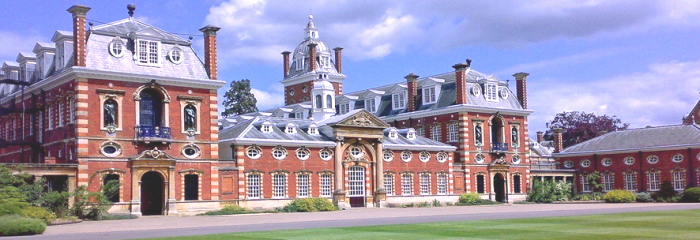
Wellington College, Berkshire, where John Beauclerk Vandeleur was a pupil between 1901 and 1904
Early Military Career
From Wellington, John Beauclerk moved on to Sandhurst for officer training, but thereafter his early Army career becomes difficult to trace. In August 1905 he appears to have joined the 4th Battalion, The Oxford Light Infantry (OLI) which, in 1908, was transferred to the Army’s Special Reserve and redesignated the 3rd Battalion. It seems therefore that John Beauclerk, like his father during his time with the Hampshire Volunteers, was a part-time soldier which may have allowed him to continue living in Winchester, at least for some of the time.
It is known that John Beauclerk became involved in the fledgling Boy Scout movement there, working with Lieutenant Bramwell Withers of the Hampshire Regiment. In 1907 Lieutenant-General Robert Baden Powell had organised a Boy Scout Camp at Brownsea Island, Dorset, and shortly afterwards Withers formed Britain’s first Boy Scout troop - known as ‘Withers’ Own’ – in the city. Other than a suggestion that John Beauclerk may have been involved with the fraternal organisation the Royal Antediluvian Order of Buffaloes, nothing more is known of his social interests.
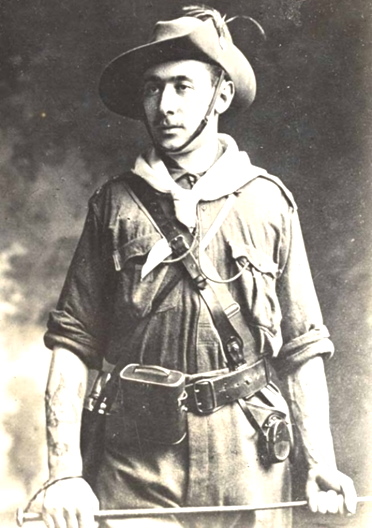
Lieutenant Bramwell Withers, of the Hampshire Regiment,
who set up Britain’s first Boy Scout troop in Winchester.
John Beauclerk Vandeleur helped him in his pioneering work
In April 1910 John Beauclerk joined the 2nd Battalion, The Durham Light Infantry as a 2nd Lieutenant, his first taste of life in the Regular Army. It appears to have been an experience he did not enjoy because in 1912, after two years with the battalion based in Colchester, he left.
Life was changing, too, for John Beauclerk’s mother Frederica. The 1911 Census reveals that she and her daughters Marie, Evelyn and Janetta, had moved the short distance from Clifton Terrace to 1, Romsey Road (just down from the St James Tavern). With ten rooms, the Vandeleurs’ new home was another large property, and the family employed a live-in servant. Alice, the eldest daughter, is believed to have moved to the United States some years earlier with her husband Thomas and daughter Elinor.
In October 1913, John Beauclerk Vandeleur was gazetted into the 3rd (Reserve) Battalion, The Leicestershire Regiment with the rank of Lieutenant. He was still with the battalion when Britain went to war in August 1914, but shortly afterwards he was attached to the 3rd Battalion, The Worcestershire Regiment and sent to the Western Front on active service.
Great War Record
The exact date that John joined the 3rd Worcesters is unknown – he was definitely not with the battalion when it landed in France on 16 August. Possibly it was after the Battle of Le Cateau (26 August) - during which the Worcesters, fighting as part of 7th Brigade in 3rd Division, suffered several officer casualties when a German shell hit the battalion HQ – or following the Battle of the Aisne (13-28 September). As the Allied and German armies then tried to outflank each other in a series of manoeuvres that became known as the ‘Race to the Sea’, the Worcesters were sent north to the Lys Valley where they fought at the Battle of La Bassée (10 October-2 November), losing a further 300 men killed or wounded, including 18 officers. Given that several sources state that John served in Flanders AND France, and that the Worcesters’ next fought in Flanders, it is likely that he had linked up with the battalion by La Bassée at the latest.
On 1 November 1914 the 3rd Worcesters were detached from 7th Brigade and reassigned to 4th Division. The 4th Division had earlier captured the town of Armentieres and Ploegsteert Wood (nicknamed Plugstreet by the British), just across the Belgian border, which it was having difficulty holding. At dusk on 2 November, the Worcesters moved forward to the front line just beyond the eastern edge of Ploegsteert Wood.
What followed for John Beauclerk and the men of the 3rd Worcesters is described, with typical military understatement, as four days of ‘great discomfort’ by Captain H. Sacke in his regimental history of the Great War. In fact, what the Worcesters endured was truly horrific. Cramped into shallow, waterlogged trenches, they were overlooked by the Messines Ridge from where German observers directed murderous artillery fire down on them. Matters eventually came to a head on 7 November, the events of which were vividly described by Captain Sacke:
In the darkness between 3 and 4am next morning (7 November) a very heavy shellfire was opened on the British line east of Ploegsteert Wood. For an hour shells crashed down on the Battalion’s line. Then about 5am masses of German infantry came plunging through the fog. Such of the front-line defenders as had survived the bombardment manned their smashed parapets and fired swiftly into the advancing hordes; and on the left of the Battalion line the attack was stopped and held. But the centre and left of the Battalion’s trenches had been practically obliterated by the bombardment, and there the German attack flooded over the defences of [the battalion’s] ‘C’ Company. Most of the defenders were killed, but a few men managed to fight their way out in the fog and were able to get back to the wood behind in time to warn the reserve companies and Battalion Headquarters. A counter-attack was organised at once to retake the lost trenches. The counter-attack met the enemy inside the edge of the wood and a confused and desperate struggle ensued.
Reinforcements were brought up … but the lost trenches could not be regained. All through the night of November 7th/8th the remnants of the 3rd Worcestershire hung on to their position, and not until evening of the 8th was the Battalion finally relieved. The losses had been very heavy – over two hundred in all, including six officers [four killed and two wounded].
Sacke records that Lieutenant John Beauclerk Vandeleur, aged 27, was one of the officers killed in Ploegsteert Wood. His body was never found. News of John Beauclerk’s death quickly reached Winchester where the Hampshire Chronicle reported:
To the list of honoured dead more directly associated with Winchester has to be added the name of Lieut. John Beauclerk Vandeleur, of the 3rd Leicestershire Regiment, killed in action about November 10th [sic]. Mr J.B. Vandeleur, whose age was 27, was the only son of the late Col. J.O. Vandeleur CB of Ballinacourty, Castle Connell, Co. Limerick, and Mrs J.O. Vandeleur of 1, Romsey Road, Winchester. He was educated at Mr E.F. Johns’, Winton House, and Wellington College, Berks. He interested himself in 1910 with Mr Withers at the Hampshire Depot in raising the Winchester Boy Scouts. Mr J.B. Vandeleur joined the 1st Leicestershire Regiment from the Special Reserve Battalion of the Regiment. He was gazetted to the Durham Light Infantry in 1910 and served with the 2nd Battalion at Colchester, leaving it two years ago for service in the old Leicestershire Militia.
The mention in the Chronicle report of the 1st Leicestershire Regiment is interesting as no record has been found to date of John serving with that battalion. However, it is possible that the information is incorrect – the newspaper was dealing with dozens of similar reports for its editions at the time involving many different military units and mistakes were far from unknown.
Family after the Great War
In his will John left effects valued at £3,578 15s 5d (worth some £370,000 in 2020), with his sisters Marie and Evelyn acting as executors. In March 1916 Marie married Captain James Balfour in Colinton, near Edinburgh. Captain Balfour, who also came from a military background, served in the 1st Battalion, The Highland Light Infantry and saw action on the Western Front and then in Mesopotamia (modern Iraq). He was killed in action there on 11 January 1917 and was buried at Kut-al-Amara, scene of the infamous siege. He and Marie had been married for just ten months and are unlikely to have had children. No further trace has been found of Marie until her death, aged about 76, on 15 August 1953. Her address then was 19A, Ashley Place, Westminster, London, and she is not thought to have remarried.
John Beauclerk’s mother Frederica remained living at 1, Romsey Road until her death in 1926 at the age of 75. Her daughter Evelyn, who never married, was named as the householder for the property in the 1927 Kelly’s Directory, but there is no further mention of any Vandeleur living in Winchester after that date. Nor has any trace been found of Evelyn in inter-war electoral records. At some point she moved to Ireland to live at West View, Greystones, County Wicklow. She died there in 1958, aged 79.
No further information about Alice Wodehouse has yet been found. In 1933 her daughter Elinor sailed from Southampton to South Africa to be a missionary. By 1939 she had returned to England and was working as a social worker in Devon. Elinor died in Oxford in October 1977, aged nearly 80. She appears to have never married.
Janetta Vandeleur, John’s younger sister, married Winchester-born Algernon Drummond – of the Drummond Bank family - in Kensington, west London, in 1917. Algernon’s father, also called Algernon, had been a Captain in the Rifle Brigade before leaving to work for the family bank. (Algernon Snr continued to maintain a Winchester connection and in the 1915 Warren’s Directory was listed as the householder of Preston House, 26, Colebrook Street. After his death in 1932 his widow continued to live at the property with two of their daughters until at least 1939.)
Algernon Drummond Jnr also worked in banking, but during the Great War he served as a Chief Petty Officer in the Royal Navy Volunteer Reserve. The 1939 Register listed Janetta and Algernon Jnr living in Godstone, Surrey, with him working as a bank accountant and part-time volunteer ARP warden. The couple had four children and later moved to Milford on Sea, Hampshire. Janetta Drummond died at Birchy Hill Nursing Home, Sway, Hampshire, on 7 January 1958, aged 68.
Medals and Memorials for John Beauclerk Vandeleur
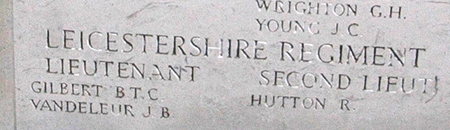
Ypres (Menin Gate) Memorial, Ypres (Ieper), West Flanders, Belgium
Lieutenant John Beauclerk Vandeleur was entitled to the 1914 Star, the Victory Medal and the British War Medal. He has no known grave but is commemorated on the Ypres (Menin Gate) Memorial, Ypres (Ieper), West Flanders, Belgium - see above. (CMWG has two panel references - Panel 33/Y and Panel XXXIV). In Winchester, John’s name is on the memorials at St Matthew’s and St Paul’s churches, Winchester. He also appears on two more Great War church memorials in the city – those at St Thomas’s, Southgate Street, and Holy Trinity, North Walls. The fact that he appears on four memorials perhaps reflects which churches members of the Vandeleur family attended. John is also named on Wellington College’s Roll of Honour.
Additional sources
- Sacke, Captain FitzM. H. The Worcestershire Regiment in the Great War, Vol I. (G.T. Cheshire & Sons Ltd, Kidderminster, 1928. Reprinted 2002 by Naval & Military Press)
- Boyle, Colonel Gerald Edmund. The Rifle Brigade Century: An Alphabetical List of the Officers of The Rifle Brigade, 1800-1905 (William Clowes & Sons Ltd, London, 1905). See pp.183-184. (On Forces War Records)
- British Army, Bond of Sacrifice: Officers Died in the Great War 1914-1916, pp. 415-6. (On findmypast.co.uk)