

Sergeant RICHARD JAMES THOMPSON, M.M.
41, Sussex Street, Winchester (no longer stands)
Service No. 54572. 117th Battery, Royal Field Artillery
Accidentally killed, France, 21 July 1916
Family Background
Richard James Thompson, the eldest child, of William and Mary Thompson, was born in 1891 in Barracktown, County Cork. Richard’s father had also been born in Cork, in 1831, and was some 27 years older than his wife and 60 years Richard’s senior. He had already retired and was living as an Army pensioner when his son was born. Richard’s mother was born Mary Mahoney in Glasson, County Westmeath, in 1858. She gave birth to a second son, Patrick, on 11 March 1892 in Cork and a daughter, Mary, in Barracktown, in 1894. It is likely that the family lived in the British Army barracks in Cork.
In the 1901 Census the Thompsons were recorded living at Rathbone Road, Cork, with the three children at school. Richard’s father, then aged 70, was listed in the census as the caretaker of the Baptist Chapel in Bing Street, Cork. He was the only member of the family unable to read and write.
Early Military Career
On 15 January 1909, 18-year-old Richard Thompson joined the Army at Fort Westmoreland, Cork. He was assigned to 116th Battery, Royal Field Artillery (RFA) as a gunner. His attestation form shows that he joined up for 12 years and was already serving as a Special Reservist (a part-time soldier similar to a Territorial) with the Royal Artillery in Cork.
On the attestation form Richard was described as 5ft 8in tall, with grey eyes, light brown hair and a fresh complexion. He weighed 8st 10lbs and his chest measured 33in. His physical development was said to be good. Richard had previously worked as a clerk and he gave his religion as Church of England. The records reveal that he later attended Army school, possibly the Royal Hibernian Military School in Dublin, and that he passed a class of instruction in cookery in May 1910 while based at Aldershot.
Richard’s father died in Cork in 1911. That year’s census showed that his mother Mary and brother Patrick – by then a railway engine cleaner – were the only members of the family still living at Rathbone Road. Richard’s sister Mary had left home and was living in Bishop’s Mill Lands, Bishopstown, Cork, with three sisters from the Bergin family. The sisters were running a private school where 17-year-old Mary was employed as a servant. In 1913 Richard’s mother died in Cork, aged 54. His brother Patrick continued to work with the railway company.
By this time Richard had moved with the Army to England where he was living at 41, Sussex Street, Winchester. Interestingly, the Warren’s Directories of 1912 and 1913 record the house being used by the Hampshire Carabiniers, a cavalry unit, possibly as a billet.
On 20 May 1914 Richard Thompson married Gwendoline Holt in Hartley Wintney, near Basingstoke. Gwendoline was the daughter of Alfred and Maria Holt and had been born on 23 January 1893 in Devonport where her father is believed to have been serving in the Army. By 1911 the family had moved to Farnborough where Alfred Holt worked as a steward at the local Conservative Club. After marrying, Richard and Gwendoline lived at 41, Sussex Street, Winchester. The house no longer stands.
Great War Record
When Britain went to war in August 1914, 23-year-old Richard Thompson had been a professional soldier for eight years. He was still serving with 117th Battery, RFA and had reached the rank of Bombardier, the artillery equivalent of Corporal.
During the war the RFA, the largest of the three branches of the Royal Artillery, provided close artillery support for the infantry and was responsible for the Army’s medium calibre guns and howitzers which were deployed close to the front line.
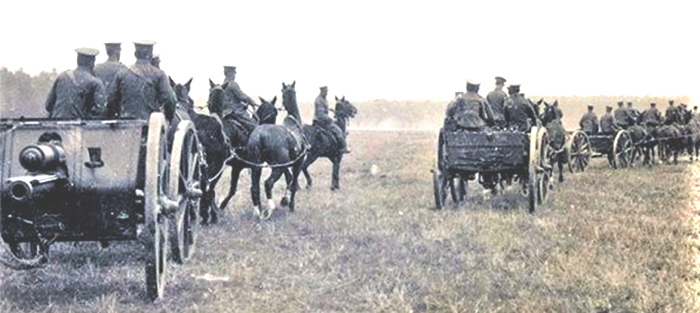
A horse-drawn 18-pounder field gun is moved into position by a British artillery team
during the Great War. This would have been a familiar sight to Sergeant Richard Thompson
The RFA’s principal weapon in 1914 was the 15-pounder field gun although by 1916 most batteries were being issued with the improved 18-pounder. These guns fired shrapnel or high explosive shells on a low trajectory at a target that was usually visible. By 1916, an artillery brigade consisted of four batteries, each of six guns. The first three, A B and C batteries, were equipped with field guns while D battery used 4.5in howitzers. The howitzer fired its shell high into the air on a much steeper trajectory and was used to target concealed enemy positions, behind a wood or a hill, for example.
Together, the 116th, 117th and 118th Batteries, RFA, formed 26th Brigade which served with the British Army’s 1st Division. The 1st Division, among the first to be deployed to France in August 1914, fought on the Western Front throughout the war and took part in most of the major actions. The early engagements included the Battle of Mons (23 August 1914) and the subsequent retreat (24 August-5 September), the First Battle of the Marne (6-10 September), the Battle of the Aisne (13-28 September), the First Battle of Ypres (19 October-22 November) and the winter operations of 1914-15.
On 23 October 1914 Richard was transferred to 117th Brigade, RFA. At the end of 1914, 1st Division moved south to the La Bassée front and took over the trenches at the Cuinchy Brickstacks where it came under German attack on 29 January 1915. The Division suffered heavy losses in the British attack on Aubers Ridge on 9 May 1915 and then again at the Battle of Loos (25 September-15 October 1915). At Loos, 1st Division was at the forefront of the fighting near the Lone Tree and Le Rutoire Farm and particularly in the unsuccessful, and costly, assault on the Hohenzollern Redoubt stronghold.
On 7 April 1915 Richard was promoted to Acting Sergeant and then full Sergeant two months later. This may have been in recognition of his performance in the field during the early phase of the war.
In early 1916 1st Division transferred to the Somme. During the Somme Offensive, Richard saw action around the village of Mametz and it was here, on 21 July 1916, that he was accidentally killed while on active duty. The circumstances of the accident are unknown, but it is possible that a shell exploded prematurely in a gun before being fired. Richard was 25 years old when he died.
Richard was posthumously awarded the Military Medal which was listed in the London Gazette on 12 September 1916. The Military Medal, which had only just been introduced, was awarded to soldiers below commissioned rank (i.e. non officers) for ‘acts of gallantry and devotion to duty under fire’.
Family after the Great War
Richard Thompson’s Army pension records show that his widow Gwendoline received a pension of 11shillings a week from 12 February 1917. The records also reveal that at that time she had moved from Winchester and was living at The Peaceful Home inn in East Street, Alresford. (This is a private residential house today.)
Gwendoline Thompson remarried in Winchester on 9 October 1917. Her new husband, 30-year-old William Newman, had been born in Camberwell, south London, and worked as a printer’s compositor. The couple went on to have two children. A daughter, named Gwendoline after her mother, was born in Winchester on 24 August 1918 and a son, Reginald, in Lambeth, south London, on 27 May 1921. (Reginald died in 1952 while fighting in the Korean War.) Gwendoline would almost certainly have lost her Army widow’s pension when she remarried.
Gwendoline and William were living at 41, Sussex Street in 1920 but by 1939 they had moved to Dagenham, Essex, where William was still employed as a compositor. William died in Farnham, Surrey, in May 1973, aged 80, and Gwendoline in Aldershot on 18 March 1979 at the age of 86.
It is not known if Richard’s brother Patrick fought in the Great War. On 18 June 1918 he married Sarah Holland at St Nicholas Church in Cork. On the marriage certificate he was listed as a fireman with the Great Southern and Western Railway, living at 9, Rockvale Street, Glanwire, Cork.
Richard Thompson is listed in the Winchester War Service Register.
Medals and Memorials for Richard James Thompson
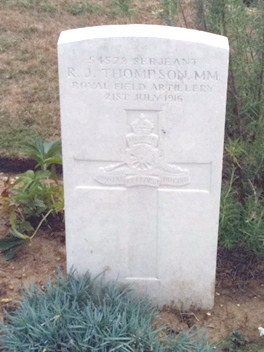
Grave at Dantzig Alley British Cemetery,
Mametz, Somme, Pas de Calais, France
Sergeant Richard James Thompson was entitled to the 1914 (Mons) Star, the British War Medal and the Victory Medal. He is buried (grave right) at Dantzig Alley British Cemetery (GR. III. F. 6), Mametz, Somme, Pas de Calais, France. His name appears on the memorials at St Matthew’s and St Paul’s churches, Winchester.