

Sapper LEOPOLD GEORGE SOTHCOTT
8, Greenhill Road, Winchester
Service number 177509. 288th Army Troops Company, Royal Engineers
Died of influenza, France, 29 October 1918
Life Summary
Leopold George Sothcott was born in Southampton on 8 July 1885, the eldest of James and Sarah Sothcott’s five children. Although Leopold enlisted in Winchester and is mentioned on the memorials at St Matthew’s and St Paul’s churches, he spent most of his life in Southampton. His connection to Winchester is thought to come through his wife who lived in 8, Greenhill Road after the war. Leopold, who is not mentioned in the Winchester War Service Register, died of influenza while on active service less than a fortnight before the Armistice which brought the war to an end.
Family Background
Leopold Sothcott’s father James was born in Portsmouth in 1865. James’s father, Thomas, was also from Portsmouth and had been born there in 1837. Thomas Sothcott worked as a brazier man and tinman - someone who made and repaired objects constructed of tin and other light metals. James’s mother, Jane, was born in Odiham, near Basingstoke, in 1836. It appears that James’s parents may have died when he was still quite young because in the 1871 Census, he and his brothers and sisters were recorded living with their aunt, Caroline Sothcott, a needlewoman.
Leopold’s mother was born Sarah Hillier in Figheldean, near Amesbury, Wiltshire, in 1860. She and James married in Southampton in 1884 and Leopold was born the following year, followed by Ernest in 1885 and Winifred in 1889.
By 1891 the Sothcotts were living in Fir Grove Road, Millbrook, Southampton. James was a whitesmith – a craftsman who worked with white or light-coloured metals such as tin and pewter. Sarah went on to give birth to three more children: Hilda (1894), Leslie (1897) and Doris (1901).
On 25 April 1892, six-year-old Leopold enrolled at Freemantle National School, Southampton, having previously attended a dame school. This was an early form of private elementary school often found in areas of poverty and usually situated in the teacher’s home. In 1898, at the age of 13, Leopold left school to start work and by 1901 he was a gas fitter’s apprentice. That year’s census showed his father working as an ironmonger and his brother Ernest as an errand boy. His other siblings were at school.
It was in this period that two of Leopold’s uncles came to live and work in Winchester. In 1900 George Sothcott was living at 2, St Thomas Street while his brother William was at 25, Stockbridge Road. George worked as a gas fitter, so he may have helped Leopold with his job. By 1908 William Sothcott had left Winchester and George died around this time, but his widow continued to live in the city.
In 1908 Leopold Sothcott married 19-year-old Dora Tiller, the daughter of Southampton blacksmith William Tiller. On 7 November 1910 Dora gave birth to a daughter, Gwendoline. By 1911 Leopold had qualified as a gas fitter and was living with Dora, her father and baby Gwendoline at 19, Nelson Road, Freemantle, Southampton. Meanwhile, Leopold’s father James was running a shop – probably a hardware store – in Southampton and employing two of his children, Hilda and Leslie.
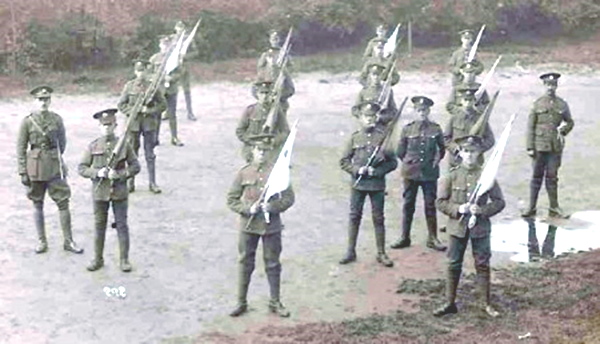
Men of the Royal Engineers Signal Service, the unit that Leopold Sothcott
served with during the Great War. Signals flags look primitive today but were vital
to communications between 1914 and 1918
Great War Record
It is not known precisely when Leopold enlisted to fight in the Great War. However, it is thought to have been in 1916 when he and his family moved to 32, Charlton Road, Shirley, as that is the address he gave when he joined up. Leopold enlisted with the Royal Engineers as Sapper 177509 and was assigned to 288th Army Troops Company, part of the Royal Engineers Signal Service.
At the outbreak of the Great War the Royal Engineers Signal Service comprised 12 Regular companies supported by a motorcyclist section of the Special Reserve and 29 signal companies of the Territorial Force. By 1918 the service had expanded to 589 companies, most of which operated on the Western Front.
The extensive use of artillery during the war produced a demand for dedicated signal sections, particularly for liaising with spotter aircraft. Other units aided in the movement of men and supplies to the front. Alongside this expansion in traditional forms of signalling, a whole new field of electronic warfare opened up thanks to the work of Signals Intelligence and the Wireless Observation Groups.
The revolution in signals technology between 1914 and 1918 enabled the British Army to make great strides in its military operations. By 1918 the old-style infantry attacks on trench systems were increasingly being replaced by more sophisticated ‘combined arms’ operations involving infantry, artillery, tanks, aircraft and cavalry. The Army’s expanded signals branch also played a crucial role by ensuring that the separate weapons ‘arms’ were able to communicate with each other.
Nothing is known about where Leopold Sothcott served during the war. His Army pension records (under the name Southcott) show that he died on 29 October 1918 of influenza contracted while on active service. He was 33 years old. The same records give Dora Sothcott’s address in early 1919 as 8, Greenhill Road, Winchester (the address then and now). Dora also appears in the Electoral Registers of 1920 and 1921 at the same address, although she, too, is incorrectly listed as Southcott. It is not known if Leopold ever lived in the house but given that his widow went to the trouble of ensuring his name appeared on the parish memorials he may well have done. For that reason, this biography uses 8, Greenhill Road as Leopold Sothcott's address.
Family after the Great War
After Leopold’s death Dora received a grant of £6 from the military authorities on 12 December 1918. From 12 May 1919 she also received a pension of 23s 6d a week to help with the cost of bringing up her and Leopold’s daughter Gwendoline. This ceased on 7 November 1926, Gwendoline’s 16th birthday.
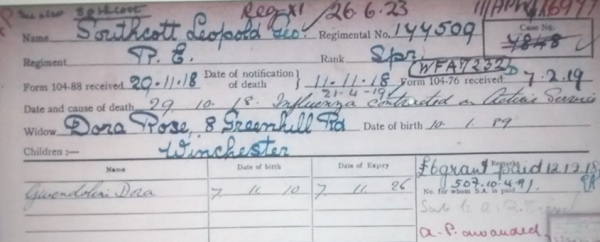
Leopold Sothcott's Army pension records showing his widow Dora living at 8, Greenhill Road
Dora Sothcott is thought to have moved from Winchester back to Southampton where she remained for several years. By 1939 she was living in Boscombe, near Bournemouth. Dora never remarried and died in Bournemouth in 1985 at the age of 98. Gwendoline Sothcott married Herbert Griggs in 1932. The couple lived in Southampton and later in Somerset. Gwendoline died in Cambridgeshire in 2006, aged 95.
Medals and Memorials for Leopold George Sothcott
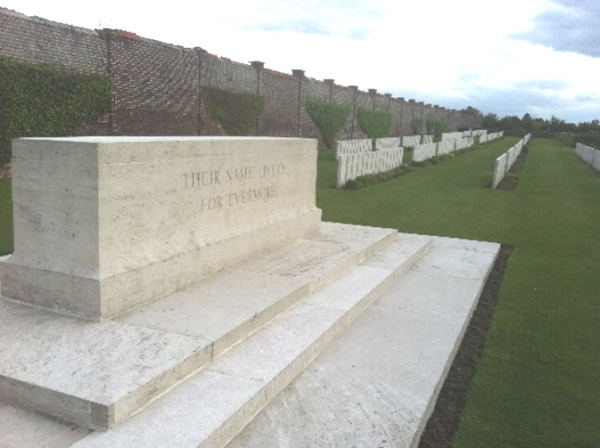
Busigny Communal Cemetery Extension, Nord, France
Sapper Leopold George Sothcott was entitled to the British War Medal and the Victory Medal. He is buried at Busigny Communal Cemetery Extension (below), Nord, France (GR. II. A. 5) with the following inscription on his headstone:
ONLY THOSE THAT HAVE LOVED AND LOST KNOWETH THE MEANING OF GONE
Leopold is mentioned on the memorials at St Matthew’s and St Paul’s churches, Winchester. His name also appears on the Southampton Main Memorial.