

Trooper HORACE SMITH
14, Gladstone Street, Winchester (no longer stands)
Service number D/3211. 5th (Princess Charlotte of Wales’s) Dragoon Guards
(Previously with Duke of Cornwall’s Light Infantry)
Died of wounds, France, 31 March 1918
Family Background
Horace Smith was born in the village of Overton, near Basingstoke, in late 1891 and baptised there on 24 April 1892. Horace was the fifth of the six children of Francis and Emily Smith. Francis, who worked variously as a farmer, butcher and pub landlord, had been born in Wherwell, near Winchester, on 4 July 1855. His wife was born Emily Budd in Overton on 17 January 1858.
Francis Smith was the youngest of five children. His father, also called Francis, had been born in the remote hamlet of Hippenscombe, Wiltshire (about four miles northeast of Ludgershall), in 1809. In the 1861 Census Francis Snr was living with his wife Mary and their family at the White Lion Inn, Wherwell, where he worked as a victualler and butcher. Mary had been born in Chute, Wiltshire, about two miles from Hippenscombe. The Smiths were still living at the White Lion in 1871 when Francis Snr was a farmer of 188 acres, employing three men and one boy. He died in Winchester in 1880.
In 1881, the year after his father’s death, Francis Jnr and his mother were recorded living in Compton, near Winchester, where Francis was working as a butcher. Horace Smith’s mother Emily was the youngest of the seven children of John Budd (1821-1897) and his wife Fanny (née Whitear, 1821-1891). The 1861 Census showed the Budds living in Winchester Street, Overton, where Emily’s father was a master butcher.
Emily and Francis Jnr married in Whitchurch, Hampshire, in 1882. Two daughters, Annie and Fanny, were born in 1884 and 1885, followed by Henry (1888), Amelia (1889) and Horace (1891). In 1891 the family were living at the White Hart Hotel, Wherwell, where Francis was a licensed victualler and farmer. In 1894, Emily gave birth to a fourth daughter, Dorothy.
Despite the great depression in British agriculture at this time, Francis ventured into farming. In the 1901 Census, the Smiths were living in Winchester Street, Overton – possibly in the home of Emily’s now deceased parents – with Francis working as a farmer. Four of the children, Henry, Amelia, Horace and Dorothy, were still at school. We know that Horace later attended St Thomas Church of England Boys’ School in Winchester because his name appears on the school’s war memorial.
Early Military Career
In 1908 Horace Smith joined the Army. His military records, including his attestation form, have survived although several of the documents are damaged and others barely legible. Nevertheless, they enable a picture to be drawn of Horace’s military career that is more rounded and detailed than some of the men in this book whose records were destroyed in the Blitz in 1940.
Horace enlisted in Winchester on 18 February 1908. Although only just 16, he stated that he was 18 so that he would be accepted into the Army. He was working as a butcher when he joined up and serving as a part-time soldier in the Militia with the 3rd Battalion, The Hampshire Regiment. Horace is shown enlisting for 12 years (including five in the Reserve) in the Somerset Light Infantry, but he actually joined the Duke of Cornwall’s Light Infantry (DCLI) and was posted to the regimental depot in Bodmin on 20 February 1908. His service number is believed to have been 8944. On 19 June he was assigned to the 1st Battalion, DCLI.
The records give a brief physical description of Horace: he was 5ft 7in tall with a 34in chest and he could read and write, although he had no formal educational qualifications. They also show that Horace was something of a rebel who was frequently in trouble with authority – the records contain details of no fewer than 29 breaches of Army discipline. These begin on 29 March 1908, just a month after joining the DCLI, when he was given 48 hours’ detention for refusing to obey an order. Insolence to his superiors, being dirty on parade and asleep while on night guard duty are among Horace’s other misdemeanours.
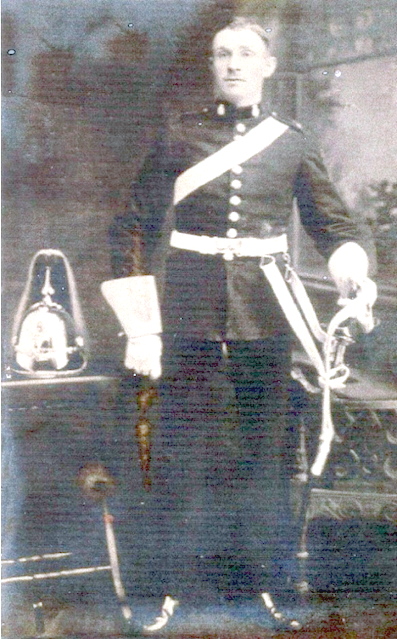
Trooper Charles Horsnell of the 5th Dragoon Guards in parade uniform.
Charles enlisted in 1909 and would have known Horace Smith
On 29 April 1909 Horace left the DCLI and transferred to the 5th (Princess Charlotte of Wales’s) Dragoon Guards, a cavalry regiment, with the service number 3211. According to his records this was so that he could serve alongside his elder brother Henry who had joined the regiment in 1905. Another Dragoon, Trooper Charles Horsnell, enlisted in 1909 and a photograph of him in parade uniform has survived.
Horace was posted to Dublin where the 5th Dragoon Guards were based in 1909. In September 1910, the battalion moved to the British Army camp at the Curragh, in County Kildare, which is where Horace and Henry were both recorded living in the 1911 Irish Census.
Although he continued to have frequent run-ins with authority, it appears that by the time the regiment returned to England in October 1912 Horace had started to mature as a soldier. His Employment Sheet dated 7 October 1913 stated that he had served as a Sergeant’s batman for the previous three months and on it he is described as ‘smart, respectful, hardworking and honest’.
Meanwhile, Horace’s parents and sister Dorothy had moved to 14, Parchment Street, Winchester, where they were listed in the 1911 Census as boarding house keepers. Francis gave his name as Frank on the census document. The family later moved to 3, St John Street, Winchester, which was the address used for correspondence by the Army.
Great War Record
The 5th Dragoon Guards formed part of the British Expeditionary Force (BEF) – Britain’s military response to the Britain’s declaration of war on Germany on 5 August 1914. On 16 August, the regiment of 549 men – including Henry and Horace Smith – arrived at Le Havre aboard the troopship SS Cestrian and disembarked to form part of the 1st Cavalry Brigade.
Horace’s first spell on the Western Front lasted just one month. His regiment was not involved in the battles of Mons (23 August) and Le Cateau (26 August) although it did come under German attack briefly on 24 August. On 1 September, as the BEF retreated southwards before the advancing German army, the 5th Dragoon Guards helped 1st Cavalry Brigade to repel a surprise attack by the German 4th Cavalry Division at the Battle of Nèry. The brigade captured 12 enemy guns in the action which saw three Victoria Crosses awarded to ‘L’ Battery, Royal Horse Artillery. The 5th Dragoon Guards lost its Commanding Officer, Lieutenant-Colonel G.K. Ansell, and about ten other men killed in the battle.

British cavalry at Nery on 1 September 1914. The battle was Horace Smith's first taste of warfare
After Nèry, Horace’s regiment continued to retreat south almost to Paris at which point the Allies counter-attacked at the Battle of the Marne (6-12 September). As the British advanced, the 5th Dragoon Guards attempted to capture the village of Sablonniere during which Horace was shot in the arm. He was taken to a field ambulance and eventually evacuated to England.
Horace was out of action until 30 October 1914 when he was posted to the 1st Cavalry Reserve Regiment based in England. He remained with the regiment for seven months until 17 June 1915 when he rejoined the 5th Dragoon Guards at Oudezeele in French Flanders.
Horace returned to a changed Western Front. The battles of 1914 had shown the lethal effect of modern firepower – particularly machine-guns and artillery – on massed cavalry charges. However, the British High Command still believed that cavalry was needed to exploit any planned breakthrough. This ‘Big Push’ would bring the return of mobile warfare and mounted units would exploit any breach using their superior speed to reach the enemy’s rear positions and destroy supply and communications lines. Until that moment came, cavalrymen – who were trained to shoot like their infantry colleagues – could fight in a dismounted role where needed. This is what the 5th Dragoon Guards did at the Second Battle of Ypres in April and May 1915.
The next three years, however, were to prove immensely frustrating for cavalry units. The 5th Dragoon Guards saw no further action in 1915 and little of note during 1916, despite the British Army launching a major offensive on the Somme. With the ‘volunteer armies’ raised in the early months of the war now in the field, and soldiers from the British Dominions – Australia, Canada, New Zealand and South Africa – also on the Western Front in large numbers, there was less need for cavalry to operate as dismounted infantry.
Instead, Horace Smith’s regiment spent most of 1916 away from the front line, training and providing working parties. Horace, however, still managed to get into trouble – on 21 September 1916 he was ordered to be confined to camp for seven days for ill-treating his horse. One month later, on 21 October, Horace’s father Francis died in Winchester, aged 61. It is possible that Horace and his brother Henry were allowed compassionate leave to visit their family and to attend Francis’s funeral.
For the 5th Dragoon Guards the early months of 1917 followed a similar pattern to 1916. The regiment was not involved in any front-line action but the regimental war diary does show that in February and March significant numbers of officers and men were sent on training courses – on the use of poison gas, musketry, veterinary practice and aeroplane signalling among others. It is not known if Horace attended any of these.
The early stages of the Arras Offensive (9 April-16 May 1917) offered hope that mounted cavalry might once more be used on the Western Front. On 9 April the 5th Dragoon Guards sent a detachment to Arras in the hope of exploiting British success there. However, while riding into the captured village of Fampoux the detachment came under German machine-gun and artillery fire which killed several men and 16 horses. The Dragoons were forced to seek cover and withdrew after dark. They tried again the following day but with no success.
The opening phase of the Battle of Cambrai (20 November-6 December 1917) also appeared to present an opportunity for a British breakthrough which the cavalry could exploit. On 20 November the 5th Dragoon Guards were deployed to the area of Grand Ravine, near Flesquieres. A squadron of mounted Dragoons then attempted to capture Flot Farm but had to withdraw after coming under machine-gun fire. On 24 November the 1st Cavalry Brigade was ordered to provide a battalion of dismounted troops to fight around Bourlon Wood, with the 5th Dragoon Guards contributing a company of men. These were relieved on 26 November. During the German counter-attack at Cambrai, which began on 30 November, dismounted Dragoons were in action again, this time at Gouzeaucourt.
Early 1918 saw Horace Smith’s regiment in camp at Buire in the Somme valley where it provided working parties to repair trenches. By March, the 5th Dragoons were serving as dismounted troops and on the night of 9-10 March six officers and 160 men mounted a trench raid on German lines at Square Copse. However, the barbed wire they encountered was thicker than expected and the party had to retire under heavy machine-gun fire. It is not known if Horace took part in the raid.
By 19 March, the 5th Dragoon Guards had moved to Montecourt, about ten miles south-east of Peronne. The following day they received orders to disperse and man outposts in case of a German attack. Early on the morning of 21 March the Germans launched their Spring Offensive against British positions in the Somme valley and east of Arras with the aim of splitting the British from their French allies and winning the war at a stroke.
The British line in the south quickly gave way before the German artillery and infantry onslaught and troops retired westwards, conducting a fighting retreat as they went. On the afternoon of 21 March, the 5th Dragoon Guards received orders to dismount and reinforce troops of 17th Brigade in 24th Division around Small Foot Wood. The following day, after coming under heavy bombardment, the regiment retreated after one company was almost outflanked and cut off by the rapidly advancing enemy. The regiment then remounted and proceeded to the town of Athies before moving into position that night to cover the British retreat across the River Somme.
In the confusing and chaotic days that followed, the 5th Dragoon Guards withdrew westwards, sometimes on horseback, on other occasions fighting as dismounted infantry. On 24 March 190 men were formed into a dismounted brigade which moved to the town of Carnoy and then to Montauban where it engaged in heavy fighting. By 28 March, the regiment was holding trenches near the village of Hamel, about 18 miles south-east of Amiens, which the Germans attacked two days later. The 5th Dragoon Guards’ regimental war diary recorded how events unfolded:
30th March – Intermittent shelling of front line and Hamel from 7.45am.
11.30am – Very intense bombardment of front line, village and surroundings for two hours, when enemy launched a strong attack on brigade front with three battalions. Capt. H.O. Wiley with his squadron rallied parties of infantry who had retired from the front line and led them back to the … trenches, remaining there during the attack. Lieut. J. Jordan M.C. and 30 men from ‘A’ Squadron went to support 11th Hussars on right. The attack was completely repulsed on the whole brigade front with heavy loss to the enemy who left many dead on the wire.
Horace Smith was wounded by an exploding grenade during the German assault on Hamel. He was taken to 5th General Hospital at Rouen but died the following day. He was 26 or 27 years old. The Winchester War Service Register states that Horace was wounded three times in total. His Army records mention two of the occasions he was wounded (1914 and 1918) but not the third.
Family after the Great War
News of Horace’s death did not immediately reach his mother back in Winchester. A telegram was sent to Emily, but to her old address at 3, St John’s Street, not 14, Gladstone Street. The telegram was returned to the Cavalry administrative HQ in Kent which then had to track down Emily to inform her of her son’s death.
On 4 October 1919 Emily wrote to the military authorities pleading for financial assistance. She stated that she had been widowed for three years and that her husband had been an invalid in his later years – implying that he had been unable to earn. Given that her other children were living in ‘fair’ circumstances, she was the only one of Horace’s dependents who needed help. She continued:
It was my son’s wish in case anything happened to him that I should have his effects, and he said it was not necessary to make a will as I was his next of kin. As I also am an invalid and a widow and nothing coming in, could I not be assisted from the funds that provide for widows of husbands and sons killed during the war?
On 29 April 1920 Emily applied for a dependent’s pension. The application is thought to have been successful. Emily also received the three war medals to which Horace was entitled.
Although Francis Smith died in 1916, he continued to be listed as the householder at 14, Gladstone Street in Warren’s Winchester Directory for another two years. By 1920, however, the address was listed under ‘Mrs Smith’ – presumably Emily. In 1939 Emily was living at St John’s Hospital, Winchester. She died in Chandler’s Ford, Hampshire, on 26 January 1947 at the age of 90.
Henry Smith, the brother with whom Horace served, was wounded in 1916 but survived the war. Both brothers are listed in the Winchester War Service Register.
Medals and Memorials for Horace Smith
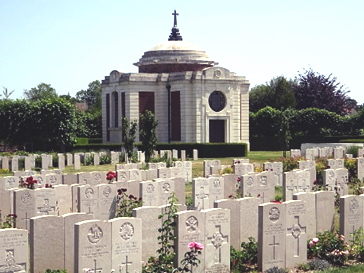
St Sever Cemetery Extension, Rouen, Seine-Maritime, France
Trooper Horace Smith was entitled to the 1914 (Mons) Star, the British War Medal and the Victory Medal. He was buried in St Sever Cemetery Extension (right), Rouen, Seine-Maritime, France (GR. P. IX. 3. EB). Horace is mentioned on the memorials at St Matthew’s and St Paul’s churches, Winchester, and on the St Thomas School memorial, held today by Kings School, Winchester.