

2nd Lieutenant JOHN SIMMONS
36, Greenhill Road, Winchester
3rd Battalion, Rifle Brigade - attached to School of Bombing
(Previously service number 7198)
Killed accidentally, Aldershot, 21 August 1916
Life Summary
John Simmons was born on 24 March 1873 in Marylebone, London. At the age of just 15 he followed his father into the Army and served as a professional soldier for 28 years, latterly with the Winchester-based Rifle Brigade. He moved to the city in around 1914 when he helped to oversee the Rifle Brigade’s preparations for war. Despite being in his forties, he was given a commission and served as a 2nd Lieutenant on the Western Front before being invalided home a few months later. He subsequently served as an instructor at the School of Bombing in Aldershot where he was killed in an accident in 1916. The Winchester War Service Register gives John’s address as 4, Greenhill Road (his wife’s address in 1921 when the Register was compiled), but this biography uses 36, Greenhill Road which was his home in 1914.
Family Background
John was the only child of John George and Emily Simmons. John Snr had been born in Bloomsbury, London, in 1841. He joined the 2nd Battalion of the 60th Rifles (officially known as the King’s Royal Rifle Corps) in March 1859. John spent much of his service overseas – in India and China and Ireland.
In 1865 John married Emily Reeve who had been born in Hayward’s Heath, Sussex, in 1846. The 1871 Census recorded John Snr living at the Army barracks in Colchester, Essex; however, there is no mention of Emily. John rose through the ranks to become a Colour Sergeant before leaving the Army, in around 1875. By the time of the 1881 Census, John Simmons Snr was working as a clerk and living at 32, Southwark Bridge Road, London, with Emily and eight-year-old John Jnr who was at school. Two other families were also living at the same address. Two years later, John Snr died in Marylebone, aged just 42. No further trace can be found of Emily Simmons after 1881.
It appears that in 1884, the year after his father’s death, 12-year-old John Simmons Jnr enrolled at King Edward School, Witley, Surrey. Situated in the village of Wormley, near Guildford, the boarding school was founded in 1553 by King Edward VI and Nicholas Ridley. John’s conduct was recorded as good, but his attainment in the school band merely ‘indifferent’. Despite this, when he left school in 1888, he joined the 2nd Battalion, The Queen’s (Royal West Surrey) Regiment at Guildford as a band boy.
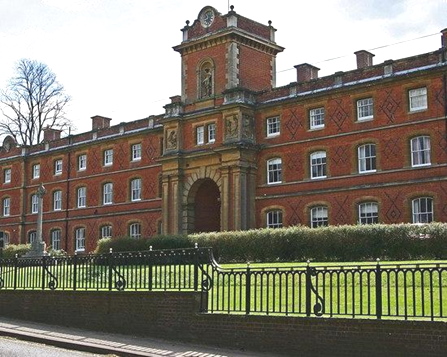
King Edward School, Witley, Surrey, which John Simmons attended
before joining the Army in 1888
Early Military Career

The Royal Marine Barracks in Woolwich, London, in the mid-1800s. John Simmons
was garrisoned here with the 5th Rifle Brigade in around 1910
by which time the building had become the Cambridge Barracks
The 2nd Queen’s Regiment had been formed in 1661 and was the senior English line infantry regiment of the British Army. John apparently signed up for six years because in August 1894 he transferred to the Army Reserve list, but in December of the same year he re-enlisted. It has not been possible to determine which regiment John joined on re-enlisting – his brief biography on the King Edward School website states that it was probably the 2nd Queen’s, although a report in the Hampshire Chronicle after his death suggests that most of his career was spent with the Rifle Brigade. To further confuse matters, his marriage certificate states that he was serving with the Border Regiment.
On 9 June 1900 John Simmons married Helen Barrow in Marylebone. The youngest of seven children, Helen had been born in 1870 in the parish of St George’s, Hanover Square, London. At the time of her marriage she was living at 4, Westmoreland Street, Marylebone. Thomas Barrow, Helen’s father, was described on the marriage certificate as a caretaker but he had previously been the manager of a soup kitchen and a painter - presumably a decorator. (Interestingly, a missionary was recorded living with the Barrows in the 1881 Census. This, together with Thomas’s role at the soup kitchen, suggests the family may have had Methodist connections. It would certainly help to explain why a memorial to John Simmons was placed in the Wesleyan Chapel in St Peter’s Street, Winchester, after the war.)
As mentioned above, the couple’s marriage certificate showed that in June 1900 John was serving with the Border Regiment in the Brigade Office at Shorncliffe Army Camp, near Folkestone, Kent, and had reached the rank of Sergeant. A few months later, in the 1901 Census, John was described as an Orderly Room Sergeant with ‘7 BRB’, which was possibly a unit in the Border Regiment. An Orderly Room Sergeant is the chief clerk of an infantry battalion whose role is to assistant the adjutant. It suggests that John was probably more a military administrator by temperament than fighting soldier.
Helen Simmons was already pregnant when she married John and on Boxing Day 1900 she gave birth to a son, John George (after his paternal grandfather), in Hackney, London. The family were recorded living at 84, Shrubland Road, Hackney, in the 1901 Census and a second son, Harold, was born there on 18 July 1903.
Given that John was serving in England with the Border Regiment in 1900 and 1901, it is unlikely that he saw action in the Boer War. The details of his military career over the next ten years are unclear, but by the 1911 Census he had transferred to the 5th Battalion, The Rifle Brigade – a Special Reserve unit - based at Cambridge Barracks (the former Royal Marine Barracks) in Frances Street, Woolwich, London, and was working in the recruiting office with the service number 7198.
At some point over the next three years John transferred to the Rifle Brigade Depot at Winchester as a Colour Sergeant. His name first appears in the Warren’s Winchester Directory in 1914 when he was listed living at 36, Greenhill Road (the address then and now), presumably with his family. He was at the same address in 1915. The house, which dated from 1912, was rented out by the Winchester Working Men’s Housing Society.

36, Greenhill Road, Winchester - John Simmons’s first
Winchester home in 1914
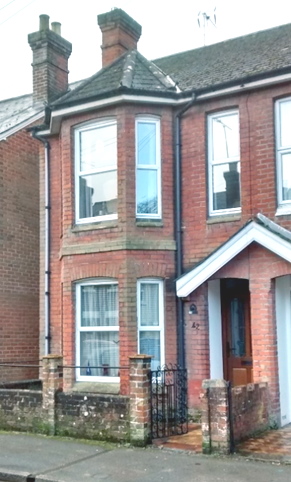
42, Nuns Road, Hyde, to where John Simmons and
his family moved in 1916

4, Greenhill Road, John Simmon's widow’s home
from 1918-31
Great War Record
On 8 September 1914, a month after the outbreak of war, John was appointed Warrant Officer 1st Class, the highest non-commissioned rank in the Army. As such, he would have helped to oversee the Rifle Brigade’s preparations for war. It was a daunting task, the Winchester Depot becoming a scene of frantic activity as hundreds of Reservists arrived in response to the country’s call to arms.
The strain of this enormous logistical exercise proved too much for John who was forced to take extended leave. However, he returned, apparently improved in health, and in December 1914 was given a commission with the rank of 2nd Lieutenant. The promotion of senior NCOs to commissioned officer rank was not uncommon in late 1914 and early 1915. As the Army expanded rapidly, it desperately needed suitable junior officers: many came from the public schools while others, like John Simmons, were promoted from the ranks.
John was soon sent to the Western Front. His Medal Index Card reveals that on 12 January 1915 he arrived in France where he joined up with 3rd Rifle Brigade, which had already distinguished itself in four months of fighting. The battalion occupied trenches near Armentieres in northern France where conditions during the winter of 1914-15 were appalling. Heavy rain and freezing temperatures led to hundreds of cases of trench foot, although the sodden battlefield did restrict the amount of fighting.
During the spring of 1915, 3rd Rifle Brigade relieved troops who had been involved in the Second Battle of Ypres (22 April-25 May). However, Rifle Brigade records show that on 25 May 1915 John Simmons was sent back to England because of sickness. No mention is made of the illness he was suffering from and he never returned to the front again.
In 1916 John moved from Fulflood with his family to 42, Nuns Road, Hyde, Winchester. He subsequently returned to Army life as an instructor at the School of Bombing at Aldershot and it was here that he was accidentally killed on 21 August 1916. On 26 August, the Hampshire Chronicle carried a report under the headline ‘Tragic Death of Lieut. Simmonds’ [sic] which stated:
Information of the death of Lieutenant J. Simmonds, Rifle Brigade, in a bombing accident was received at the Rifle Depot at Winchester on Monday evening, he having been killed in Aldershot that morning. Deceased was, it transpired, instructing a number of officers in what is known as ‘demolitions’ and when the accident happened he was demonstrating how to demolish barbed wire entanglements by the use of explosives. These were laid by the uprights supporting the wire with a time fuse attached. Deceased had set the fuse and was turning away when a sudden explosion took place and he was killed instantly.
An Army doctor who gave evidence to the inquest stated that John had suffered severe wounds in the blast, particularly down the left side of his body. Death, he said, would have been instantaneous. The Chronicle report also included the following details about John’s Army career:
He joined the Rifle Depot at Winchester as a Colour Sergeant and at the time of the outbreak of war was the Sergeant Major at the Rifle Depot. The heavy work and the great strain entailed in this office during the autumn months of 1914 proved too much for him and he was granted leave. He returned much improved in health and was subsequently given a commission. Proceeding to France, he saw active service there, but was in the course of time invalided back and was more recently attached to the School of Bombing at Aldershot as instructor. A thorough soldier, and one who enjoyed the esteem of officers and rank and file alike, his death will be generally regretted by a wide circle of friends at Winchester, and the deepest sympathy will go out to Mrs Simmonds and her family (who still reside in Winchester) in their great sorrow. The late Lieut. Simmonds was a member of the ‘William of Wykeham’ Lodge of Freemasons who have sent a message of sympathy to the widow and family.
Family after the Great War
John Simmons was buried at Aldershot Military Cemetery on 26 August 1916. Following her husband’s death, his widow Mary remained at 42, Nuns Road until 1918 when she returned to Fulflood to live at 4, Greenhill Road. This is the address given for John in the Winchester Warrvice Register of 1921. Mary lived at 4, Greenhill Road until 1931 when she moved to 38, Andover Road, Winchester. From 1934 she shared the address with an Albert Hayter while the 1939 Register shows her widowed sister Henrietta also living there. (38, Andover Road is thought to be the house now named Whitecott, just north of the junction with Boscobel Road.) Mary Simmons died in Winchester in 1942, aged 71.
John Simmons’ elder son, John George, enlisted in the Royal Flying Corps (from April 1918 the Royal Air Force) as a Boy in October 1917, just short of his 17th birthday nearly. He survived the war and served in Germany immediately after the Armistice. John Jnr married Edith Marks in Winchester in 1926 and the couple had a daughter, Jeanette, the following year. John later became a haulage driver and he and his family lived at 30, Clifton Road, Winchester, for more than 30 years. He died in Winchester in 1966 at the age of 65.
John Simmons’ daughter Jeanette married Vincent Morgan in 1951 and they went on to have two children – Carol, born in Winchester in 1952, and Adrian, born in Portsmouth in 1967.
John Simmons’ younger son Harold married Muriel Henning in Alresford, near Winchester, in 1930. A son, Geoffrey, was born in 1931 but he died the same year. In 1933, Muriel gave birth to a second son, Brian, in Winchester. No further details of him can be found. In 1939 Harold was working as a tailor’s cutter and living with his family at 13, Western Road, Fulflood, where he remained until at least 1954. He died in Winchester in 1988, aged about 85.
Medals and Memorials for John Simmons
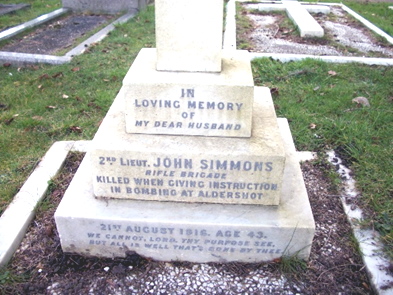
John Simmon's grave in Aldershot Military Cemetery
2nd Lieutenant John Simmons was entitled to the 1914-15 Star, the British War Medal and the Victory Medal. In Winchester, he is listed on the memorials at St Matthew’s Church, Weeke, St Paul’s Church, Fulflood and St Bartholomew’s Church, Hyde (where he is ‘Simmonds’). His name also appears on the memorial from the Wesleyan Methodist Church, St. Peter’s Street, Winchester, which is now kept at the United Church in Jewry Street. His connection with the Methodist church has not yet been positively established. John was buried in Aldershot Military Cemetery (PR. AH. 347) where his gravestone (pictured above) bears the following inscription:
IN LOVING MEMORY
OF MY DEAR HUSBAND
2nd LIEUT. JOHN SIMMONS
RIFLE BRIGADE
KILLED WHEN GIVING INSTRUCTION
IN BOMBING AT ALDERSHOT
21st AUGUST 1916. AGE 43.
WE CANNOT, LORD, THY PURPOSE SEE,
BUT ALL IS WELL THAT’S DONE BY THEE
Additional sources
- King Edward School, Witley, website: John Simmons profile.
http://fluencycontent2-schoolwebsite.netdna-ssl.com/FileCluster/KingEdwardsWitley/MainFolder/Old-Wits/In-Memoriam/WW1-1916/John_SIMMONS.pdf - Kitchen, Leigh. Drummer Boys – Boys Serving in the British Army.
https://gmic.co.uk/topic/23848-quotdrummer-boysquot-boys-serving-in-the-british-army/ - We would like to thank the Hyde900 group for their assistance in preparing this biography.