

Sergeant JOHN WILLIAM SEWARD
16, Stockbridge Road, Winchester
Service numbers 355 and 26123. 101st Company, Machine Gun Corps (Previously 2nd Battalion, Rifle Brigade)
Killed in action, France, 26 August 1917
Life Summary
John William Seward was born in Winchester on 26 November 1886, the eldest of eight children. A professional soldier with the Winchester-based Rifle Brigade, he served overseas in Malta and India before being sent to the Western Front in the early months of the Great War. John was brought up in east Winchester and it was not until mid-way through the war that his family moved to Stockbridge Road, a year before he was killed while serving with the Machine Gun Corps.
Family Background
John’s father, also named John, was born in Exeter in 1861, the son of labourer William Seward (born around 1824) and his wife Harriett (born 1825). Little is known of John Seward Snr’s early years, but he married Esther Edwards at St Peter’s Church, Winchester, in 1886, the same year that John Jnr was born.
Esther had been born in Winchester in 1863. Her father, George Edwards (1827-1907), worked variously as a bricklayer and labourer in the building trade, and later as a milkman. George married Jane Philpott in Winchester in 1854. Jane had been born in Longstock, near Stockbridge, Hampshire, in 1834. George and Jane went on to have nine children together. In the 1861 Census they were living in St John’s Street, Winchester, with two young children and George’s 80-year-old father, William, a butcher. By 1881 they had moved a short distance to 24, Cheesehill Street with Esther, then 18, working in domestic service. Ten years later, George was working as a milkman and living with Jane at 26, Wharf Hill, Winchester.
John Seward Snr spent much of his working life as a labourer, latterly to a sawyer in the timber business. Esther, meanwhile, looked after the couple’s children, all of whom were born in Winchester apart from their eldest daughter, Louisa, who was born in Exeter in 1888. Besides John Jnr, the other children were Alice (born 1891), Harry (1893), Esther (1894), Charles (1896), George (1898) and Rosa (1900). With so many mouths to feed and only a small income, life for the Sewards would have been extremely hard, as it was for many working-class people in Winchester at the time.
The family regularly moved from one rental property to another. The 1891 Census showed them living at 72, Wales Street but two years later they had moved to 52, Canon Street. By 1895 they were at 13, Cheesehill Street and in 1897 at 20, Colebrook Street. The Sewards were at 68, Middle Brook Street between 1901 and 1905 and at 84, Middle Brook Street in 1907. From 1908 to 1910 they lived at 2, The Weirs and between 1911 and 1912 at 46, Canon Street. In the years when the family do not appear in any traceable official record it is likely that they were living with Esther’s parents at 42, Wharf Hill.
John Seward Jnr entered St John’s National School, Winchester, on 28 November 1893 when he was six years old. His sister Louisa enrolled at the school a few days later, on 4 December, aged five. Their address in the school logbook is 1, Wales Street. It is not known when John Jnr left school, but by the time of the 1901 Census, when he was 14, he was already working as an errand boy.
Early Military Career
On 8 April 1904 John Jnr enlisted with the Rifle Brigade in Winchester. His attestation papers show that he lied about his age, giving it as 18 years and five months when in fact he was a year younger. He initially enlisted for three years’ service (with nine years in the reserve) but later extended this to seven and then 12 years. John was described as 5ft 6½in tall with fair hair and blue eyes. He had a scar on the nape of his neck, tattooed dots on his left forearm and he gave his previous occupation as shoeing smith. He was assigned to the 2nd Battalion, Rifle Brigade (The Prince Consort’s Own) with the service number 355 and sent to Chatham, Kent, for training.
John’s Army career got off to an inauspicious start. In November 1904 he was confined to barracks for eight days for making an insolent reply to an NCO and he continued to have periodic run-ins with authority over the following years, but always for relatively minor offences of disobedience and insubordination. In 1905, his training completed, John embarked for Malta to join 4th Rifle Brigade and he remained there for more than a year. In December 1906 he was sent to India to serve with 2nd Rifle Brigade.
John’s first posting was to Chaubattia, high in the Kumaon Hills in north-west India (in modern Uttarakhand state). Conditions here were tough: not only was the remote British base 50 miles from the nearest railway station, but disease – mainly malaria and enteric fever – exacted a constant and often deadly toll on soldiers of all ranks. Company training and musketry practice formed the backbone of the working day. John was also posted to Shahjahanpur on the River Ganges (in modern Uttar Pradesh, northern India) and Calcutta.
In 1908 John was awarded the Army Certificate of Education 3rd Class. The certificates had been introduced in 1861 to encourage soldiers to broaden what was all too often a rudimentary school education. The third-class certificate specified the standard for promotion to the rank of Corporal: the candidate was required to read aloud and to write from dictation passages from an easy narrative, and to work examples in the four compound rules of arithmetic and the reduction of money.
In the summer of 1911, while stationed at Fort William, Calcutta, John spent more than two weeks in hospital after contracting gonorrhoea. He was hospitalised with the same disease again, this time for two months, in early 1912 while stationed in Rawalpindi (in the Punjab province of modern Pakistan). John had either been re-infected or, more likely, the disease had flared up again, this time more severely. Treatment for venereal disease in the days before penicillin was notoriously unreliable and would later cause significant problems for the military authorities during the Great War.

The British Army base at Kuldana, India, where John Seward served from 1912 to 1914
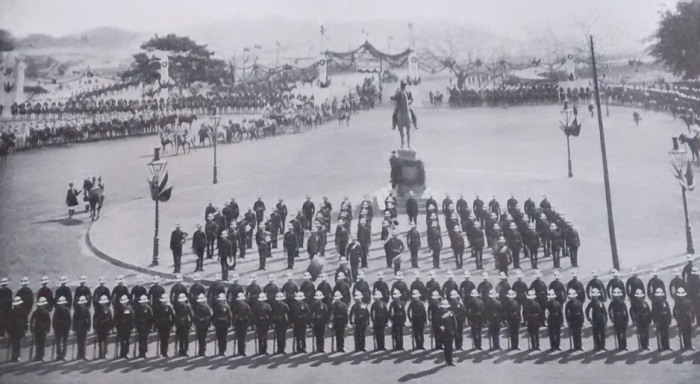
2nd Rifle Brigade form the guard of honour for King George V in Calcutta during the state visit of 1911-12
It is not known whether John was well enough to take part in the Calcutta Pageant in early January 1912 which marked the end of King George V’s state visit to India. The 2nd Rifle Brigade formed the guard of honour for the royal party at the pageant, but Army records show that by 22 January John was in hospital being treated for VD. The same year brought more bad news with the death of John Seward Snr in Winchester, aged 53. John Jnr would probably have received the news by letter or telegram but would not have been able to attend the funeral given that India was many weeks away by ship.
By the start of 1914 John had been promoted to Lance-Corporal. The 2nd Rifle Brigade were stationed at Kuldana, some 7,000ft up in the Murree Hills in Rawalpindi district. Training here focused on mountain warfare and manoeuvres were frequently extremely hazardous! The battalion was due to return to England in October that year, but Britain’s declaration of war hastened its departure.
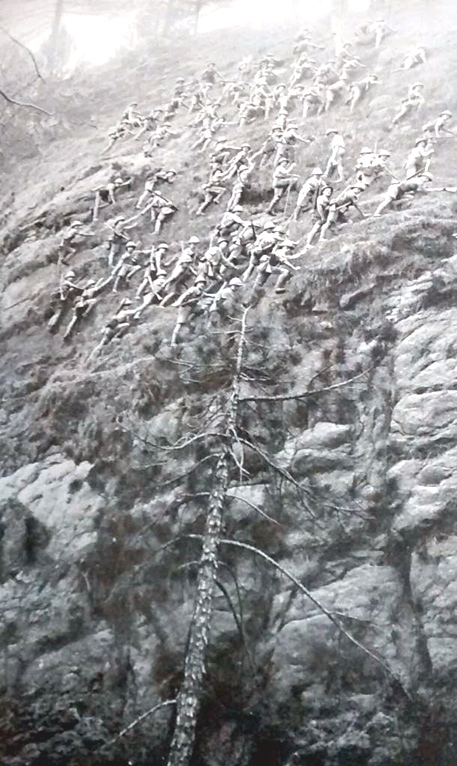
Soldiers of 2nd Rifle Brigade training in mountain warfare in
the Murree Hills in 1912
Great War Record
As a Regular battalion of trained professional soldiers, 2nd Rifle Brigade was needed urgently on the Western Front to reinforce the British Expeditionary Force (BEF). Consequently, the War Office ordered the battalion to return from India early. Its place – and that of many other Regular Army units in India - was taken by Territorial battalions from England, including several dozen Winchester men of the 4th Battalion, The Hampshire Regiment.
On 26 August 1914 2nd Rifle Brigade received orders to return to England. By 8 September hundreds of men – and in many cases their families as well – plus tons of baggage and equipment had been transported to Bombay docks. The 1914 Rifle Brigade Chronicle recorded this impressive logistical feat:
Early on Tuesday morning, 8 September, both troop trains steamed into Princes’ Dock, Bombay, only for us to find that we were not expected so soon and were not wanted for another week! Someone had blundered! However, we could not bed down for ten days on the quayside and so, at 10am, we started to embark on the S.S. Somali. By night the whole Battalion and all the baggage was on board and we had the first drink since Barakao, a free bottle of beer all round … and a very welcome drink it was too, for the Battalion had man-handled quite 50 tons of baggage three times, marched 40 miles by road, entrained, travelled 1,700 miles by rail, dis-entrained and embarked – all in 132 hours!
After a six-week voyage, 2nd Rifle Brigade arrived at Liverpool on 22 October 1914 and made their way by train down to Winchester. From here they marched the short distance to Hursley Park to join up with 25th Brigade, part of 8th Division, which was mobilising there.
On 25 October John Seward was appointed Acting-Corporal. It is likely that he took the opportunity to visit family and friends in Winchester before his battalion embarked for France, where it arrived on 7 November. Ten days later 2nd Rifle Brigade entered the front line for the first time, in trenches in front of the German-held village of Aubers, nine miles west of Lille in northern France. Almost immediately the weather, which had already been wet, took a turn for the worse. The Battalion Chronicle reported:
The trenches were full of mud and water on the 18th [November]and a heavy fall of snow made matters worse. On the night of the 18th a very hard frost set in, freezing the men’s wet boots with the result that almost all ranks suffered badly from swollen feet. Tallow and Vaseline have since been provided, and sandbags with straw in them for the men’s feet are now up in the trenches.
The severe weather led to more than 44 men being treated for frostbite of the feet on 22 November. For John Seward it must have seemed a far cry from the stifling heat and dust of India.
The 2nd Rifle Brigade did not take part in the First Battle of Ypres (19 October-22 November 1914) which saw the BEF suffer heavy casualties. However, the battalion did see action at the Battle of Neuve Chapelle between 10 and 13 March 1915. The battle, the BEF’s first major planned offensive of the war, involved 40,000 troops and the heaviest British artillery bombardment to date. The assaulting battalions managed to capture Neuve Chapelle village, but communications difficulties meant reinforcements were not called up in time to capitalise on this success.
John Seward and his battalion had spent 2-9 March out of the front line, training for the battle. On the day of the attack they quickly took the German front line trenches but were then forced to dig in after losing a ‘good many men’ from the fire of two enemy field guns and a machine-gun. Over the following three days 2nd Rifle Brigade suffered grievously as the Germans counter-attacked in a bid to recapture lost ground. By 13 March five officers had been killed, five wounded and two had died of wounds. Among the other ranks, 83 had been killed and 269 wounded. Another 15 men were missing.
It is not known whether any letters written by John Seward from the front to his family have survived. However, correspondence from one of his comrades, Rifleman Frederick Peters, gives some idea of what the men of 2nd Rifle Brigade endured during the Battle of Neuve Chapelle. Writing to his mother on 21 March 1915, Frederick stated:
I suppose you will have seen the letter I wrote to [sister] Edie by now so you will know that I came safely out of the big battle. No doubt you read all about it in the People [newspaper], but that was only the official reports. There will be a lot more details given when Sir John French [British Commander-in-Chief] issues his despatches. We were surprised to see what a big affair it was, according to the papers. We suddenly realised we had earnt a name in history, but we had a heavy price to pay for it. If you keep a look out in the People you will see the casualty lists published in three or four weeks’ time and will find a lot of Rifle Brigade names in them, for we were right in the thick of it.
Frederick gave more details of the battle in a letter home on 13 April 1915:
I saw those pictures of Neuve Chapelle in that piece of paper and was around the two spots all day. The Germans were shelling it, and bricks, tiles, and rafters kept falling about us. The ground was like a nutmeg grater, one mass of big holes caused by the terrific explosions. A cemetery was torn up, and all the headstones were smashed to atoms and strewed the ground. Dead bodies were blown up; some were of our poor fellows who had been killed about there in August or September. Anyone who visited the place now and was ignorant that a war was on, would think an earthquake had taken place.

16, Stockbridge Road, Winchester – this was home
to John Seward's family from 1916 to 1925
Less than a month later 2nd Rifle Brigade was in action again, at the Battle of Aubers Ridge. The battalion attacked near the village of Fromelles on 9 May with 24 officers and some 1,000 men. At 5am the following day when the battalion marched back to their billets 21 officers and 571 other ranks had been killed, wounded or were missing - the highest casualties of any unit involved that day. Among those who died were Rifleman Frederick Peters and Brigadier General Arthur Cole, the commander of 25th Brigade. The losses for the Aubers Ridge attack were just as catastrophic as any incurred more than a year later on 1 July 1916, the first day of the Battle of the Somme, but in 1915 it was the loss of the experienced professionals from the pre-war regulars that was so keenly felt.
John Seward was promoted to full Corporal on 10 May 1915, the day that 2nd Rifle Brigade came out of the line after Aubers Ridge. On 9 July John suffered gunshot wounds to the thigh and hand and was taken to 22nd General Hospital at Etaples. Four days later he was evacuated to the Horton (County of London) War Hospital in Epsom, Surrey, for treatment and rehabilitation. On 14 December 1915 he was posted to the 5th (Reserve) Battalion, Rifle Brigade, a depot/training unit based at Minster on the Isle of Sheppey where it formed part of the Thames and Medway Garrison.
In early 1916 John’s military career took a new turn when he transferred to the Machine Gun Corps (MGC) and was sent to Grantham, Lincolnshire, for training. The MGC had been set up in October 1915 in response to the need for more effective use of heavy machine guns on the Western Front. One MGC Company, usually comprising ten Vickers heavy machine guns, was attached to each infantry brigade. Each weapon required a team of six to eight men - one fired, one fed the ammunition and the rest helped to carry the weapon, its ammunition, and spare parts.
The Vickers machine gun had a reputation for great solidity and reliability. This was demonstrated in an action in August 1916 during the Somme Offensive when the 100th Machine Gun Company fired their ten Vickers guns continuously for 12 hours. Using 100 barrels, they fired a million rounds without a failure. During the war, the MGC earned a reputation for heroism as a fighting force. Some 170,500 officers and men served in the MGC, with 62,049 becoming casualties, including 12,498 killed, earning it the nickname ‘The Suicide Club’.
John Seward remained in England until 24 April 1916 when he embarked for France with 102nd Machine Gun Company. There the unit was assigned to 102nd Brigade, part of 34th Division. At some point over the next six months John transferred to the 101st Machine Gun Company, part of 101st Brigade, also in 34th Division. Both companies saw action at the Battle of Albert (1-13 July 1916), the opening phase of the Somme Offensive, although the 102nd Company was transferred to 37th Division after 102nd Brigade suffered exceptionally heavy casualties on 1 July.
The surviving military records do not show which company John served with on the Somme. However, they do reveal that on 4 October 1916 he was promoted to Sergeant in 101st Machine Gun Company. One possible scenario is that John served with 102nd Company until early October, transferring to 101st Company when the bloodletting on the Somme left it short of experienced NCOs.
By the start of 1917 John Seward was a hardened war veteran. His 12-year period of service in the Army should have ended on 8 April 1916, but intriguingly – and for reasons unknown - it did not in fact do so until a year later. An entry in his Army records states: ‘Continued in the service under the Military Service Act (Session 2) from 8-4-17’. The two Military Service Acts of 1916 (in January and May) introduced conscription in Britain for the first time, effectively putting the country on a ‘total war’ footing. One of the provisions stated that soldiers who had been discharged from the Army were eligible for service again. The implication here is that John wanted to leave the Army in April 1917 but was immediately conscripted back in.
John Seward’s next taste of action came in the Arras Offensive of April and May 1917. On April 9 – the day after it is thought that he was conscripted – John went over the top in the First Battle of the Scarpe. The assault, fought in tandem with the Battle of Vimy, brought considerable early gains before bogging down. The Scarpe battle ended on 14 April, but after a fortnight out of the line John found himself in the fray once more at the Battle of Arleux (28-29 April).
In terms of BEF lives lost each day, the Arras Offensive, which ended on 16 May, was the bloodiest of the entire war, yet John Seward again emerged unscathed. In addition to his good fortune, one senses that he had developed into a fine soldier, no longer the headstrong, rebellious Rifleman of his India years but an effective and trusted NCO. Tragically, however, his luck was about to run out.
From March 1917 the German army in the Somme sector of the Western Front had begun to pull back to new, heavily fortified positions known as the Hindenburg Line. The BEF advanced in the wake of the German retirement and eventually encountered the outposts of the Hindenburg Line, including the village of Hargicourt, situated between the towns of Peronne and St Quentin. The British attacked Hargicourt in April 1917 but made only limited gains. On 26 August, in pouring rain, 34th Division attacked again and captured enemy positions east of the village on a front of more than a mile. As in April, casualties were heavy and among those killed was 30-year-old Sergeant John Seward. His body was never found, suggesting that he and his machine-gun team may have been hit by an artillery shell.
Family after the Great War
Two of John’s brothers served in the war and survived. According to the Winchester War Service Register (WWSR), Charles Seward joined the Hampshire Regiment in October 1915 and fought in Mesopotamia before transferring to the Northumberland Fusiliers. He was wounded once. However, Army records indicate that instead of the Hampshires Charles served first with the Wiltshire Regiment.
George Seward, meanwhile, enlisted with the Hampshire Regiment in August 1915 and later transferred to the RAF. He served on the home front.
In 1916 John’s widowed mother Esther moved to 8, Lower Stockbridge Road which was renumbered 16, Stockbridge Road in 1918. This is the address given for John Seward in the WWSR compiled in 1921. The 1918 Warren’s Winchester Directory shows several of John’s siblings living at the house, including his sister Louisa and her husband Joseph Thorpe, a labourer, who she had married in 1917.
Esther Seward remained at 16, Stockbridge Road – which still stands - until 1925 when she moved with her son Charles to Hutment 31, Alresford Road, Winchester. This was one of 57 huts which had served as married quarters at the military camp on Morn Hill during the Great War. The huts were taken over by the local council after the war and provided homes for between 30 to 40 families before being demolished in around 1927.
There is no trace of Esther in Warren’s after 1927, but in 1939 she was living at Women Lodge, Beeding Hill, Sussex, with her daughter Esther Jnr and her son Charles and his wife Ellen who had married in 1937. She is thought to have died in Worthing, West Sussex, in 1940, aged 78. Charles Seward, who had been working as a pigman in 1939, died in Horsham, Sussex, in December 1973, aged 77. Esther Seward Jnr never married and died in Worthing in 1951 at the age of 57.
Louisa and Joseph Thorpe continued to live in Winchester and in 1939 were at 25, Fivefields Road (off Highcliffe Road). Louisa died in Winchester on 27 June 1952, aged 63. Sister Rosa married Percy Seymour in Winchester in 1919. Percy went on to serve in the RAF and the couple had at least one child, Ronald, who was born in 1924. Rosa died in Staffordshire in 1979, aged 78.
John’s brother George married Edith Luce in Cirencester, Gloucestershire, in October 1918. He was serving as a labourer in the RAF at the time, stationed at Queensferry in North Wales. In 1935 Edith gave birth to a daughter, Sylvia, and in 1939 the family were living in Cirencester with George working as a builder’s labourer. George died in Cirencester in 1958 at the age of 61. Alice Seward is believed to have married in Winchester in 1911 but no further trace of her can be found.
Medals and Memorials for John William Seward
Sergeant John William Seward was entitled to the 1914 (Mons) Star, the British War Medal and the Victory Medal. He has no known grave, but his name appears on the Thiepval Memorial, Somme, France (Pier and Face 5 C and 12 C). He is also mentioned on the memorials at St Paul’s and St Matthew’s churches, Winchester.