

Company Sergeant Major ERIC GRANVILLE SUTHERLAND RULE
10, St Paul’s Terrace, Winchester (4, St Paul’s Hill today)
Service numbers 4/25 and 200005. 1/4th Battalion, The Hampshire Regiment
Missing, presumed killed, Mesopotamia, 21 January 1916
Life Summary
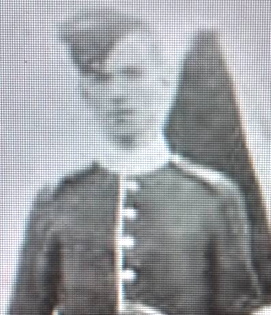
Company Sergeant Major Eric Granville Sutherland Rule
Eric Granville Sutherland Rule’s family roots lay in Scotland and the north of England, but he came to live and work in Winchester in the late 1890s. For more than a decade before 1914, Eric served as a part-time soldier with the Hampshire Regiment, initially with the 1st Volunteer Battalion and then as a Territorial with the 4th Battalion. During the Great War he served in India and Mesopotamia (modern Iraq). He was killed in January 1916 during an attempt to relieve the besieged British garrison at Kut-al-Amara. Eric Rule’s name does not appear on the Winchester War Service Register, probably because his family had moved away from the city before it was compiled.
Family Background
Eric was born in the village of Filford, near Farnham, Surrey, on 10 August 1878, the youngest son of Thomas Baillie Rule and his wife Elizabeth. Thomas had been born in 1825 in Dornoch, Sutherlandshire, in the Western Highlands. He worked variously as a carpet manufacturer, dealer and commission agent and was clearly a prosperous man - he is described as ‘gentleman’ under the heading ‘Quality, Trade or Profession’ on his son’s baptism record (dated 1 December 1878). A further indication of Thomas’s social standing is that in 1870 he was living with his family at 14, Hanley Road, Holloway, north London, next door to the very grand-sounding A.B. Dennistoun-Sword, solicitor.
Eric’s mother was born Elizabeth Ord in the city of Durham in 1837. The daughter of hatter and wig maker John Ord and his wife Rebecca, Elizabeth came from a respectable background. However, the Ords were blighted by family tragedy. Of Elizabeth’s 12 siblings, no fewer than seven died under the age of three and another aged just 11. However, Rebecca lived to be 88, surviving Elizabeth by 12 years.
Thomas and Elizabeth married in Bishopwearmouth, an area of Sunderland, County Durham, in 1867. Thomas’s work took him around the country with the result that Eric and his six siblings were born in various locations in Scotland and England – Ellen Gertrude (1862-) in Glasgow; Arthur John Percy (1865-1876) in Leicester; Florence Annie (1868-) in Tottenham, north London; Edith Jessica Margaret (1870-1874) in Hornsey, north London, William Taylor (1872-1873) in Surrey, and Charles Campbell (1874-1941) in Dalston, north-east London. Again, it is interesting to note that despite Thomas Rule’s apparent prosperity at least three of his six children died young. Diseases such as tuberculosis, scarlet fever and smallpox – not to mention cholera – were no respecters of class or status.
Thomas Rule died in the Guildford area in 1880, aged 55. The following year the family were living in Woking, Surrey, with his widow Elizabeth listed on that year’s census as an ‘annuitant’ – in other words she was receiving a pension, presumably provided by her late husband. It must have been a reasonable sum of money as Elizabeth was still able to afford to employ a servant. Elizabeth Rule died in Deal, Kent, in August 1890, aged 53. Intriguingly, probate for her estate was not granted until 1903 with Eric receiving £88 10s. Given his father’s apparent wealth this seems a rather paltry sum.
The period immediately following his mother’s death must have been a difficult time for Eric. The 1891 Census found him boarding at Kent County School in Burchington-on-Sea. It is possible that he spent school holidays with his surviving elder brother or sisters or with other family members.

Eric Rule’s home at 10, St Paul’s Terrace, Winchester, a short distance from
St Paul’s Church. The house is now 4, St Paul’s Hill
After leaving school, Eric appears to have moved to Winchester for work and by 1901 was employed as an auctioneer’s clerk, lodging at 6, Great Minster Street. Living at 2, Great Minster Street was Violet Mary Minter, who became Eric’s wife just a few weeks after the census. Violet had been born Mary Ann Minter in the rural parish of Westleton, Suffolk. Her father, Clifton, was born in 1850 and worked as a master tailor. Her mother, Naomi, was born in 1852.
Eric and Violet married in Ipswich in the second quarter of 1901 but continued to live in Winchester. On 19 December 1902 Violet gave birth to a son, Gordon Granville, in Winchester. A daughter, Beryl Enid, followed on 19 April 1905. Nothing is known of the children’s early education, but in 1914 Beryl entered the County High School for Girls in Cheriton Road.
The Rules lived at several addresses in Winchester. Between 1902 and 1903 they were at 36, Hyde Close and from 1904 to 1905 at Drysdale, a house in Owens Road. By 1911 the family were living at 10, St Paul’s Terrace, Upper Stockbridge Road. (Houses in the road were renumbered after the war and it is now 4, St Paul’s Hill). Living a few doors down the hill at No. 2 in 1914 was Andrew Bogie who fought in the same battalion as Eric during the war. Both men died in Mesopotamia.
Early Military Career
Eric Rule had a deep interest in military matters. We know this because the Royal Hampshire Regiment Museum in Winchester holds in its archives several scrapbooks and collections of photographs that Eric compiled. These illustrate events such as the Boer War as well as the annual summer camps that he attended as a part-time soldier. The earliest, a series of photos of the Hampshire Regiment’s 1st Volunteer Battalion on summer camp in Swanage, Dorset, dates from 1901. It shows that Eric joined the Regiment soon after he arrived in Winchester.
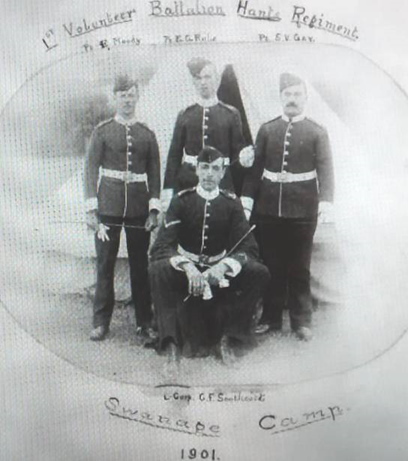
Eric Rule’s first summer camp with the Hampshire Regiment – at Swanage
in 1901, shortly after he moved to live in Winchester. Eric is back row, centre
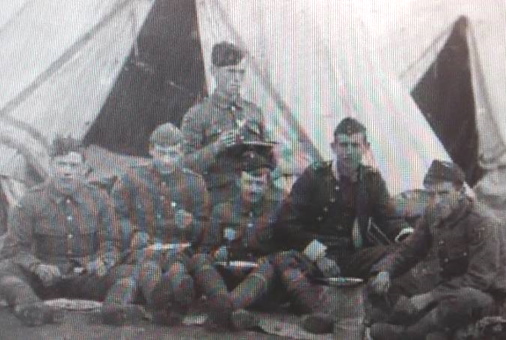
Lance-Corporal Eric Rule (rear) at summer camp with the
Hampshire Regiment’s 1st Volunteer Battalion in 1904

Butchers prepare meat at the Hampshire Regiment
summer camp on Morn Hill, Winchester, in 1904

Men of the 4th Hampshires at their summer camp at Bulford, Wiltshire, in July 1912.
Two years later, many of these part-time soldiers marched off to war
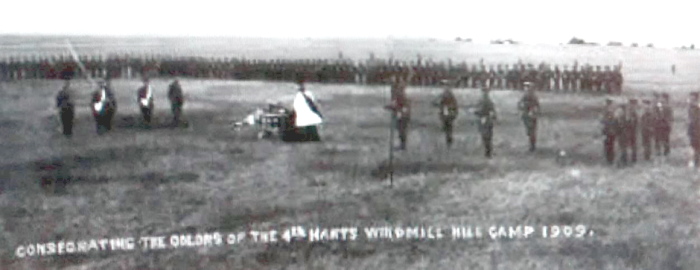
The Colours of the 4th Battalion, The Hampshire Regiment are consecrated at the
summer camp of 1909.The battalion had been formed the previous year as part of
the Haldane Army reforms (All photos: Royal Hampshire Regiment Museum)
The 1908 Haldane Army reforms created the Territorial Force and saw the 1st Volunteer Battalion replaced by the 4th Battalion, The Hampshire Regiment. Eric merely swapped the old battalion for the new. He was clearly a respected soldier and won promotion regularly so that by 1914 he had reached the rank of Colour-Sergeant.
Great War Record
Following Britain’s declaration of war in August that year Eric volunteered for overseas service and sailed for India with the 1/4th Hampshires in October. After three months’ training and acclimatising in India the battalion was sent to Mesopotamia as part of 6th Poona Division, arriving there on 18 March 1915.
At some point, either in India or in Mesopotamia, Eric was promoted again, to Company Sergeant Major (CSM). This put him in charge of discipline, standards and administration within his company of around 250 men. (Although most records state that Eric was a CSM when he died, the Army Register of Soldiers’ Effects, 1901-1929 states that he was Acting CSM.)
Eric Rule was killed on 21 January 1916 at the Battle of El-Hanna, an attack launched to try to break through to the 14,000 British and Indian troops under siege by Turkish forces at Kut-al-Amara. (For a full account of the siege of Kut and operations carried out by the 1/4th Battalion in Mesopotamia in 1915 see Mission Creep). It failed disastrously, with the 1/4th Hampshires losing 13 officers and 230 men killed, missing and wounded out of 16 and 339 in action. Eric Rule was among the dead, together with the battalion’s Commanding Officer, Lieutenant Colonel Frederick Bowker, and Private Sidney Coles who lived at 44, Western Road, Winchester, a short distance from Eric.
Eric Rule was 37 years old when he died. Although his body was never found, and he was officially listed as missing, presumed killed, his wife Violet clung to the hope that he may have survived and been taken prisoner in the battle. An entry in the Hampshire Regimental Journal of July 1916 states:
MISSING - Mrs E.G. Rule, 10, St Paul’s Terrace, Winchester, would be very grateful to anybody who could give her any definite news (first hand) of No. 25 Co-Sergt-Major E.G. Rule, 1/4th Hants Regt, reported missing in Mesopotamia since January 21st, 1916.
Family after the Great War
The Army Registers of Soldiers’ Effects, 1901-1929 shows that Violet Rule received £11 17s 9d on 25 July 1918 in respect of her late husband’s effects. Violet and her children moved to Chelsea, west London, before the war ended – there is no entry for her in the Warren’s Winchester Directory after 1916. Consequently, she would not have been in Winchester to provide the necessary information for Eric to be included in the WWSR. Violet died in Holborn, London, in 1931, her death being registered under her birth name Mary Ann.
Medals and Memorials for Eric Granville Sutherland Rule
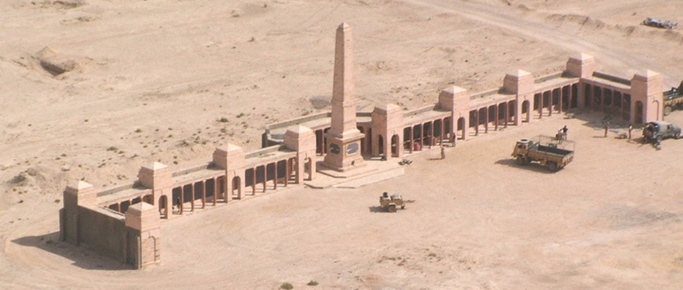
Basra Memorial, Iraq
Company Sergeant Major Eric Granville Sutherland Rule was entitled to the 1914-15 Star, the British War Medal and the Victory Medal. He is commemorated on the Basra Memorial (above), Iraq (Panel No. 21 and 63) and on the memorials at St Paul’s and St Matthew’s churches, Winchester.