

Gunner PERCY DOUGLAS NORGATE
4, Brassey Road and 46, Andover Road, Winchester
Service number 153118. 233rd Siege Battery, Royal Garrison Artillery
Died in German captivity, France, 10 August 1918
Family Background
Percy Douglas Norgate – he appears to have been known by his middle name - was born on 18 October 1879 in Bighton, near Alresford, Hampshire. His father, Michael, was a blacksmith who had been born in Bighton on 26 March 1837. His mother, Elizabeth (née Jacob), was a schoolteacher who was born in 1840 in Longwood, Hampshire, although her birthplace is also recorded as Tichbourne and Owslebury. The couple met when Elizabeth began lodging with Michael’s parents (also called Michael and Elizabeth) in the family’s home, The Knapp, after becoming a teacher at the Bighton village school in 1860.
Michael and Elizabeth married in Bighton on Christmas Eve 1862 and initially they lived with Michael’s parents and his brother Alfred. They had 12 children in 18 years, all born at home except for one who arrived while the family were temporarily living elsewhere after a fire which had started in the smithy damaged their home.
Four children died in childhood. Owen, aged six, and six-month-old Ernest fell victim to scarlet fever within a week of each other in February 1869. Then in May 1880 Edward, aged eight, and Ethel, aged three, died within five days of each other, presumably following another outbreak of an infectious disease. One child was probably stillborn in 1871. The remaining children lived into adulthood. Douglas grew up with six sisters - Amy, who was born in 1865, Minnie (1867), Clara (1870 and the one Norgate sibling not born at The Knapp), Ellen (1874) and Mabel (1875). Only one sister, Mary (1881), was younger than Douglas.
Michael’s father died in 1866 and his mother in 1873, long before their grandson Douglas was born. Michael’s brother Alfred continued to live with the family until his death. In the 1871 Census he was described as an ‘imbecile’ and in the 1881 Census as ‘an imbecile from childhood’, but by then he was contributing to the household finances after inheriting an annuity.
On 10 August 1888, Bighton School Log recorded that eight-year-old Douglas won a school prize for attendance. One wonders whether he had any choice but to attend given that his mother had been the school’s headmistress since 1864!
By 1891, Amy and Clara Norgate had left home as had 16-year-old Ellen who was working as a nurse maid in London. (Ellen kept a birthday book which has survived within the family and has proved invaluable for establishing actual dates of family events.) Minnie, then aged 24, was still at home and was an assistant school mistress working with her mother at Bighton School. Mabel, aged 15, was also still at home and was employed as a cook. Douglas, aged 11, and his younger sister Mary were still at school.
In about 1898, according to a family record, Douglas started to work in Winchester for Messrs Lipton Ltd, Grocers. However, he may also have worked in their Southampton branch as the 1901 Census records a Douglas Norgate boarding at 10, Magdalene Terrace in the St Mary’s district of Southampton and working as a grocer’s assistant. Douglas’s uncle Alfred, the ‘imbecile’, died in 1904, aged 62, and his father, Michael, in 1909, at the age of 72. The two brothers had lived in the same house all their lives. In 1909 Douglas’s mother retired from Bighton School after 49 years’ service, 45 as headmistress.
By 1911 Douglas was back in Winchester, boarding in Sussex Street at 37 (now the site of Cowdray House) and working as the manager of a grocery business, presumably Lipton’s. His mother Elizabeth was still living in Bighton along with his sister Minnie who had taken over as headmistress at the village school in 1909. Elizabeth also had two grandchildren with her on census night - Nelly Bartlett, aged 16, who was a pupil teacher, the third generation in the family to follow that profession, and Nelly’s brother, 12-year-old Clement. These were the children of her eldest daughter Amy who had married in 1893 but whose husband, Samuel Bartlett, had been killed in a road accident in 1904.
Elizabeth Norgate died in May 1915 and so did not live to see her son Douglas marry Annie Barnett in Winchester later that year. Annie, then 28, was a dressmaker in her own account, as was her elder sister, Mabel. Both women had been recorded working at home in the 1911 Census. Home was 46, Andover Road, which lay between Victoria Road and Worthy Lane. (The terrace which included No.46 no longer exists and Albert Court now stands in its place.)
The 1911 Census recorded Annie’s father, Thomas Barnett, aged 57, and her older brother, Charles, working as shoeing–smiths on their own account. Annie’s mother, Mary, also 57, had been born in Northamptonshire. She married Thomas, who was from Leicestershire, in about 1884. Their three children were all born in Newmarket, Suffolk. According to Warren’s Winchester Directory the family had moved to the city by 1893 and were living at 46, Andover Road.
The Winchester War Service Register gives Douglas’s address as 4, Brassey Road (the address then and now). However, the only record of the couple living there is the 1919 Electoral Register (Douglas is marked as ‘absent’); there is no trace of a Norgate living in Brassey Road in the relevant Warren’s Directories. The assumption must be that Douglas and Annie lived there for only a short time. The couple had one child, John, born on 7 May 1916 when Douglas was still manager at Lipton’s Groceries at 116/117, High Street. An article in the Hampshire Chronicle in March 1919 states that he had been a well-known figure in Winchester as manager of the Lipton’s shop, having worked there for 20 years.
Great War Record
Unlike many of the men in this book, Douglas Norgate chose not to volunteer for military service at the start of the war. Nor was he called up in the early phases of conscription in 1916 which suggests that he may have successfully appealed against being conscripted at a Military Service Tribunal. These bodies, formed by local councils, heard applications for exemption from conscription and one common argument given by appellants was that they performed work crucial to the war effort. Further research would be required, but it is possible that Lipton’s Grocers were involved in supplying food to the Army camps which sprang up around Winchester during the war and furthermore that Douglas argued that his role was crucial to the smooth-running of the business.
In April 1917, however, Douglas enlisted in the Army, almost certainly as a conscript. He joined the 233rd Siege Battery of the Royal Garrison Artillery as a gunner with the service number 153118. Siege Batteries were equipped with heavy howitzers which fired large calibre high explosive shells. As British artillery tactics developed during the Great War, heavy artillery was most often used to destroy or neutralise enemy guns and to bombard strongpoints, dumps, stores, roads and railways behind enemy lines. The 233rd Siege Battery formed part of 66th Heavy Artillery Group and took part in the Third Battle of Ypres (better known as Passchendaele) which was fought in Flanders between 31 July and 10 November 1917. It is likely that Douglas took part in some, or all, of the battery’s engagements during the campaign.
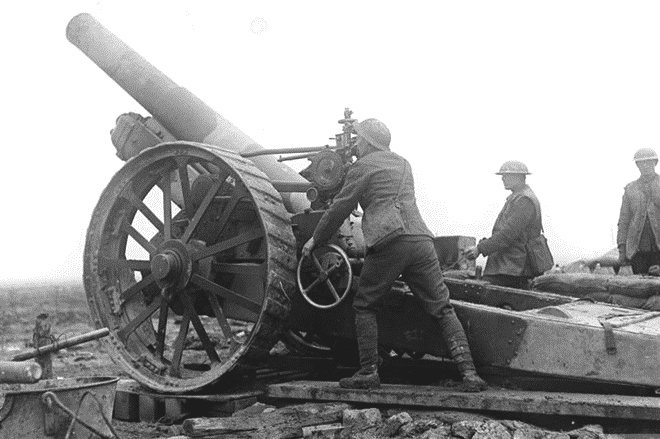
A British howitzer team in action on the Western Front in February 1918
Douglas was taken prisoner on 21 March 1918, the opening day of the German Spring Offensive on the Western Front. In just five hours the Germans fired one million artillery shells at positions held by the British Fifth Army – more than 3,000 every minute. The bombardment was followed by an attack by elite stormtroopers and by the end of the day 21,000 British soldiers, including Douglas, had been taken captured.
Although the Hampshire Chronicle reported on 3 March 1919 that Douglas had been taken to Gustrow PoW Camp in north Germany, this does not seem possible as he died of intestinal catarrh (gastro-enteritis) on 10 August 1918 in a German war hospital at Valenciennes, close to the Western Front. He was 38 years old. Douglas was first buried in a German extension to the cemetery at Valenciennes. A nameplate was put on the coffin and the site was marked with a temporary wooden cross. Later, the coffin was exhumed and reburied in a British extension to what appears to be the same cemetery, now known as Valenciennes (St Roch) Communal Cemetery.
Family after the Great War
Douglas’s personal effects amounted to £14 16s 3d, equivalent to about eight months’ pay for a gunner (1s 2½d per day). On 3 September 1919, the money was authorised to be released, with his widow Annie receiving approximately one third and his son John two thirds. It is believed that in late 1919 or early 1920 Annie left 4, Brassey Road and moved back to her family home at 46, Andover Road as that is the address given on Army records for Douglas’s next of kin.
Annie Norgate and her son remained in her parents’ house until 1937. The 1938 Warren’s Directory shows Annie as the named householder and in the 1939 Register, her occupation is listed as ‘housekeeper’, rather than ‘unpaid domestic labour’ which was the more usual description for married or widowed women in that record. The Register gives John Norgate’s occupation as a clerk of works in local government. The third member of the household in 1939 was Mabel Newbury, Annie’s sister, whose occupation is listed as dressmaker. It is not known why Mabel was living with her sister, but it is possible that her husband was serving in the forces.
Annie Norgate remained the named householder for 46, Andover Road until at least 1961, but by 1964 it had changed to her son John. Annie died in Winchester in 1968, aged about 81. She would have been the last person alive from the two families to have remembered Douglas. All his sisters were dead by then, along with Nelly and Augusta, the niece and nephew who had been staying with his mother at the time of the 1911 Census.
John Norgate continued to live at 46, Andover Road until 1972 when he would have been 56. By 1973, he had moved to 12, Lawn House, in Lawn Street, one of the new blocks of flats in the Friarsgate development. It is possible that the terrace that included 46, Andover Road was due for demolition; the property was listed as empty in the 1973-4 Warren’s Directory. John eventually retired to Brighton, Sussex, where he died, aged 75, in 1991.
Medals and Memorials for Percy Douglas Norgate
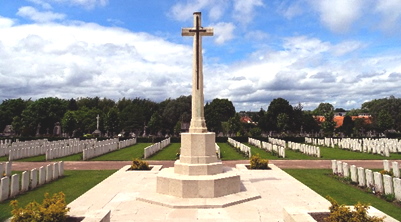
Valenciennes (St Roch) Communal Cemetery, Nord, Pas-de-Calais, France
Gunner Percy Douglas Norgate was entitled to the British War Medal and the Victory Medal. He is buried in Valenciennes (St Roch) Communal Cemetery, Nord, Pas-de-Calais, France (GR. V. R. 20). The family’s personal inscription on his headstone is:
PEACE PERFECT PEACE WITH LOVED ONES FAR AWAY
He is remembered on the memorials at St Matthew’s and St Paul’s churches, Winchester, as P.D. Norgate. All Saint’s in Bighton remembers him as D. Norgate. He is also commemorated as Percy D. Norgate on the war memorial at Holy Trinity Church, North Walls, Winchester, but it is not yet known what his or his family’s connection was with that parish.