

2nd Lieutenant ALAN HERBERT NEWTON
Morn Dale, Bereweeke Road, Winchester (No. 24 today)
2nd Battalion, The Duke of Cambridge’s Own (Middlesex Regiment)
Died of wounds, France, 7 April 1916
Life Summary
Alan Herbert Newton was born in Winchester on 10 March 1892, the son of Gertrude (née Eastment) and Thomas Edwin Newton. The second of four children, Alan came from a family of prosperous farmers on his father’s side while his mother was the daughter of a Dorset magistrate. The Great War interrupted his blossoming career in land management when he joined the Army in 1915. Alan served on the Western Front where he died of wounds the following year.
Family Background
The Newton family came from Twyford, near Winchester. Alan’s grandparents lived in Shawford House, a large property between Twyford and the neighbouring village of Shawford. His grandfather, William Edwin Newton, was born in Britford, near Salisbury, in 1816 and married twice. His first wife, Sarah (née Cozens), was born in 1821 and in the 1841 Census the couple were recorded living in Twyford where William was a farmer. In 1842 Sarah gave birth to a son, William Jnr, and then a daughter, Mary, three years later. Both children were born in Twyford. However, Sarah Newton died in 1846, aged about 25.
William was still a widower in the 1851 Census which also revealed that he was still living at Shawford House and farming 530 acres. He employed 18 labourers and five boys. His sister Martha was also living at the house, presumably looking after young William and Mary.
In July 1856 William Newton, then aged 39, married for a second time. His new wife, Sarah (née Lywood), was ten years younger and had been born in Clatford, near Andover, Hampshire, in 1828. The couple had four children, all born in Twyford: Thomas in 1858, John in 1859, Florence in 1861 and Lywood in 1864. William Newton died in 1870 but the following year’s census showed his widow and children still living at Shawford Farm along with a governess, two servants and the farm bailiff. It is not known where Thomas Newton went to school, although given that his family was wealthy, he may have attended Twyford Preparatory school.
By the time of the 1881 Census Sarah Newton had moved from Twyford to a house in Berrylands, near Kingston-upon-Thames, Surrey. Two of her children, John and Florence, were living with her along with two servants. Sarah was recorded as living on an annuity while John was working as a trainee architect. The youngest son, Lywood, was at boarding school in Buckinghamshire. Meanwhile, Thomas Newton had left home and was training as a land agent in Salisbury where he was lodging in Exeter Street.
On 8 May 1888, Thomas married 21-year-old Gertrude Eastment in Drayton, near Langport, Somerset. Gertrude had been born in Martock, Somerset, in October 1866 and was one of nine children. Her father, Francis, was a county magistrate, a salaried position, who had been born in Wincanton in 1831. He died in Sherborne, Dorset, in January 1882, leaving an estate of £10,674 5s 7d. (about £1.3 million today). Gertrude’s mother was born Kate Grant (1841-1916) in Portsmouth and she also came from a prosperous family – her father was a banker and magistrate.
By 1891 Thomas Newton was working as a land agent in Winchester and living at 30c Hyde Street, which was to be more usually known as Exeter House, with Gertrude and their daughter Elsie who had been born in 1890. The young couple had one residential servant. Exeter House, built towards the end of the 1870s, was a large detached house in a ¼ acre of grounds and with its own carriage sweep. Gertrude gave birth to three more children: Alan Herbert in 1892, Gertrude Joan in 1894 and Thomas Meade Bertram in 1896. All four children were born in Winchester, so Exeter House was probably Alan’s birthplace. The 1901 census recorded the family as still living at Exeter House. Thomas was again listed as a land agent and auctioneer and he appears to have had his own business as the census recorded him as an employer. In September of the same year Thomas’s mother, Alan’s grandmother, Sarah died in Surrey at the age of 73.
Thomas Newton’s business clearly continued to flourish in this period because in 1904 he and his family moved to the newly built Morn Dale in Bereweeke Road, Weeke, Winchester. (After the Newtons had left Exeter House, it became from 1906 the first home of Winchester High School for Girls, now The Westgate school. Rosewarne Court was built on its former site.) Morn Dale was a large 12-room house where, according to the 1911 Census, the Newtons employed two residential servants. The house is situated nearly opposite the later Bereweeke Avenue and was subsequently renamed ‘Thornleys’ and then ‘Tregony’. Now it is 24, Bereweeke Road.
By 1911 Alan Newton, then 19 years old, was studying to be a land agent at Reading University College, no doubt with his father’s approval. Alan was a member of the university’s Officer Training Corps, but sport appears to have been his true love and he was secretary of the Reading Athletic Club hockey team and vice-captain of the tennis club in both 1911 and 1912. It is not clear whether the athletic club concerned was the Reading University College organisation or the prestigious Reading Athletic Club, one of the oldest in the United Kingdom. Formed in November 1881, Reading A.C. was one of the inaugural clubs that formed the sport’s governing body, the Amateur Athletic Association.
Great War Record
Alan Newton’s whereabouts in August 1914 when the Great War broke out are not known. However, in May 1915, aged 24, he was commissioned into the 2nd Battalion, The Duke of Cambridge’s Own (Middlesex Regiment) with the rank of 2nd Lieutenant. His younger brother Thomas had enlisted as a Private with the Hampshire Regiment the previous year. On 2 June 1915 Alan joined his regiment on the Western Front in France. By this time, the 2nd Middlesex, a Regular Army unit, had been in France for seven months and had fought at the Battles of Neuve Chapelle and Aubers Ridge in the spring of 1915. The battalion, part of 23rd Brigade in 8th Division, saw action again in September 1915 at Bois Grenier, an unsuccessful diversionary attack that coincided with the Battle of Loos.
In January 1916, the 8th Division transferred to the Somme sector of the Western Front as part of the build-up for the major operation that was to be launched there on 1 July. The 8th Division attack on that fateful day was on the German-held village of Ovillers, just to the east of Albert. Alan Newton, however, never got a chance to fight in the Battle of the Somme because on April 7 1916, just a few weeks after his 24th birthday, he died of wounds, probably sustained during an artillery barrage or while raiding an enemy trench.
Family after the Great War
Probate records show that Alan left effects worth £170 1s 7d to his father. However, Thomas Newton himself died in Winchester in 1917 at the age of 58 and it was left to Alan’s widowed mother Gertrude to apply for his medals after the war. Gertrude Newton remained at Morn Dale with her two daughters until 1918 when she moved to Arundel, 17, Christchurch Road, St Cross, Winchester. In 1921 the family moved again, to 1, Clifton Hill, Winchester, where they remained until Gertrude’s death on 23 November 1939. In her will Gertrude left £10,285 to her daughters who took over the house on Clifton Hill and lived there until the early 1970s. Neither of the Newton sisters married: the 1939 National Register lists Elsie as a diocesan organiser for religious education and Gertrude as the chief clerk for motor taxation at Hampshire County Council. Elsie died in 1971 and Gertrude the following year.
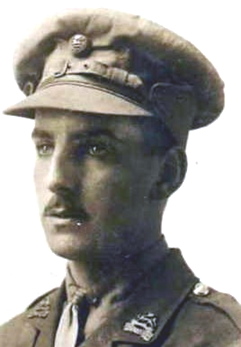
Alan Newton's brother, Thomas,
who served in the Army and the
Royal Flying Corps in the Great War
Alan Newton’s brother, Thomas, had an interesting military career. After enlisting with the 5th Battalion, The Hampshire Regiment he was commissioned into the 2nd Battalion, The Royal Berkshire Regiment with whom he served in France from 1916. However, in September 1915 he had gained his Royal Aero Club Aviators Certificate at the Military Flying School, Farnborough, which enabled him to subsequently transfer to the Royal Flying Corps with the rank of Captain. Thomas survived the war.
On 4 September 1918 Thomas married Edith Folkard, a 27-year-old bank manager’s daughter, at St Andrew’s Church, Farnham, Surrey. The couple, who are not believed to have had children, lived in Eashing, near Guildford, Surrey during the 1920s. When war broke out again in 1939 Thomas re-joined the RAF. He was killed, aged 44, in what is believed to have been an accident at Cranfield Aerodrome, Bletchley, Buckinghamshire, on 23 October 1940. His widow died in Buckinghamshire in 1975, aged 84.
Medals and Memorials for Alan Herbert Newton
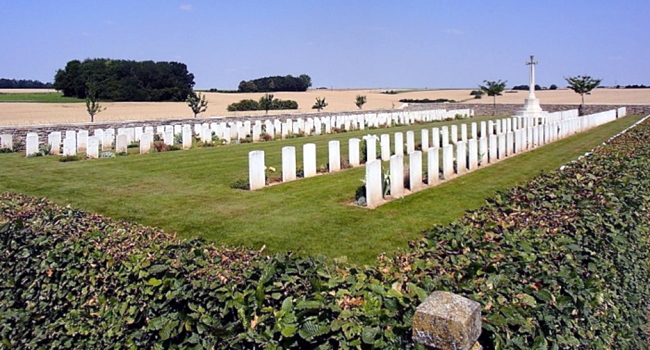
Millencourt Communal Cemetery Extension, Somme, Picardy, France
Alan Herbert Newton was entitled to the British War Medal, the 1914-15 Star and the Victory Medal. He is buried at Millencourt Communal Cemetery Extension, Somme, Picardy, France (GR. C. 38). His headstone bears the inscription:
THE LORD IS MY SHEPHERD PSALM 23
He is commemorated on the memorials at St Matthew’s and St Paul’s Churches, Winchester, as well as that located at St Cross Chapel, Winchester. His name also appears on the memorial at Reading University College.
Additional sources
- Christine Grover: Hyde from Dissolution to Victorian Suburb. (Winchester, The Victorian Heritage Press, 2012)