

Armourer Sergeant-Major DAVID THOMSON MORRISON (Believed to be A. Morrison listed on memorials)
19, Brassey Road, Winchester
Service numbers 655 and A/1663. 12th Section, Army Ordnance Corps
Died in Winchester, 24 February 1919
There is uncertainty over the identity of the soldier listed as A. Morrison on the memorials at St Paul’s and St Matthew’s churches. No one of that name appears in the Winchester War Service Register, the official censuses or Warren’s Winchester Directory. However, the records of the Commonwealth War Graves Commission do include a David Thomson Morrison, a pre-war Regular soldier who lived in Brassey Road. He served with the Army Ordnance Corps (which became the Royal Army Ordnance Corps in 1918) during the Great War and died in Winchester in early 1919. Errors on war memorials are not unknown and so, in the absence of an alternative explanation, the authors believe it is likely that David Morrison is the man listed on the two memorials.
Family Background
David Morrison was born in Edinburgh on 8 February 1866, the youngest of six children. His father, Alexander, was born in Salton, East Lothian, in 1824 and worked as a blacksmith. On 1 June 1846 Alexander married Isabella Harrison in Edinburgh. Isabella, who had been born around 1826, was the daughter of Edinburgh shoemaker William Harrison and his wife, also called Isabella. Alexander and Isabella went on to have five children in addition to David: Anna, born in 1850, Jane (1855), William (1858), John (1861) and Jessie (1863). All were born in Edinburgh.
David spent his childhood in Edinburgh. The 1871 Census showed the Morrisons living at 83, Rose Street, which is possibly where David had been born. Nothing is known of his education, but by 1881 when the family were at 108B, Rose Street, he was working as an apprentice to Edinburgh gunsmith John Dickson & Son, based in nearby Princes Street. Established in 1820, Dickson & Son had gained fame for their unique gun trigger plate mechanism that was admired for its strength, elegance and balance. David’s brothers were also working by this time - William as a printer’s machine-man and John as a blacksmith.
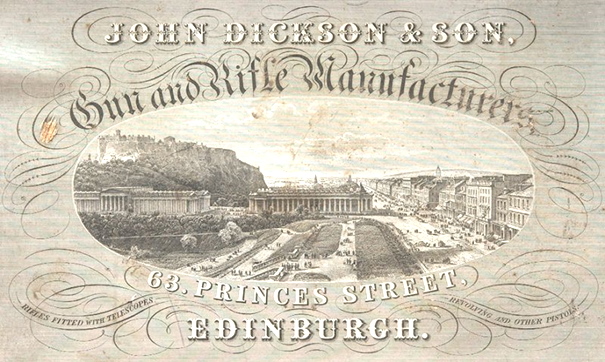
An advertisement for Edinburgh gunsmith John Dickson & Son
with whom David Morrison was apprenticed in the 1880s
Early Military Career
On 29 October 1888 David Morrison joined the Army in Birmingham, enlisting as a Private with the Corps of Armourers, a branch of the Army Ordnance Corps (AOC), for seven years plus five in the Reserve. However, over the course of his career he twice extended his period of service and ended up serving more than 25 years before his retirement in 1914. Although armourers were ‘badged’ and trained by the AOC most went on to serve with infantry battalions (one per battalion). Their job was to maintain and repair the unit’s rifles, pistols and other mechanical equipment – including, oddly enough, bicycles. With his background as a gunsmith David was perfectly suited to the role.
On enlisting, David received the service number 655. His Army records showed that he was 5ft 7in tall, weighed 9st 4lbs and had brown eyes and dark brown hair. He was clearly a good soldier because by the following March, after less than five months in the Army, he had been promoted to Armourer Sergeant, 2nd Class. David’s Army records show that besides military training and instruction he also received a more general education at the Royal Military Asylum, Chelsea, and the Royal Hibernian Military School in Dublin.
On 8 September 1889, David married Catherine Elizabeth Worrall at St Saviour’s Church, Birmingham. The couple had almost certainly met after David moved to the city to enlist. Catherine, known to friends and family as Lizzie, had been born in 1865 in the Aston area of Birmingham. Her father, Henry (1842-1894), was a pearl button maker and he and Catherine’s mother, Lucy (née Paddon 1843-1901), had a total of ten children together.
Within weeks of marrying, David was posted to India and his new bride either accompanied him or followed shortly afterwards. Once in India David was sent to the Ordnance Corps base at Allahabad (modern Prayagraj in the state of Uttar Pradesh) in November 1889 and then, a month later, to the AOC arsenal at Rawalpindi (in Punjab province in modern Pakistan). In April 1890 he was assigned to the 2nd Battalion, The Highland Light Infantry based in Peshawar (in modern Pakistan)
On 5 September 1890 Catherine Morrison gave birth to a daughter, Jessie, in Peshawar. Two more daughters followed – Lucy on 1 March 1892 and Helen on 1 September 1895. Both girls were born in Fyzabad (modern Faizabad in Uttar Pradesh, India).
As David’s family life prospered so, too, did his military career and on 1 March 1894 he was promoted to Armourer Sergeant 1st Class. However, life in India was starting to take its toll on his wife. During 1896 Catherine suffered frequent attacks of dyspepsia – a condition affecting the oesophagus, gullet and intestine – which led to vomiting and ultimately anaemia. She was sent to the hills to recuperate and prescribed iron tonics, but to little avail. In January 1897, an Army medical board recommended that Catherine, by this time pregnant with a fourth child, should return to England and that David should be allowed to go with her.
On 10 May 1897, two months after arriving back in England, David was posted to the 2nd Battalion, The Lincolnshire Regiment with whom he remained for a year before returning to the Ordnance Corps depot in Sheffield. Catherine, meanwhile, had given birth to another daughter, Lilian, on 18 June 1897. Lilian, however, died two years later and was one of two Morrison children to die in infancy. Another daughter, Elsie, was born in Sheffield on 3 January 1899, by which time it appears Catherine Morrison’s health had improved significantly.
In January 1900 David Morrison was posted to South Africa where he saw action in the Second Boer War. It is not known to which regiment he was assigned, but his Army records show that he remained overseas until 1903 and was awarded the King’s South Africa Medal with clasps for ‘Cape Colony’, ‘Paardeburg’ and ‘Johannesburg’. The Battle of Paardeburg, fought at Paardeburg Drift in Orange Free State between 18 and 27 February 1900, was particularly significant. In it, a 4,000-strong Boer force under General Piet Cronje was besieged and eventually forced to surrender to a British and Canadian army commanded by Field Marshal Lord Frederick Roberts and General Horatio Kitchener.
In June 1903 David returned to England where he was to spend the next 11 years of his Army career. The following month he was transferred to the AOC base at Colchester, Essex, before being promoted to Staff Armourer Sergeant on 5 December. A posting to 1st Battalion, The Grenadier Guards followed in March 1904 when his rank was redesignated as Armourer Quarter-Master-Sergeant. On 29 August, the same year Catherine gave birth to another daughter, Marjorie Primrose, in Windsor. The Morrisons were clearly moving around a great deal in this period because on 9 March 1906 a sixth surviving child, Grace, was born in Aldershot.
In 1909 David Morrison was presented with the Long Service and Good Conduct Medal together with a gratuity in recognition of his 21 years’ military service. The same year he was promoted to Armourer Sergeant-Major and posted to the Rifle Brigade Depot in Winchester where he settled down to spend what he believed would be his final five years in the armed forces.

19, Brassey Road, Winchester – David Morrison’s
home from 1913 until his death
The family moved in to 10, Brassey Road, a comfortable five-room house which became No. 19 when the street was renumbered in 1913. In the 1911 Census all the Morrison daughters except Jessie were living at the house, with 19-year-old Lucy working as a dressmaker and Elsie, aged 12, a pupil at the County High School for Girls in Cheriton Road. Jessie, meanwhile, was living in London and working as a dressmaker.
Great War Record
David Morrison retired from the Army on 3 February 1914, but he had little opportunity to enjoy his new-found leisure time. When war broke out six months later, he immediately re-joined his old Corps as a volunteer and was assigned the rank of Warrant Officer 1st Class. He received the new service number A/1663 and served with the 12th Section of the Army Ordnance Corps. Few details of David’s war record can be found but given that he was nearly 50 it is unlikely that he served overseas. It is believed that he probably served with the AOC at the Rifle Brigade Depot in Winchester.
David Morrison survived the war but just three months after the Armistice, he was suddenly taken ill – probably with Spanish flu – and died at his home on 24 February 1919. He was 53 years old. His obituary in the Hampshire Chronicle on 8 March 1919 stated:
MILITARY FUNERAL – The death took place on February 24th, at his residence Brassey Road, of Armourer Sergeant-Major David Thomas [sic] Morrison, Army Ordnance Corps. For five years prior to 1918 Armourer Sergeant-Major Morrison was at the Rifle Brigade Depot and he re-joined on the outbreak of war. In his earlier days he served in India and also in the South African War. He returned home from Stirling, where he had recently been employed, on February 14th, and was taken ill almost immediately, passing away as stated.
The funeral with full military honours was last Saturday afternoon. The body – enclosed in a coffin covered with the Union Jack, and on which were placed beautiful floral emblems – was borne on a gun carriage from the R.G.A. (Royal Garrison Artillery) Camp, the escort, firing party, band and buglers being furnished from the Rifle Depot. The first part of the service was conducted at St Paul’s Church, after which the cortege crossed the Rifle Depot Square to the cemetery at West Hill, where the interment took place.
Family after the Great War
Following her husband’s death Catherine Morrison continued to live at 19, Brassey Road before moving a few doors to No.7 in around 1930. Three of her daughters - Lucy, Marjorie and Grace – lived with her throughout the 1930s. Lucy and Marjorie both worked as clerks while Grace was a teacher. The three daughters, who never married, remained at 7, Brassey Road, following their mother’s death in 1948. Records show them living in the property in 1951 and Lucy was still there in 1954. She later moved to a new property in Bereweeke Avenue where she remained until her death in 1972, aged 80. Grace died in Winchester in 1988, aged 82, and Marjorie in 1991 at the age of 86.
Jessie Morrison also remained single. In 1939 she was working as a live-in domestic help for a family in Epsom and Ewell, Surrey. It is not known when she died. Helen Morrison, too, never married. In 1939 she was living in Bognor Regis and died in Winchester in 1981, aged 86. Elsie was the only Morrison daughter not to remain single. She married Wilfred Hurry in Gipping, near Stowmarket, Suffolk, in 1940 and died in Bury St Edmunds on 19 December 1992, aged 95. It is not known whether the couple had any children.
Medals and Memorials for David Thomson Morrison
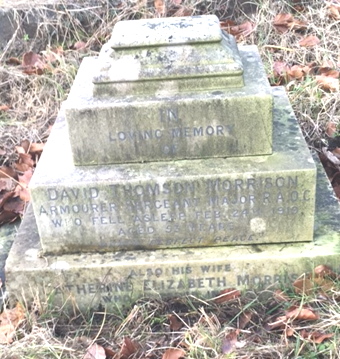
Armourer Sergeant-Major David Thomson Morrison
and his wife Catherine, grave in West Hill Cemetery, Winchester
Armourer Sergeant-Major David Thomson Morrison was not entitled to any Great War medals because it is not believed that he served in a theatre of war between 1914-18. Together with his wife Catherine, he is buried at West Hill Cemetery (grave above), Winchester (Record Plan No. 63 and GR. 16609). David is listed in the records of the Commonwealth War Graves Commission, but his grave is not typical of those instituted by the CWGC. It is inscribed with the words:
IN LOVING MEMORY
DAVID THOMPSON MORRISON
ARMOURER SERGEANT MAJOR R.O.A.C
Who fell asleep Feb 25th 1919
Aged 53 years
Peace Perfect Peace
Also his wife
Catherine Elizabeth Morrison
David Morrison is also commemorated on the memorials at St Paul’s and St Matthew’s churches, Winchester, under the name A. Morrison