

Lance-Corporal BERTRAM CHARLES MIDDLETON
50, Western Road, Winchester (7, Cheriton Road today)
Service number S/16457. 1/8th Battalion, Argyll and Sutherland Highlanders
Died of wounds, England, 21 May 1918
Life Summary
Bertram Charles Middleton, the eldest child of John and Charlotte Middleton, was born in Winchester on 24 October 1892. His father worked as a tailor and his mother was a trained dressmaker. One of four siblings, Bertram – or Bertie as he was known to family and friends - enlisted shortly after the outbreak of war in 1914 and served initially with the Army Pay Corps. He later transferred to the Argyll and Sutherland Highlanders and is believed to have fought with no fewer than four of the famous Scottish regiment’s battalions. He died of his wounds in England in 1918 after being wounded in Flanders during the German Spring Offensive and is buried in Winchester.
Family Background
John Middleton, Bertram’s father, was born in Hythe, near Southampton on 21 March 1865 and was one of six children. John’s father, William, worked as a gardener and had been born in Netherhampton, near Salisbury, in around 1828. John’s mother was born Caroline Palmer in the Berkshire village of Eastbury, between Newbury and Hungerford, in 1836. John had an older sister, Elizabeth (born 1863) as well as two younger sisters, Caroline (1866) and Alice (1869) and two brothers, William (1870) and Ernest (1874).
By 1871 William and Caroline Middleton had moved to Winchester and were living at 2, Queen’s Terrace, off the Romsey Road. Five years later, Caroline died at the age of just 40, leaving her widower husband to bring up their young family. The Middletons were still living in Queen’s Terrace in 1881 with 16-year-old John working as a tailor’s apprentice.
William Middleton died in Winchester in 1887, aged 60. His daughter Caroline had married the previous year and emigrated to Australia where, between 1888 and 1906, she had a large family of seven children (two more died in infancy). She died in Western Australia in 1908, aged 41. Ernest, the youngest sibling, also moved to Western Australia where he died in 1910 at the age of 37. By the time of the 1891 Census only John and Elizabeth Middleton were left living in the family home in Queen’s Terrace.
In 1891 or 1892, John Middleton married Charlotte Wood in Winchester. Charlotte had been born in Hursley, near Winchester, on 11 April 1865 and was the daughter of greengrocer Charles Wood and his wife Maria. In the 1891 Census, Charlotte was recorded living with her parents at 7, St James’s Street, Winchester, and working as a dressmaker. (The house is now 10, Romsey Road and in early 2020 was the unoccupied last shop up from The Westgate public house). Charlotte had a younger brother, William, who was a book binder.
John and Charlotte quickly started a family, with Bertram being born in October 1892. Charlotte then gave birth to a daughter, Freda, in early 1895, followed by Harold on 6 December 1896 and Lena on 11 November 1900. All the children were born in Winchester. By 1896 the family were living at 50, Western Road, Winchester, a six-room property in Fulflood. The house was later renumbered 7, Cheriton Road. John and Charlotte may have moved there earlier as the Warren’s Winchester Directories list an S. Middleton living at the house in 1891 and again from 1893-5 (the 1892 directory in the Hampshire Record Office is missing), but it is not known whether this is a typographical error.
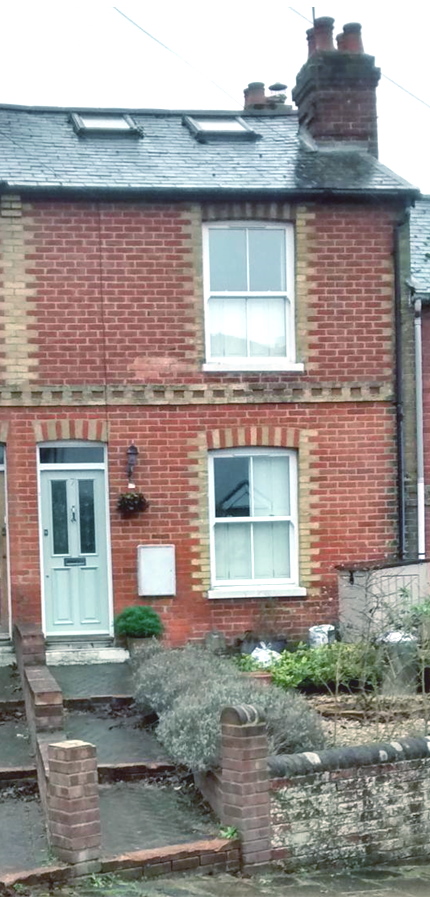
7, Cheriton Road, Winchester (it had been 50, Western Road before being
renumbered after the Great War). Bertram and his family lived here from at least
1896. His parents were recorded still living there as late as 1942
On 1 February 1900, seven-year-old Bertram entered St Thomas National Church of England Boys’ School, Winchester, having previously been a pupil at Western Infants School in Elm Road, Fulflood. His younger brother Harold also attended Western School between February 1904 and October 1910.
The Middletons were still at 50, Western Road in the 1911 Census which listed John as a tailor, Bertram, then 18, as a law clerk and 16-year-old Freda as a millinery apprentice. Harold and Lena, meanwhile, were both described as being at school, although Harold had probably already left by this time. Also living in the house was 81-year-old Maria Wood, Charlotte Middleton’s mother.
Great War Record
Bertram Middleton volunteered for military service in November 1914. This was at least three months after Britain declared war on Germany, suggesting that his decision to enlist was not taken in haste. He initially joined the Army Pay Corps (APC), which perhaps suited him given his civilian job as a clerk, but at some point he transferred into one of the British Army’s most famous fighting regiments, the Argyll and Sutherland Highlanders.
According to the World War One Service Medal and Award Rolls, 1914-20, Bertram served with four battalions of the Argylls – the 10th, the 11th, the 2nd and the 1/8th. Although it was common for men to join more than one battalion, to serve with four was rare. One possible explanation is that because these four battalions all fought on the Western Front, and the Argylls were often in the thickest of the fighting, casualties would have been high. Consequently, reinforcements from other units within the regiment (and elsewhere) would have been constantly required.
Unfortunately, no record has been found to indicate the dates when Bertram joined these battalions and nor does his Medal Index Card show when he first entered a theatre of war. Without these details it is extremely difficult to accurately piece together his military background. However, by using a degree of informed guesswork we can establish a rough outline.
What is known is that Bertram was not entitled to the 1914-15 Star which means that the earliest he could have seen action was 1916. Given that he served with four battalions, he must have been on the Western Front for a considerable time - it was unheard of for a man to serve with four battalions in six months or even a year. Therefore, it is not unreasonable to conclude that Bertram was posted to France sometime in 1916 after leaving the APC. If one accepts this premise, then it is possible to unlock some of the details of his military service.
The four battalions with which Bertram Middleton has been linked all fought in the major campaigns on the Western Front from 1916 until the spring of 1918 – namely the offensives on the Somme, at Arras and at Passchendaele plus the defensive battles during the German Spring Offensive. Although we cannot identify the individual actions in which he took part, Bertram probably fought in most, or all, of these campaigns. It also means that by the time of his death he was a tough, battle-hardened soldier.
While accepting that the precise details of where and when Bertram fought will never be known, it is believed that that he may have first seen action at the Battle of the Somme on 14 July 1916. Why? The four battalions as listed on Bertram’s Service Medal and Award Rolls begin with the 10th Argylls and end with the 1/8th. If the list is chronological, then Bertram was serving with the 1/8th Argylls when he suffered his fatal wounds in 1918. This is supported by the Soldiers Died in the Great War (SDGW) records but contradicted by Commonwealth War Graves Commission records which give his unit as the 2nd Argylls. For this biography it has been assumed that the last battalion Bertram served in was the 1/8th Argylls and that he began his fighting career in France with the 10th Argylls in 1916.
The 10th (Service) Battalion, The Argyll and Sutherland Highlanders had been formed at Stirling in August 1914 and came under orders of 27th Brigade in 9th (Scottish) Division. The battalion moved to billets in New Alresford, near Winchester, in November the same year and then to Bramshott in east Hampshire in February 1915. In May 1915, the Argylls were sent to France and transferred to 26th Brigade, also in 9th Division.
The 10th Argylls had been on the Western Front for about a year when Private Bertram Middleton is thought to have joined them. The battalion was in reserve on 1 July 1916, the opening day of the Somme Offensive, when the British Army suffered more than 57,000 casualties. However, it did take part in the dawn attack of 14 July on objectives that included the village of Longueval and Delville Wood. The assault involved new tactics, with some 22,000 men secretly assembling in the dark and then creeping forward into no-man’s land just before zero hour to reduce the distance to the German trenches.
In places, the British forced their way into the German line within seconds. The Argylls, who were attacking Longueval, had to cut their way through the barbed wire, but eventually broke through into the village. German troops in orchards on the northern edge of Longueval poured machine-gun fire on to the attackers, but the Argylls pushed on and even established a foothold in Delville Wood. The Argylls, with the rest of 26th Brigade, fought on for most of the day until exhausted and although unable to capture all of Longueval they did manage to consolidate and construct strongpoints before the Germans counter-attacked.
It is possible that Bertram Middleton took part in the action at Longueval, but for the reasons outlined above the details of the remainder of his military service on the Western Front remain obscure, with one exception – his final battle.
On 21 March 1918, the Germans launched their Spring Offensive in a bid to win the war before the arrival in Europe of hundreds of thousands of American troops. Having failed to achieve a decisive breakthrough in March, they turned their attention the following month to Flanders at the Battle of the Lys (7-29 April).
As stated previously, Bertram is believed to have been serving in Flanders with the 1/8th Argylls when the Lys offensive began. (Incidentally, the 2nd Argylls, listed by the CWGC as Bertram’s unit at the time, was posted in the same area.) The 1/8th Argylls, who came under orders of 183rd Brigade in 61st (South Midland) Division, found themselves blocking a German advance towards the strategically important railway town of Hazebrouck. So serious was the situation that on 11 April the British Commander-in-Chief, Field Marshal Sir Douglas Haig, issued a Special Order of the Day:
There is no other course open to us but to fight it out. Every position must be held to the last man: there must be no retirement. With our backs to the wall and believing in the justice of our cause each one of us must fight on to the end. The safety of our homes and the freedom of mankind alike depend upon the conduct of each one of us at this critical moment.
Between 12-15 April desperate fighting raged in the villages, fields and forests around Hazebrouck. On 12 April, Bertram Middleton was seriously wounded and after being taken from the battlefield to a Casualty Clearing Station he was evacuated to England. Despite being treated in hospital for more than a month he died of his wounds on 21 May 1918, aged 25. According to the Winchester War Service Register, he was a Lance-Corporal at the time he was wounded, but the date of this appointment is unknown.
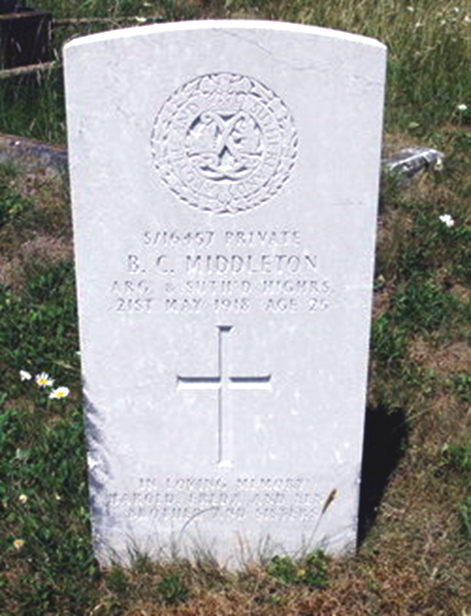
Bertram Middleton’s Commonwealth War Graves Commission
headstone in Winchester (West Hill) Cemetery.
Family after the Great War
After the war, John and Charlotte Middleton continued to live at 7, Cheriton Road and were still there in 1942. Army records show two war gratuity payments in respect of Bertram’s effects being made to Charlotte in 1918 and 1919. Although it has not been possible to establish when John died, records show that Charlotte passed away in Bournemouth in early 1957, aged 90.
Harold Middleton, Bertram’s brother, also fought in the Great War. He enlisted in 1916 and served as a sapper with the Royal Engineers on the home front, reaching the rank of Sergeant. He was not entitled to any medals because he did not enter a theatre of war. In 1923 Harold married 25-year-old Irene White in Winchester and the couple had a son who they named Bertram after Harold’s brother. Harold and Irene later moved to Reading where he worked as a clerk at a Ford car distributor. It is not known when Harold died.
Bertram’s eldest sister Freda married Edgar Bolwell in 1923. Edgar had served in the Great War with the Royal West Kent Regiment, rising from the ranks to become a 2nd Lieutenant before being discharged – presumably because of wounds – in June 1916. The couple, who are believed to have had one child, moved to Horsham, West Sussex, where Edgar worked as a teacher. He died in Bournemouth in 1963, but the date of Freda’s death is unknown.
Lena Middleton, Bertram’s youngest sibling, married Ernest Yaldren in Winchester on 17 December 1921. Ernest, who served in France with the Royal Berkshire Regiment in the war, came from a Winchester family and he and Lena appear to have remained in the city after marrying – in 1928 they were living at 28, Greenhill Road, Fulflood, and later moved to 76, Stuart Crescent, Stanmore. The couple had three children – Myra (1924-2012), Kenneth (1929-2013) and Cyril (1925-2008) – all of whom were born in Winchester. After Ernest’s death at St Paul’s Hospital, Winchester, in 1957, Lena remained in Stanmore until 1972 when she moved to 25, Godson House, Lawn Street, Winchester. She died on 14 February 1978, aged 77.
Medals and Memorials for Bertram Charles Middleton
Private Bertram Charles Middleton was entitled to the British War Medal and the Victory Medal. He is mentioned on the memorials at St Paul’s and St Matthew’s churches, Winchester, and on the St Thomas School War Memorial, now held at Kings School, Winchester. Bertram is buried in Winchester (West Hill) Cemetery (GR. 16516). In 1977 his gravestone was replaced by the Commonwealth War Graves Commission and now bears the following additional inscription:
IN LOVING MEMORY
HAROLD, FREDA AND LENA
BROTHERS AND SISTERS