

Lance-Corporal REGINALD HARRY MALE
Trevenna, Stockbridge Road, Winchester (No. 176 today)
Service Number 46366. 6th Battalion, Machine Gun Corps (Previously Trooper 1249, Hampshire Carabiniers Yeomanry)
Killed in action, France, 18 September 1918
Life Summary

Lance-Corporal Reginald Harry Male
Reginald Harry Male, the son of George Henry and Caroline Fanny Male, was born in Southampton (not Wyke Hill, Winchester, as stated in several sources) on 24 February 1897. He came from a comfortable background: his father was Superintendent of Winchester Post Office while Reginald himself attended Peter Symonds School before becoming a bank clerk in 1913. When war broke out, he enlisted with the Hampshire Carabiniers Yeomanry and later transferred to the Machine Gun Corps. Reginald served for two years on the Western Front and saw action in some of the bloodiest fighting there. He was killed in action in September 1918 during the British Army’s final advance to victory.
Family Background
Reginald’s father George was the son of Henry Male and his wife Caroline Kate (née Leverton and known by her middle name). Henry, a master mariner, had been born in Weymouth, Dorset, in around 1841 and Kate in Whiteparish, near Romsey, in March 1846. In the 1851 Census, Kate was at her maternal grandfather’s inn, The Three Tuns in Romsey, with her mother Louisa Leverton, a farmer’s wife. By the 1861 Census, Kate, then aged 16, was living with her brother William Leverton, by then the publican of The Three Tuns, and his wife Emma and their family.
Henry Male and Kate Leverton married in Mottisfont, near Romsey, on 16 April 1867. The following year, on 28 October, Kate gave birth to George – Reginald Male’s father - in Romsey. The 1871 Census recorded Henry, Kate and young George living at 10, Aberdeen Road, St Denys, Southampton. However, on 21 December 1875 Kate died at the age of just 29.
On 15 August 1877 Henry Male remarried. His second wife, Fanny Oake (1840-1922), had been born on the Isle of Wight in around 1840 and in 1861 she was employed as a maid in the Ryde home of Augustus Clifford, a retired Royal Navy Admiral. Fanny and Henry married in Lewisham, Kent, and in 1878 the couple had a son, Charles, a step-brother for George. The 1881 Census listed Fanny living at 3, Brighton Terrace, Southampton, with her occupation given as ‘lodging housekeeper’. Although young Charles was living with her on Census night Henry Male was not, although this was probably because he was at sea.
Meanwhile, George Male, Henry’s son by his first marriage, was being looked after by his uncle and aunt, William and Emma Leverton, at their home, Trout Cottage, Chilbolton, near Stockbridge, Hampshire. William was no longer a publican but employed as a schoolmaster. The 1881 Census also recorded another nephew living with the Levertons – nine-year-old Harry Male, probably George’s brother. No further record can be found of Harry Male, but it is worth noting that Reginald Male’s middle name was Harry.
There is no trace of George Male in the 1891 Census, but in 1893 his marriage to Caroline Lock was registered in Andover. Caroline had been born in Ringwood, Hampshire, on 23 January 1870. On 20 June 1894 she gave birth to a son, William, and a daughter, Winifred, on 15 August 1895. Both children were born in Southampton, as was Reginald, who arrived in 1897 and Gladys, born in 1900. It is possible that all the children were born at 84, Gordon Avenue, Portswood, Southampton, as this was the address given for the family in the 1901 Census. George, then aged 32, was working as a Post Office clerk and he and Caroline were prosperous enough to employ a live-in servant.
Reginald and William Male both attended Southampton Boys’ College, a private secondary school. However, in 1908 their father was appointed Chief Clerk at Winchester Post Office, then situated in Parchment Street, with the result that on 7 May 1909 Reginald and William were admitted to Peter Symonds School. (Reginald’s date of admission on the Peter Symonds records is given as 7 May 1907 but this is almost certainly an error.) The grammar school records do not show either boy receiving any sort of grant so one must assume their parents could afford the fees.
The Commonwealth War Graves Commission wrongly gives Reginald’s birthplace as Wyke Hill, Winchester. In fact, the Males moved from Southampton to live at Trevenna, Upper Stockbridge Road, which had previously been known as Wyke/Weeke Road or Hill. This may partly explain the error. Today, the house is No. 176, Stockbridge Road, although the name Ecclesfield – the name given to the property by the occupiers after the Males - also appears above the doorway.
William Male left Peter Symonds School in February 1911 to become an apprentice locomotive engineer, probably at the Eastleigh railway works. Reginald left just over two years later, on 7 June 1913. He joined the Alton branch of the Union of London and Smith’s Bank as a clerk and was working there when Britain went to war in August 1914.
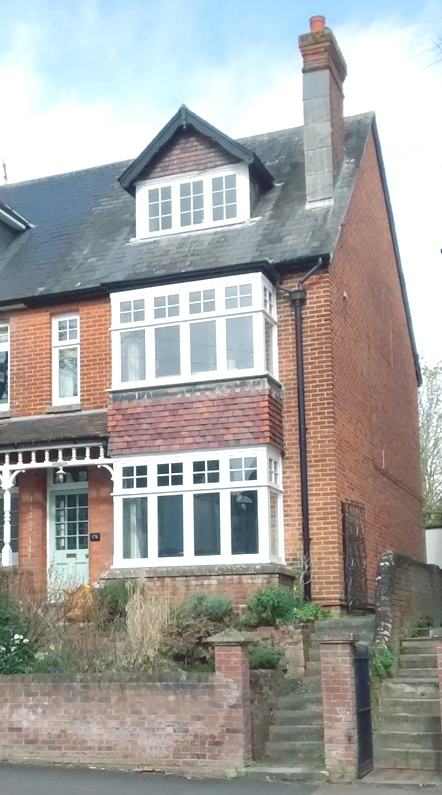
176, Stockbridge Road, Winchester, was the Male family home from
1908 to 1916 when it was known as Trevenna
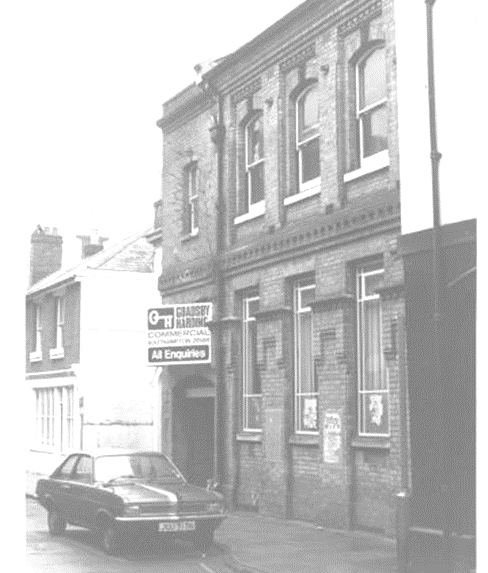
The old Winchester Post Office in Parchment Street
in the 1970s. Reginald Male’s father was Chief Clerk
and then Superintendent here from 1908 to 1916
Great War Record
The following month, aged 17, Reginald Male volunteered for military service, joining the Hampshire Carabiniers Yeomanry as a trooper with the service number 1249. The Hampshire Yeomanry, part of the Territorial Force, were trained and equipped as mounted infantry. The Drill Hall in Hyde Close, Winchester (a carpet showroom today and originally, in the mid-1800s, the city’s first museum), served as the unit’s headquarters and there were four Squadrons (A, B, C and D) based at Portsmouth, Winchester, Southampton, and Bournemouth. Which squadron Reginald joined is not known for certain, but it is likely that it was B, given that it was based in Winchester where he lived and had a detachment in Alton where he worked.
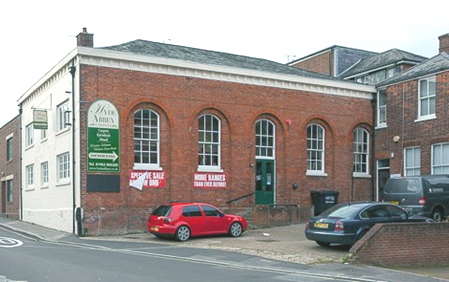
The Drill Hall in Hyde Close, Winchester, was the Hampshire
Carabiniers Yeomanry HQ at the outbreak of the Great War
when Reginald Male joined. Today it is a carpet showroom
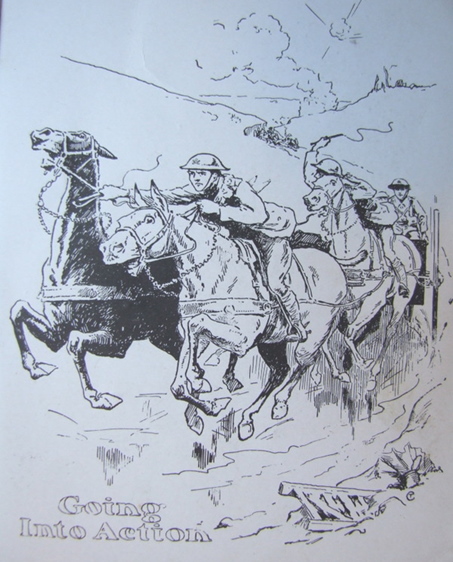
A contemporary artist’s impression of a Machine Gun Corps
transport limber going into action
Reginald did not fight overseas with the Hampshire Yeomanry. Instead he completed his basic training with them and then served on the home front, first in Portsmouth and then in Sussex. In April 1916 he was compulsorily transferred to the Machine Gun Corps (Infantry), which had been formed in September the previous year, and allocated the new service number 46366. Reginald was sent to the MGC HQ and Training Centre at Belton Park, near Grantham, Lincolnshire, for an intensive gunnery course before embarking for France in September as part of 16th Machine Gun Company in 6th Division.
In 1916, when Reginald Male arrived on the Western Front, all MGC teams were formed into Companies - one to each Brigade – comprising about 150 men and fielding 16 heavy Vickers MK1 machine guns. These were each operated in by a team of six men ¬– No. 1 who fired the gun, No. 2 who assisted, feeding ammunition belts, No. 3 a range taker using an optical instrument, No. 4 the signaller, and Nos. 5 and 6 who carried boxes of ammunition and doubled up as runners or scouts. This accounted for 96 men. The majority of those remaining served in the transport section which operated six four-wheeled limbers (wagons) drawn by horses or mules. Their purpose was to keep the guns supplied with ammunition, spares and other materials from dumps several miles behind the front line. It was an arduous and dangerous job since the Germans kept all the roads and tracks leading to the front under constant bombardment.
It appears that Reginald initially served with the gun section and that he also doubled as servant to one of the Company officers. He later transferred to the transport section, no doubt because of his expertise with horses gained while serving with the Hampshire Carabiniers. He would have enjoyed periods of home leave, but from 1917 these would have been spent in Pembroke, South Wales, where his father had been appointed Postmaster at the docks Post Office.
The heavy machine gun was one of the most effective weapons of the Great War and there are numerous instances of a single well-placed weapon cutting great swathes in attacking infantry – most notably on 1 July 1916, the first day of the British Army’s Somme offensive. It followed that multiple machine guns, with interlocking fields of fire, were an incredibly destructive defensive weapons system and the Germans employed them in huge numbers after withdrawing to the Hindenburg Line in spring 1917. The British copied this but also used machine guns during attacks – in particular, creeping barrages, where fire fell ahead of the artillery barrage to catch enemy troops moving to the rear. Machine gunners like Reginald would also concentrate fire on specific targets or sweep the ground behind the enemy’s front and support positions. For these tasks, machine guns were generally placed about 1000 yards behind the advancing infantry and then moved up as soon as the enemy positions were captured.
The Somme Offensive was still raging when Reginald arrived in France in September 1916. The precise date that he joined his unit is unknown, but it may have been in time for him to see action at the Battle of Flers-Courcelette (15-22 September), the capture of Lesboeufs (25 September) and the Battle of Morval (25-28 September). He almost certainly took part in the Battle of the Transloy Ridges (9-18 October). The following year 16th Machine Gun Company was involved in the fighting on Hill 70 near Lens (13-22 April 1917) and then in the tank attack at Cambrai (20-21 November), the capture of Bourlon Wood (23-28 November) and helping to stem the German counter-attacks (30 November-3 December).
By the start of 1918 Reginald Male was a hardened veteran of the Western Front and had been promoted to Lance-Corporal. That spring the four Machine Gun Companies in each Division were amalgamated to form Machine Gun Corps Battalions, the old 16th Company becoming A Company of the 6th Battalion MGC. The unit was heavily involved during the German Spring Offensive – at the Battle of St Quentin (21-22 March), the Battle of Bailleul (13-15 April), the Second Battle of Kemmel Ridge (25-26 April) and the Battle of the Scherpenberg (29 April).
Reginald survived this bitter fighting after which 6th MG Battalion enjoyed a period out of the front line to rest and re-equip. During the summer, the tide of the war began to change in favour of the Allies and by September the British Army had recaptured much of the ground lost in the spring. On 18 September, Reginald – by this stage serving in the battalion’s transport section – took part in a major assault on the French village of Epehy, which guarded the approach to the Hindenburg Line. He was killed in action the same day, aged 21.
On 28 September 1918, under the headline Roll of Honour (page 5), the Hampshire Chronicle reported:
Lance-Corpl. R.H. Male MGC – the many friends in Winchester of Mr G.H. Male, Postmaster of Pembroke Docks (formerly Superintendent at Winchester Post Office), will regret to hear that he has this week received the news that his youngest son, Reginald Harry, was killed in action in France on September 18th.
Lance-Corpl. Male – whose age was 21 – previous to joining the Army was a clerk in the Union of London and Smiths Bank at Alton. In September 1914, at the age of 17, he joined the Hampshire Carabiniers Yeomanry. In April 1916 he was transferred to the Machine Gun Corps Depot at Grantham and proceeded overseas to France in September 1916.
The Commanding Officer of the section, in a letter to Mr Male informing him of his son’s death, writes: ‘Personally, I viewed Lance-Corpl. Male’s career with the greatest interest. He was my personal messenger a good while ago, when we were both in the gun sections, and as such I had many opportunities of observing his unswerving devotion to duty and the high personal regard with which he imbued all those with whom he came into contact. The Battalion has lost a good soldier, but we of the Transport have lost more than that – we have lost a loveable and faithful comrade.’
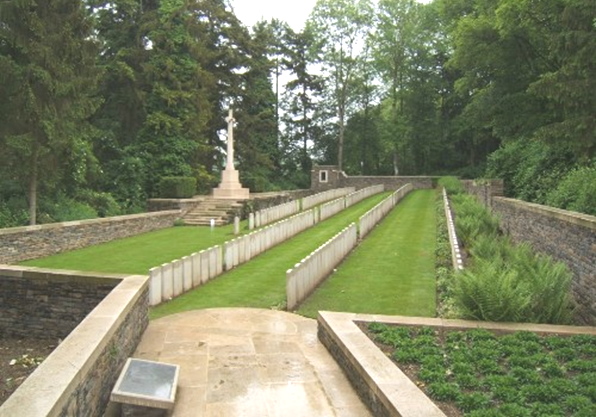
Trefcon British Cemetery at Caulaincourt, northern France,
where Reginald Male is buried
Family after the Great War
Reginald’s parents had, of course, moved from Winchester by this time but they clearly still had friends in the city, including, presumably, in Fulflood and Weeke. This explains why they decided to have their son’s name included on the parish war memorial. The Commonwealth War Graves Commission gives George and Caroline Male’s address as Holland House, Church Street, Malvern, Worcestershire, which is possibly the address to which they moved after George was transferred by the Post Office from Pembroke in the early to mid-1920s.
By 1939 George Male had retired and he and Caroline were living at 10, Brightlands Avenue, Bournemouth, along with their daughter Winifred who was unmarried. George died in Bournemouth on 26 February 1941, aged 72. In his will he left £443 5s to Caroline who died in early 1963 at the age of 92 or 93. Winifred Male was recorded working as an ARP warden in the 1939 Register. No further record of her has been found to date.
It is not known whether William Male, Reginald’s elder brother, served during the Great War; it is possible that his job as a railway engineer was a reserved occupation. In 1929 he married Mildred Morgan in Ashby-de-la-Zouch, Leicestershire. Ten years later, the couple were living in Birmingham with William employed as an inspector of engineering parts at the Austin works where he was also an ARP warden. It is not believed that he and Mildred had any children. William died in Birmingham on 3 April 1974, aged 79, leaving £9,289 in his will.
Reginald’s younger sister, Gladys, is thought to have married Alfred Walker in Southampton in 1932 and died in Winchester in September 1998, aged 98.
Medals and Memorials for Reginald Harry Male
Lance-Corporal Reginald Harry Male was entitled to the British War Medal and the Victory Medal. He is buried at Trefcon British Cemetery, Caulaincourt, Aisne, France (GR. B. 10). His headstone is inscribed with the following:
THY WILL BE DONE
Reginald is mentioned on the memorials at St Paul’s and St Matthew’s churches, Winchester, as well as on the Peter Symonds School War Memorial. His name also appears on the National Provincial and Union Bank of England War Memorial in the City of London, the Pembroke and Monkton War Memorial in Pembroke, Dyfed, and the memorial at St Mary the Virgin Church, Pembroke.br
Additional sources
- We are grateful to Graham Sacker of the Machine Gun Corps Database for his assistance in tracing Reginald Male’s service with 16th Company MGC and 6th Battalion MGC and for explaining the role of the MGC transport section.
- Trefcon British Cemetery - WW1 Cemeteries.com
https://www.ww1cemeteries.com/trefcon-british-cemetery.html - See also https://astreetnearyou.org/person/273271/Lance-Corporal-Reginald-Harry-Male