

Sergeant HUBERT GEORGE MAIDMENT
2, Gladstone Street, Winchester (no longer standing)
Service number 2760. 2nd (City of London) Battalion, The London Regiment (Royal Fusiliers)
Killed in action, France, 17 September 1916
Life Summary
Hubert George Maidment was born in Winchester in 1892, the second child of William and Alice Maidment. He trained to be a teacher before volunteering for military service with the City of London Battalion. Hubert fought at Gallipoli in 1915 and at the Battle of the Somme the following year where he was killed in action.
Family Background
Hubert’s father William was born in Wilton, near Salisbury, on 24 April 1865, the son of agricultural labourer John Maidment. William worked first as a florist and fruiterer and later as a gardener and nurseryman. Hubert’s mother was born Alice Bell in Sunderland, County Durham, on 6 March 1861. William and Alice also had a daughter, Alice Lizzie, who was born in Winchester on 21 November 1888.
The 1891 Census showed the Maidments living at 10, Boundary Street, Winchester, with William employed as a gardener. (Boundary Street was Hubert’s probable birthplace, but the address no longer exists. The street was at right angles to and on the western side of Eastgate Street.) After Hubert’s birth the following year, the family moved at some stage to 153, High Street, Winchester, to the west of Cross Keys Passage, which is where they were listed in the 1901 Census. William was a florist and fruiterer so presumably had a shop there.
By 1908 the Maidments had moved to 2, Gladstone Street, Winchester, where they remained for many years. Although it is not known which infants and primary school Hubert attended, he was clearly an able student as he went on to Peter Symonds Boys' Grammar School. We know this because his name is listed on the war memorial there. Given that his family were not particularly well-off, it can probably be assumed that he received a grant to pay for all or part of his fees.
Like all Symonds students, Hubert would have enlisted with the school's section of the Officer Training Corps which was linked to the local Territorial battalion, the 4th Hampshires. His experience of the OTC would put him in good stead when the Great War broke out and may be the reason he won promotion so rapidly.
In the 1911 Census William Maidment was working as a gardener and nurseryman and his daughter Alice as a dental secretary. Hubert, who had by then left Peter Symonds School, was training to be a teacher. The evidence suggests that this was not at the Diocesan Training College in Winchester (he is not listed on the College war memorial).
The Maidments remained at 2, Gladstone Street until 1913 when they moved next door to 1, Gladstone Street. So that would have been the family address from which Hubert went to war and that explains why it is 1, Gladstone Street that appears in the Winchester War Service Register of 1921. The Maidment family are believed to have worshipped at the Primitive Methodist chapel in Parchment Street as Hubert’s name appears on the memorial board there. It is possible that the chapel supported Hubert financially through his teacher training. After qualifying as a teacher Hubert moved to London, where he started work as a teacher employed by London County Council.
Hubert enlisted with the 2nd (City of London) Battalion, The London Regiment (Royal Fusiliers) with the service number 2760 on 21 September 1914, about six weeks after the start of the Great War. As volunteers flocked into its ranks the 2nd Royal Fusiliers were divided into first, second, third and, eventually, fourth line battalions – namely the 1/2nd, 2/2nd, 3/2nd and 4/2nd.
Great War Record
The Winchester War Service Register (WWSR), in which his name appears as Herbert, states that Hubert served in Malta and Gallipoli with the Royal Fusiliers. The 1/2nd and 2/2nd Battalions were both stationed on Malta and both saw action at Gallipoli in 1915. However, whereas the 1/2nd Battalion fought for the whole of the Gallipoli campaign, landing there on 25 April 1915, the 2/2nd did not arrive until much later in the year. Hubert almost certainly served with the 2/2nd Battalion as his Medal Index Card shows him entering the Egyptian theatre of war on 30 August 1915, the same day that the 2/2nd arrived there from Malta. The 2/2nd remained in Egypt for about six weeks before embarking for Gallipoli, landing at Cape Helles on 13 October when they joined 2nd Brigade in the Royal Naval Division.
The Allies had started to run down the Gallipoli campaign by the time Hubert arrived and the battalion’s time in the trenches was quiet compared to what had gone before. He did, however, endure a great storm and blizzard at the end of November. In December, the battalion was evacuated from Gallipoli and sailed via the Greek island of Lemnos to Egypt, arriving there on 24 January. In April, the 2/2nd Royal Fusiliers transferred to France where they were disbanded the following month with most men sent to other units. Among these were three officers and 126 other ranks who were sent to the 1/2nd Battalion and it is thought they included Hubert Maidment.
The 1/2nd Royal Fusiliers had been assigned to 169th Brigade in the 56th (London) Division when it arrived in France from Gallipoli in February 1916. After joining his new battalion, Hubert began training for the British summer offensive on the Somme. He had probably already been promoted to Lance-Corporal and would go on to reach the rank of Sergeant.
On 1 July 1916, the first day of the Somme Offensive, 56th Division took part in a diversionary assault on the village of Gommecourt, at the northern end of the British Army’s 13-mile long attack sector. It proved a disaster, with the Division losing more than 4,000 men killed, missing and wounded. The Division was then pulled out of the line until 9 September when it returned to take part in the Battle of Ginchy. A week later, 52nd Division went over the top again at the Battle of Flers-Courcelette (15-22 September) which featured the first use of tanks in military history. Hubert Maidment was killed in action on the opening day of the battle, aged 24. His body was never found.
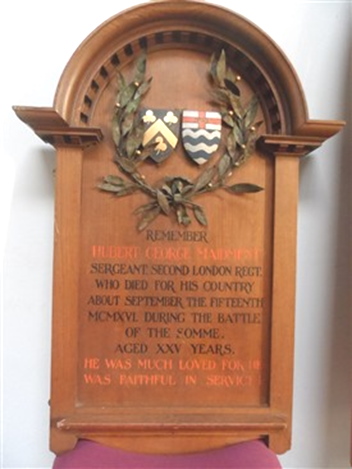
The Parchment Street Methodist Church memorial
to Hubert Maidment, now held at the United Church in Jewry Street
Family after the Great War
Hubert’s parents, William and Alice, remained at 1, Gladstone Street until about 1930, when they moved to 53, Brassey Road. William Maidment continued to work as a market gardener after the war. In 1939 he and Alice were still living at 53, Brassey Road together with their 23-year-old granddaughter Ruth Hunter. Ruth was the daughter of Hubert’s sister Alice and her husband Cecil Hunter, a dentist, who had married in 1914. William Maidment died in Winchester in 1946.
Medals and Memorials for Hubert George Maidment
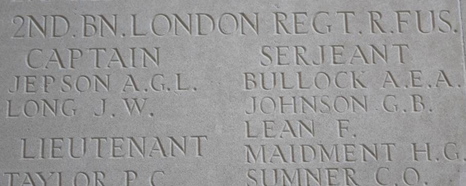
Thiepval Memorial, Somme, France
Sergeant Hubert George Maidment was entitled to the 1914-15 Star, the British War Medal and the Victory Medal. He is commemorated on the Thiepval Memorial (above), Somme, France (Pier & Face 9D & 16B). His name also appears on the memorials at St Matthew’s and St Paul’s churches, Winchester (although as H.S. Maidment), and on a special memorial erected at Parchment Street Methodist Church, Winchester, and now held at the United Church, Jewry Street.