

Private GEORGE ALLAN LOVELOCK
10, Greenhill Road, Winchester
Service number 3/4553. 10th (Service) Battalion, The Hampshire Regiment
Killed in Action, Gallipoli, between 9 and 21 August 1915
Life Summary
George Allan Lovelock was born on 23 March 1882, one of the 11 children of Thomas and Sarah Lovelock. George joined the Army in 1901 but was discharged the same year. However, he joined the Special Reserve and was called up for military service with the Hampshire Regiment when Britain went to war in August 1914. He was killed in action at Gallipoli the following year.
Family Background
George’s father Thomas was born in about 1847 in St Cross, Winchester. In the 1851 Census Thomas was recorded living at 28, Back Street, St Cross, with his parents, William and Sarah Lovelock and elder sister Daisy. William Lovelock, a farm labourer, had been born in the village of Compton, near Winchester, in about 1793, and Sarah in neighbouring Otterbourne in about 1803.
In 1861 the family still lived in Back Street and young Thomas was working as a shop boy. Ten years later, with William Lovelock dead, Sarah and Thomas were boarding at 1, Back Street, the widow working as a laundry charwoman and her son as a domestic gardener.
George’s mother was born Sarah Hopkins in Winchester in about 1852, the daughter of George and Elizabeth Hopkins. George Hopkins had been born in Christchurch, near Bournemouth, in around 1818. In 1851 he was living with his wife and two elder daughters at 8, Sussex Street, Winchester, and working as a journeyman tailor. Ten years later he was a pork butcher and the family, including nine-year-old Sarah, were living at 17, High Street, Winchester. By 1881 George was working as a tailor once more and living with his wife at 35, Jewry Street, Winchester. Elizabeth Hopkins (née Bishop) had been born around 1815. Her place of birth is given variously as London and Colerne, Wiltshire, on the censuses.
Thomas Lovelock and Sarah Hopkins married in Weeke, Winchester, on 28 October 1874. Two years later the first of their children, Sarah Jnr, was born in Winchester. She was followed by Louisa (1878), William (1879), Ellen (1880), George himself in 1882, Thomas (1883), Alice (1885), Amelia (1886), Eva (1888, but died the same year), Daisy (1889) and Horace (1891, but died the same year). Sarah gave birth to all the children in Winchester apart from Amelia and Daisy who were born in Longparish, near Andover.
In 1881 Thomas, Sarah and their four elder children were living at 4, Abbey Passage, Winchester. Thomas was working as a gardener. By 1891 the family had moved to 15, Elm Road, Fulflood, and in that year’s census no fewer than 12 people were recorded living in the house. George, by then nine, was a pupil at Central Infants School in Winchester. He moved up to St Thomas Senior Church of England Boys’ School on 21 February 1893 and left on 12 March 1896, as he approached his 14th birthday. A few months earlier, on 9 December 1895, his mother had died, aged just 43. One wonders just how much the strain of giving birth to, and caring for, 11 children in 17 years contributed to her early death.
George Lovelock joined the Army on 26 March 1901 with the service number 8378. He signed up with the Rifle Brigade for seven years plus five years in the Reserve. His attestation papers reveal that he was working as a labourer when he enlisted and that he had been serving in the Militia. The Militia was Britain’s military reserve force which was transformed into the Special Reserve in 1908 when the Territorial Force also came into being. George’s Army records also reveal that he had previously been rejected for military service because he was underweight.
Within a few days of joining up, George was stationed in barracks in Gosport. However, his time in the Army proved short-lived as he was discharged the same year, possibly on physical fitness grounds. This setback failed to put George off the Army because at some point in the following years he joined the Special Reserve.
In July 1910 George married Lillian Jeffery In Winchester. Lillian had been born in Otterbourne in August 1883, one of the seven children of William and Ann Jeffery. By the following year’s census, the newly-weds were living at 14, Staple Gardens, Winchester, with George working as a house painter. By 1912 they had moved to 85, Upper Stockbridge Road, and in 1914 were living at 10, Greenhill Road which is George’s address in the Winchester War Service Register (WWSR).
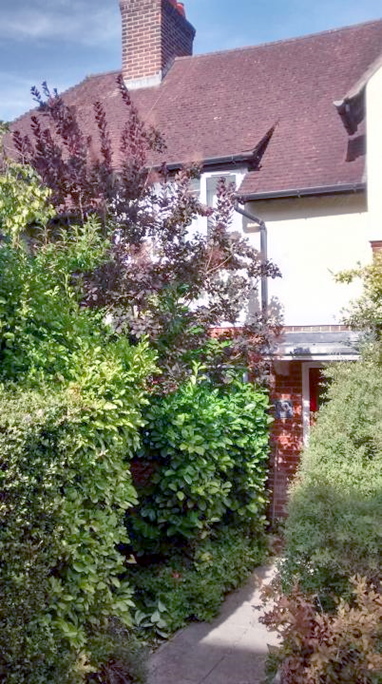
10, Greenhill Road, Winchester - George
Lovelock was living here in August 1914
In 1914, 10, Greenhill Road was just two years old. It was built and owned by the Winchester Working Men’s Housing Society (WWMHS) which provided affordable homes for rent in the city. One of 82 houses in Milverton Road, Greenhill Road and Cheriton Road, it was first rented out in 1912. Among those living in a WWMHS property was George Lever who was lodging with his mother-in-law Maria Holt at 11, Milverton Road. George Lever was killed in action in France in October 1914 and his name appears with George Lovelock’s on the memorials at St Matthew’s and St Paul’s churches. See George Lever's biography.
Great War Record
As a Special Reservist (his service number 3/4553 confirms this), George Lovelock would have been called up when Britain declared war in August 1914. He was assigned to the 10th (Service) Battalion, The Hampshire Regiment, which was initially composed of Reservists and volunteers. The 10th Battalion was originally formed in Winchester, but after being attached to 10th Division, which was made up largely of Irish units, it was sent to Dublin to complete its formation. The battalion later moved to Mullingar where the men underwent rigorous training.
In May 1915, the 10th Hampshires returned to England with 10th Division for final training in the Basingstoke area. It was assumed that 10th Division would be sent to the Western Front, but in June it received orders to prepare for service at Gallipoli. The change of destination meant much re-equipping and re-fitting but on 6 July 1915 the battalion embarked at Liverpool for the Mediterranean.
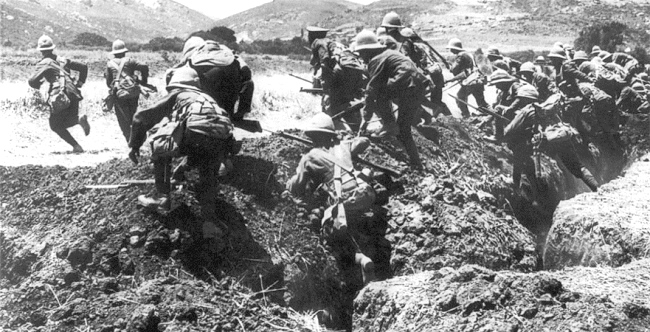
British troops on Lemnos in training for Gallipoli in the summer of 1915. Many older
Reservists such as George Lovelock were found to be in poor physical condition
when they reached the island. George was killed within a month of arriving here
George Lovelock entered a theatre of war on 22 July when the battalion landed at Lemnos, an island in the eastern Mediterranean close to the Turkish coast and the ‘jumping off point’ for troops engaged in the attack on Gallipoli. Today Lemnos is a pleasant Greek tourist destination, but it was utterly different in 1915. According to C.T. Atkinson, the Hampshire Regiment’s official biographer of the war, the 10th Battalion quickly became acquainted with ‘the flies, the dust, the thirst … and the diarrhoea which were the chief features of residence on Lemnos’.
Atkinson states that many of the battalion’s experienced soldiers – Reservists such as George Lovelock – were in a poor physical state when they were sent into battle at Gallipoli. This was because they were generally older and because the ship that had transported the battalion to the Mediterranean had been so crowded that physical exercise had been impossible.
George Lovelock died at Gallipoli in August 1915 although the exact date and place of his death are unclear. According to the WWSR it was on 9 August, during the Battle of Sari Bair (6-21 August 1915), the final attempt by the British to seize control of the Gallipoli Peninsula from the Turks. The battle proved costly for the 10th Hampshires who lost 10 officers and 155 other ranks killed or missing and 276 wounded between 6 and 10 August. However, both the Commonwealth War Graves Commission and Soldiers Died in the Great War state that George was killed on 21 August in the attack on a Turkish position known as Hill 60. Here the 10th Battalion lost another 43 men killed and missing and 110 wounded. George’s body was never found. He was 33 years old when he died.
Family after the Great War
George’s brother Thomas also served in the Great War. After marrying Louisa Budd in Winchester in 1911, he signed up with the Rifle Brigade in Basingstoke in January 1915, aged 33. His attestation papers show that he was living and working as a butler in Preston Candover, near Basingstoke, and that he had previously served with the Rifle Brigade for eight years. Thomas survived the war, but no record can be found of his life afterwards or when he died.
Lillian Lovelock, George’s widow, never remarried. In 1941 she was living at 47, North Walls, Winchester, and she died in the city in June 1965 at the age of 81. George’s father remained a widower until his death in Winchester in 1929, aged 82.
Apart from sister Sarah, all of George’s siblings moved away from Winchester. Sarah married John Page in 1896 and the couple’s first daughter, Henrietta, was born the following year. A second girl, Violet, arrived in 1900 and by 1901 the family were living at 23 Union Street, Winchester, together with George and Sarah’s younger sister Amelia, then aged 14. One assumes this arrangement was to help ease the burden on their widowed father. In 1911 the Pages were living at 85, Upper Stockbridge Road, together with Henrietta and Violet as well as Louise Lovelock, 33, another sister of George and Sarah. No record can be found of Sarah, Amelia or Louise’s death.
Medals and Memorials for George Allan Lovelock

Helles Memorial, Turkey
Private George Allan Lovelock was entitled to the 1914-15 Star, the British War Medal and the Victory Medal. He is commemorated on the Helles Memorial (above), Turkey (PR. Panel 125-134 or 223-226, 228-229 & 328.) and on the memorials at St Matthew’s and St Paul’s churches, Winchester. His name also appears on the St Thomas Church of England Boys’ School Memorial, which is now held at Kings’ School, Winchester.