

Private ERNEST ALBERT LAWRANCE
56/86 Lower Stockbridge Road, Winchester (now 15, Stockbridge Road) and 25, Greenhill Road
Service numbers 5091 and 33643. 2/5th Battalion, The Gloucestershire Regiment and 1st Battalion, The Devonshire Regiment
Killed in action, France, 22 April 1918
Family Background
Ernest Albert Lawrance was born on 10 August 1884 in Winchester. He was the fifth child of gardener Charles Lanham Lawrance, who was born in Romsey in 1851 and his wife Betsy (née Grass) She had been born in 1851 or 1852 in Tollard Royal, Wiltshire. As an adult Ernest was probably known as Albert as his military service records show his two birth names switched round – he is listed as Albert E. Lawrance in the Winchester War Service Register (WWSR), for example. To avoid confusion, this biography uses the Christian name Ernest throughout but does state when he chose to use Albert. The family’s surname was also spelt variously Lawrance and Lawrence, but the former is used here.
Ernest’s parents married in Romsey in 1873 and by the 1881 Census they were living at 24, North Walls, Winchester, with three children. The eldest, Frances Mildred, aged six and at school, had been born in Romsey, while four-year-old Frederick Charles and William, aged one, were both born in Bighton, near Alresford. Their ages suggest that the Lawrances had moved to Winchester in about 1879 or 1880. The family home has long been demolished but used to be one of several houses and two pubs that once stood in the gap that is now the pedestrian entrance to St Peter’s car park. The 1881 Census records that there were 16 occupants in No. 24 made up of four families.
Charles and Betsy were to have three more children, all born in Winchester. Edith Rose was born on 9 July 1881 and Ernest followed three years later. The last child, Alfred Henry, is believed to have been born on 4 August 1887.
The Warren’s Directory of 1884 shows the family living at 22, Wyke Road, Fulflood, which is probably where Ernest was born. The Lawrances stayed at the house until at least 1897. Fulflood was an expanding suburb at that time and there were frequent re-numberings and changes of road names. Thus, the address of the Lawrances’ home was recorded variously as 22, Wyke Road, 56, Lower Stockbridge Road and 86, Lower Stockbridge Road. The modern address is 15, Stockbridge Road, the right-hand half of Ripples bathroom store. In the late 1890s it was part of a row of residences with The Red Deer public house on the corner of Elm Road as the only commercial premises.
The 1891 Census showed that Ernest’s eldest sister, Frances, had left home to train as a housemaid at ‘the House for Training Servants’ in Whippingham, within the royal estate of Osborne on the Isle of Wight. In the same census, Frederick Lawrance was recorded working as an errand boy while William, Edith and six-year-old Ernest were all at school. All three may have gone to Western Infants School in Elm Road with Edith probably moving up into Western Girls Elementary School on the same site.
Which elementary school Ernest and William attended is not known but it may have been St Thomas Church of England Boys’ School in Mews Lane, Winchester. The youngest Lawrance child, Alfred, almost certainly went there - according to the school’s records an Alfred Henry Lawrence, born on 4 August 1887, and who lived in Lower Stockbridge Road, entered St Thomas’s on 4 March 1895, from Western Infants School. It is believed that this is the correct Alfred Lawrance, although the father’s name was given as Thomas, not Charles. According to the school records, Alfred was readmitted on 20 January 1897 and again on 5 April with no reason given for the need for re-admission. However, the final entry records that he left on 8 July 1897, aged nine, because of illness.

15, Stockbridge Road, Winchester. Ernest Lawrance is believed to have been born
in 1884 in the right-hand side of what today is Ripples bathroom store and spent his
childhood living there.Originally, the house was 22, Wyke Road and later became
56 and then 86, Stockbridge Road before finally being renumbered No. 15
Ernest’s father died in Winchester in 1897, aged 46. His widow, Betsy, was listed in the Warren’s Directory the following year (confusingly, at 87, Lower Stockbridge Road, not 86), but this is the last time she was recorded living in Winchester under the name of Lawrance. It is believed she may have married a John Coster sometime before 1901 because the census of that year showed a John and Betsy Coster living as boarders at 54, Lower Brook Street, Winchester, together with Alfred Lawrance, then aged 14.
No records have been found for John and Betsy Coster’s marriage nor can either be found in the 1911 Census as a couple or John Coster on his own. However, the census does have an entry for a Betsy Lawra/ence (the spelling is not clear), a widow, who was an inmate at the Hursley Workhouse in Hursley Road, Chandlers Ford. Her previous occupation was a ‘domestic’. If this is Ernest Lawrance’s mother, the wrong age, 49, was given for her. She was in fact 59 but workhouse records were often inaccurate and significantly the workhouse entry does give Betsy’s correct birthplace. The fate of John Coster is unclear although the death of a man of that name, aged 64, was recorded in 1915 at Andover, not far from his birthplace at Amport.
In 1900, 16-year-old Ernest Lawrance joined the Royal Navy at Portsmouth, using the Christian name Albert. He is believed to have signed up for 12 years and gave his previous occupation as a bugler with the 3rd Hampshire Militia. In his service record he is described as 5ft 4½ins tall, with dark brown hair, grey eyes and a dark complexion. He was already well tattooed on both arms with horseshoes, whips, butterflies, a heart with an arrow through it and an anchor on each arm. He also had a scar on one of his wrists.
On 17 December 1900 Ernest, with the rating of Boy 2nd Class, was sent to HMS Boscowen, a boys’ naval shore training establishment at Portland, Dorset. In the 1901 Census, he was among a long list of ‘2nd Class Boys’ on HMS Boscawen. From 14 June 1901 his sub-rating was that of Bugler. Ernest appears to have served mainly on older ships that were accommodation vessels for HMS Boscawen, and therefore permanently moored off Portland.
As a bugler, Ernest’s duties would have included signalling wake up and lights out as well as taking part in the ceremonial aspects of ship’s life. He would also have been fully trained as a naval rating. On 5 June 1902 Ernest was sent to the accommodation ship HMS Agincourt and made Boy 1st Class. Just a few weeks later, he transferred to HMS Camperdown and on 10 August was promoted to Ordinary Seaman.
HMS Camperdown had been recommissioned in 1900 as a Royal Navy coastguard ship, patrolling near the coastguard station on the shores of Lough Swilly, County Donegal. The loch provided sheltered anchorage for the Royal Navy on the Western Approaches to the British Isles and a Royal Artillery fort at the entrance testified to its importance. The son of the coastguard from 1896-1901 remembered as a child what a dramatic picture the Channel Fleet made steaming out of the lough and how on one occasion the coastguard families were invited aboard HMS Camperdown. Ernest served on Camperdown from 6 August 1902 until 5 May 1903, around the time that she was paid off and put into the reserve fleet.
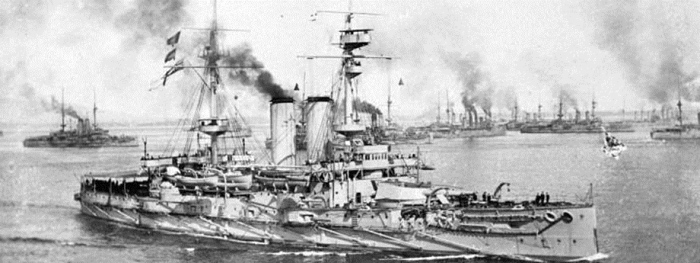
The battleship HMS Exmouth on which Able Seaman Albert Lawrance served between 1904 and 1905
On 18 May 1904 Ernest Lawrance was promoted to Able Seaman and assigned to the battleship HMS Exmouth, flagship of the Vice Admiral of the Home Fleet, Sir Arthur Wilson. Ernest spent a year on HMS Exmouth before being sent to HMS Excellent, the Navy gunnery school, on Whale Island, Portsmouth, in May 1905. The following month his sub-rating became Seaman-Gunner, but within days he was transferred again, this time to Nelson’s flagship HMS Victory, which was then being used as an accommodation vessel. On 4 January 1906, Ernest was invalided out of the Navy at the age of just 21.
By the 1911 Census, the former seaman was calling himself Ernest Lawrance once more and working as a gardener in Chandlers Ford. He was living with his sister Frances, her husband George Goodall and their three children in a house in Southampton Road, which they shared with another family.
Frances and George had married in Winchester in 1895 and by 1901 they were living at 2, Mill Yard, Laverstoke, near Basingstoke, where George worked as a stoker in the local paper mills (started by the Huguenot Portal family in 1719 and now the Bombay Sapphire Distillery). The couple had two young sons, Frederick and Bertram, and a daughter, Ethel, was born in 1902. By 1911 the family had moved to Chandler’s Ford with George, then aged 40, employed as a carter to a coal merchant. However, early the following year, Frances Goodall died aged just 37.
Ernest’s eldest brother, Frederick, can also be traced up to 1911. Frederick married in 1900 – his wife Alice had been born in Vernham, Berkshire – and in the following year’s census the couple were recorded living at 12, Winchester Road, Eastleigh, a property they shared with another couple and their young child. Frederick worked as a coal merchant’s carman. By 1911, the Lawrances, still childless, were living at 23, Winchester Road (possibly the renumbered No.12). That year’s census also provides reasonably convincing evidence of the correct spelling of the family surname – Frederick, by then a railway contractor’s porter, has clearly signed the census form as ‘Lawrance’. After the 1911 Census, records for Frederick and Alice Lawrance become less certain.
What of Ernest’s other sister, Edith? In 1901, aged 20, she was one of three laundry maids at the Andover Road Laundry which served Winton House school. Two years later Edith married Walter Herridge in Winchester and the newly-weds went to live with Walter’s father, jobbing gardener Edward Herridge, at 9, Greenhill Road (now No.17). Edward, Walter and Edith were still at the house in 1911 when Walter was working as a labourer. The couple had three children – Elizabeth, Albert and Edward and a fourth, Edith (named after her mother), was born in 1914. The extended Herridge family may have lived at 11, Brassey Road for a while but the records in Warren’s do not paint a clear picture. By 1914 Edward Herridge was back in Greenhill Road but at No. 25 (the house number then and now), and the address given in the WWSR in 1921 for Ernest Lawrance.
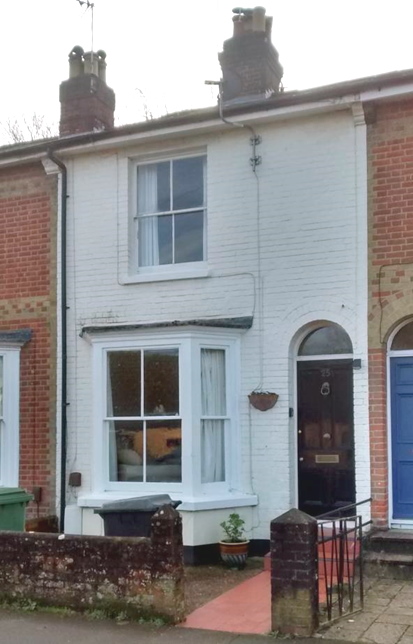
25, Greenhill Road, where Ernest’s sister Edith moved with her husband and
family in 1914 – it is Ernest’s address in the Winchester War Service Register
Ernest’s younger brother Alfred has been more difficult to trace. As mentioned earlier he may have been living with at 54, Lower Brook Street in 1901 with his mother Betsy and her new husband John Coster. In 1903 an Alfred Lawre/ance (the signature on his attestation papers is difficult to read) enlisted with the Hampshire Regiment as a militiaman, the forerunners of the Territorials. He signed up for six years with the service number 617. On his attestation papers, dated 26 August 1903, he gave his occupation as labourer. Nothing is known about Alfred’s military career nor has he been found in the 1911 Census. However, there is a record for an Alfred Lawrance’s death in Winchester in the late summer of 1913 at the age of 25 which would be the correct age if he died before 4 August.
Great War Record
In March 1916, 31-year-old Ernest Lawrance joined the British Army as Albert E. Lawrance. His service records show that he was living in Eastleigh at the time, possibly still with his brother Frederick and sister-in-law Alice. The date of March 1916 suggests that he may have been among the first waves of single men aged 18-40 to be conscripted – the introduction of compulsion had begun two months earlier.
Ernest enlisted as a private with the 2/5th Battalion, The Gloucestershire Regiment in Winchester. The 2/5th Glosters were a Territorial battalion formed in Gloucester in September 1914 and were assigned to 184th Brigade in 61st Division. The battalion spent the early years of the war serving on the home front before moving to the Western Front in May 1916. It is unlikely that Ernest would have been with them at this stage because he would have been completing his training. However, he may well have joined up with the Glosters by the time the battalion first saw active service in July 1916 when 61st Division joined the 5th Australian Division in an attack on Fromelles, about ten miles west of Lille. The assault cost the Australians 5,500 casualties and the 61st 1,550. The 2/5th Glosters were in reserve for the attack and had the depressing task of bringing in and burying the dead, which took four days.
At some stage, Ernest transferred from the 2/5th Glosters to the 9th Battalion, The Devonshire Regiment, acquiring a new service number (33643) in the process. He later moved to the 8th Devons and eventually to the 1st Devons. It has not been possible to determine when these transfers took place, but as all the battalions with which he was associated fought at the Third Battle of Ypres in the summer and autumn of 1917, we can assume that he took part in that campaign. He may also have taken part in the Battle of Arras in April and May of the same year.
Ernest was definitely with one of the three Devonshire battalions sent to northern Italy as part of 7th Division in November 1917 following the Austro-German breakthrough at Caporetto. The Devons held the line near Vicenza and served on the River Piave front. Ernest was probably serving with the 1st Devons when they transferred to Italy because he was certainly with that battalion when it was recalled to France in early April 1918, shortly after the start of the German Spring Offensive.
During the Battle of the Lys (7-29 April 1918), the second of the German spring attacks, the 1st Devons were assigned to hold the British line in the Nieppe Forest, near Armentieres in northern France. As part of 95th Brigade, they threw back numerous German attacks - on 13 April alone, the battalion repulsed no fewer than four assaults in ‘last ditch’ engagements. Ernest Lawrance was killed in action on 22 April in the vicinity of Nieppe Wood. He was 33 years old. Following his death his personal effects, amounting to £14 15s 11d, were sent to his sister Edith at 25, Greenhill Road.
Family after the Great War
It is not known for certain whether any of Ernest’s brothers served in the Great War. As stated above, Alfred Lawrance is believed to have joined the Army in 1903 but then died in 1913. The last definite mention of William Lawrance, meanwhile, is in the 1891 Census and records for Frederick are similarly scarce. Given that Ernest’s family went to the trouble of ensuring that he was listed in the WWSR in 1921, it seems unlikely that they would have failed to mention any other brothers who served.
Albert’s brother-in-law, Walter Herridge, Edith’s husband, did. He joined up in July 1917, aged 38, and was probably conscripted. As happened to many older married men with children, he served on the home front as a private in the Labour Corps.
Ernest Lawrence’s mother Betsy is believed to have died in Winchester in 1936, aged 85. She was buried at Magdalen Hill Cemetery on 31 March that year. Edith Herridge, Ernest’s sister, remained at 25, Greenhill Road until around 1925 when she and her husband Walter moved a short distance to 16, North View. In the 1939 Register, Walter’s occupation was given as bricklayer. After her husband’s death, Edith continued to live at 16, North View at least until 1964. The couple’s fourth child, also called Edith, married William White in Winchester in the spring of 1941. She died in Winchester in 1999, aged 85.
Frederick Lawrance and his wife Alice continued to live in Eastleigh after the war, but no definite records for have yet been found for them or Ernest’s other brother, William, after the 1920s.
Medals and Memorials for Ernest Albert Lawrance
Private Ernest Albert Lawrance was entitled to the British War Medal and the Victory Medal. He is buried at Morbecque British Cemetery, Nord, France (GR. Plot I. Row C. Grave 6). The name on his headstone reads Private A. Lawrence. He is commemorated as Lawrance A.E. on the Memorial Board at St Paul’s Church, Fulflood, and in the Memorial Book at St Matthew’s, Weeke, where his name is written with the initials A.F.
Additional sources
- Memories of being brought up on a coastguard station on Lough Swilly, Donegal, Ireland. https://www.coastguardsofyesteryear.org/articles.php?article_id=34
- Conversation with Mike Brentnall, builder, about 15, Stockbridge Road.