

Petty Officer Motor Mechanic ARCHIBALD LEONARD JOHNSON
11, Newburgh Street, Winchester
Service number F/1996. 18 Squadron, Armoured Car Division (Russia), Royal Naval Air Service
Died of disease, Russia, 17 or 18 July 1916
Life Summary
Archibald Leonard Johnson was born in Petersfield, Hampshire, on 15 May 1889. Details of his early life, and those of his parents, are at times confusing and contradictory, but he appears to have moved to Winchester in the early 1900s. Known as Archie to family and friends, he worked as a cycle agent before the Great War. In November 1914 he enlisted as a mechanic with the Royal Naval Air Service (RNAS) and served in an armoured car squadron. He spent a short time on the Western Front before joining the Armoured Car Expeditionary Force (ACEF) which was sent to Russia at the end of 1915. He died of food poisoning in southern Russia in July 1916 before the ACEF fired a shot in anger.
Family Background
Archie was the son of Nathaniel Luther and Alice Sarah Johnson. Nathaniel’s parents, William (1828-1885) and Fanny Johnson, had married in 1852. William, who had been born in London, worked as a tailor. Fanny died in 1855, two years after giving birth to Nathaniel in Portsmouth. In 1856 William Johnson remarried, his second wife being Sarah (nee Moss), and the couple went on to have four children together.
The 1861 Census recorded William and Sarah Johnson living in Portsmouth with their first two children. Nathaniel, however, was not with them. Instead, he was listed living at a different Portsmouth address with shipwright Hiram Mildred and his family. Hiram is thought to have been Nathaniel’s uncle.
By 1871, Nathaniel, then aged 17, was still living with Hiram and working as a carpenter. Nathaniel clearly had an aptitude for business because by 1881, when still only 28, he had his own building firm which employed 60 workers. He was also able to join the Freemasons. In the summer of 1881, he married 24-year-old Alice Sarah Drew, the daughter of a dockyard worker, in her hometown of Portsmouth. The couple’s first child, Ernest, Archie’s older brother, was born in Portsmouth on 11 November 1883. However, in the years before Archie was born, something happened in Nathaniel’s life which led to him being excluded from the Freemasons. Whether he had been made bankrupt or involved in a scandal is not known, but the apparent result was that he left the building trade and by 1891 was working as an assistant superintendent for an assurance company.
That year’s census recorded a ‘Nath. L. Johnson’ living in Station Road, Petersfield, with his wife Alice T. (not Alice S). To further muddy the waters, this ‘Nath’ gave his birthplace as Stepney, London, not Portsmouth as on the previous census listings for Nathaniel Johnson. However, the evidence suggests that ‘Nath’ and Nathaniel are the same person. All the family’s names, initials, ages and birthplaces are correct, apart from Alice’s middle initial and Nathaniel’s place of birth. Another clue is Archie Johnson’s birth in 1889. This was registered in Petersfield which, of course, is where the Johnsons were recorded living in the 1891 Census.
At some point over the next four years Archie Johnson’s family moved to Twyford, near Winchester, and it was there that Alice gave birth to a daughter, Florence Dorothy, on 9 March 1895.
The 1901 Census failed to restore complete consistency to the information about the Johnsons. The entry for the family showed that Nathaniel, aged 47, was living with his wife and three children in Park Lane, Twyford, and had returned to his original trade of carpenter and joiner. However, he no longer had his own business but was working as an employee. His wife was correctly listed as having been born in Portsmouth, but her name had changed from Alice to Annie and her age had increased by two years. Meanwhile, although Archie, Ernest and Florence had the correct names and ages, Archie’s birthplace was put down as Portsmouth, not Petersfield. Census inconsistencies were certainly not uncommon in this period, but the number in the case of Nathaniel Johnson and his family are unusual. The reason, however, remains unclear.
Nathaniel died in 1905, aged 52, with his death registered in Winchester. By the time of the 1911 Census his widow Alice - not Annie as in 1901 - had moved to Winchester where she and her grown-up children were living at 11, Newburgh Street. (The property, next to Newburgh House, still stands.) Ernest, the elder son, was 27 years old and working as a carpenter like his father. No occupation was given for Florence, 16, but 21-year-old Archie was a self-employed cycle agent – in effect a bike mechanic.
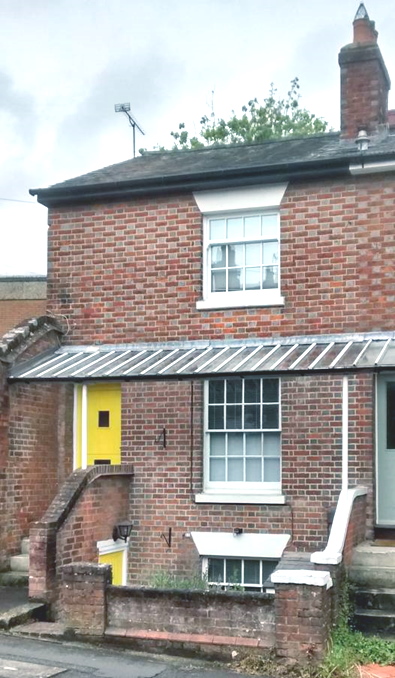
11, Newburgh Street, Winchester, where Archie
was living with his family when he enlisted with the Royal Naval Air Service
in November 1914
Great War Record
Archie Johnson was 25 and still unmarried when war broke out in August 1914. Three months later, on 12 November, he volunteered for military service as a Petty Officer Air Mechanic with the RNAS and was assigned the service number F/1996. Archie’s Navy record card provides some interesting personal details – he was just under 5ft 10ins tall with a 33ins chest, brown hair, grey eyes and a fresh complexion. In the ‘Character and Ability’ section he was twice rated V.G. (Very Good) for character and Sat. (Satisfactory) once for ability. He enlisted for the duration of the war.
The RNAS was the air arm of the Royal Navy and came into being because of the inter-service rivalry between the Navy and the Army. When the Royal Flying Corps (RFC) had been established under Army control in 1912 it was intended to encompass all military flying. However, the Navy was not willing to cede control over all forms of naval aviation and soon formed its own, unauthorised, flying branch. In July 1914, the RNAS was officially recognised by First Lord of the Admiralty, Winston Churchill. It was separate from the Royal Flying Corps and became in effect a rival air force. Ultimately, it would merge with the RFC in 1918 to form the Royal Air Force (RAF).
When war broke out in 1914, the RNAS sent a squadron under Commander Charles Samson to the Continent to support Allied ground forces. However, with too few aircraft at his disposal, Samson sent his men to patrol the French and Belgian countryside in the privately owned cars that some of them had taken to war. Samson had two RNAS vehicles, a Rolls-Royce and a Mercedes, fitted with armour plate and a single machine-gun. Within a month most of the cars had been armed and armoured and these were soon joined by others which had been armoured at Navy workshops.
The success of Samson’s forces in reconnaissance missions and rescuing downed pilots so impressed Churchill that in September 1914 he established the Royal Naval Armoured Car Division (RNACD). However, with the loss of Antwerp the following month the armoured cars were withdrawn to England and reorganised. During the winter of 1914-15 they were deployed to East Anglia as part of the anti-invasion force before returning to France in March. Shortly afterwards one squadron was sent to South West Africa and two squadrons to Gallipoli.
The RNACD eventually boasted 20 squadrons. Its vehicles, mainly Lanchesters and Rolls Royces, were commandeered from across the country and then strengthened to carry armour plate and a revolving machine-gun turret. Heavier cars carried a three-pounder gun to deal with enemy strongpoints. Each squadron consisted of three sections of four armoured cars plus a heavy section. There was also a support section of lorries, a motor ambulance; a wireless vehicle and a mobile workshop which is where Archie Johnson would presumably work.
The cost of forming armoured car squadrons was relatively high so the Admiralty accepted officers from wealthy individuals who offered to pay for them. Two such men were the Duke of Westminster and Oliver Locker-Lampson, the latter being commissioned as a Lieutenant Commander and his unit designated No.15 Squadron.
Obtaining sufficient personnel for the RNACD posed problems as motoring was still relatively new. Only the well-off could afford cars, few men could drive and even fewer could maintain them. For the relatively small numbers of men in these categories the Navy was in competition with the Army, which needed men with the same skills for its Service Corps. While drivers could be trained easily, skilled mechanics could not, and so suitably qualified men were recruited with the rank of Petty Officer Mechanic and the appropriate level of pay - £3 a week. This is the rank that Archie was given when he enlisted.
Like all military recruits, Archie underwent a period of training after joining up. His service records (below) show that he was posted to two ships – HMS Pembroke III, from 12 November 1914 to 31 March 1915, and HMS President II, from 1 April 1915 until his death the following year.
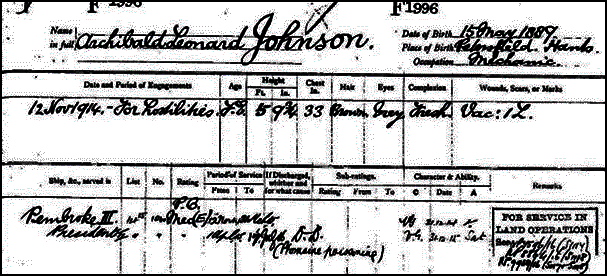
Archie Johnson’s Navy record card (www.findmypast.co.uk)
These ‘ships’ were not actual vessels but shore establishments which the Navy used for training and administrative purposes. However, while HMS Pembroke II was a well-known RNAS training base on the Isle of Sheppey, Kent, during the Great War, no record can be found of an HMS Pembroke III in this period. HMS President II, which has been traced, was a Navy accounting base, located variously at Chatham, Crystal Palace, Chingford and Shrewsbury. During his training Archie would have learned how to service, maintain and repair armoured cars. Although he had been a bicycle mechanic in civilian life, working on engines was far more complex, but the character reports on his military records suggest that he rose to the challenge.
After completing his training, Archie was assigned to 18 Squadron RNACD and posted to the Western Front in 1915 – his entry in the Winchester War Service Register (WWSR) states that he served in Belgium as well as Russia. By this time, however, the increasingly static nature of trench warfare greatly inhibited the use of armoured cars on the Continent. The Admiralty also began to question why it was involved in what was clearly not a naval function and so in mid-1915 most of the squadrons were transferred to the Army.
However, in the autumn of 1915, with Britain keen to bolster the faltering Russian war effort on the Eastern Front against Germany and the Austro-Hungarian Empire, the Admiralty agreed to send a Division (three squadrons) of its remaining armoured cars to Russia where operational conditions for the vehicles were more favourable. The new Division was placed under the command of Oliver Locker-Lampson who had lobbied strongly for an armoured car force to be sent to the Eastern Front. It was created around the nucleus of his 15 Squadron and the detachment of 17 Squadron heavies which was then serving with it. The unit’s active service strength was 32 officers and 372 men plus 21 officers and 83 men at base in England. Additional personnel to complete the complement came from volunteers from the disbanded squadrons. It is likely that these volunteers included Archie Johnson.
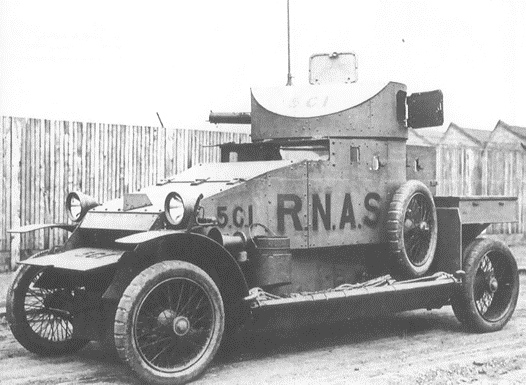
An early RNAS Lanchester armoured car, complete with revolving machine-gun
turret. As a mechanic, Archie Johnson would have been responsible
for servicing and maintaining vehicles such as this
Six weeks were needed to equip the force with Lanchester cars and winter clothing, followed by a short spell of leave, during which time Archie Johnson no doubt visited his family in Winchester. Then, on 3 December 1915 and buoyed by messages of goodwill from King George V and Rudyard Kipling, the Division, now called the Armoured Car Expeditionary Force, sailed from Liverpool aboard SS Umona for the Russian port of Archangel. (The expedition had to use the northern route via the Arctic Ocean because the southern access to Russia through the Black Sea had been blockaded by the Turks.) In the hold were 45 cars, 15 lorries and 50 motorcycles. Conditions for the men were cramped: in peacetime the liner had accommodation for only 75 crew and 58 passengers. On 5 December, Umona ran into a storm that nearly sank her. Petty Officer Ted Lockie, who was serving with the ACEF, described the conditions on board:
We lost a couple of lifeboats and several temporary buildings on the well decks [were] smashed to splinters by the tremendous seas that broke over us ... The situation became critical; over 500 men, including experienced sailors, were sick as horses. The Captain never left the bridge for over 24 hours, and at one time the ship listed to port so far that it was feared she would capsize ... The sanitary conditions were bad, the water froze, and the ship was covered in snow and ice...
Umona was blown 150 miles off course in the storm. The hold in which the men were sleeping filled with 18ins of water so that clothes and mess utensils floated about. Three days later the storm blew itself out, but life aboard the battered ship remained grim. Below deck, in stinking conditions, the men were allowed no heat or cigarettes for fear of igniting the ammunition stored beneath them.
Ten days out from Liverpool, having rounded the Northern Cape of Norway, Umona anchored in Ukansky Bay to make urgent repairs. The expedition very nearly ended here. By then the White Sea was frozen, closing the route to Archangel and the expedition received orders to return home. However, Locker-Lampson connived with the senior medical officer to persuade the Admiralty that a pneumonia epidemic was likely unless they could get the men ashore. The ploy succeeded and Umona was allowed to proceed to the ice-free port of Alexandrovsk (later Murmansk), which it reached on Christmas Day.
The men went ashore to be billeted among the Laplanders. Rations were augmented with black bread and reindeer meat, which Ted Lockie found ‘bitter and unpalatable’. The men kept fit with training sessions and helping to develop their base. However, the storm at sea had damaged many armoured cars, so these, together with the repair staff – including, presumably, Archie Johnson - and the sick, were brought home.
Umona reached Newport in South Wales, the Division’s home base and workshop, on 26 February 1916. A week was needed to unload the ship and discharge patients before the men were allowed home on leave. If Archie was indeed among the men sent home, then this would be the last time that his family would ever see him.
In May 1916, Umona, with the repaired armoured cars and Archie Johnson and the other mechanics on board, sailed for Alexandrovsk once more. The spring thaw allowed them to reach Archangel uninterrupted, and on 30 May they came ashore to a rousing welcome from their colleagues who had remained in Russia. (These men had earlier made their way to Archangel independently on another ship.) Two days later the day the ACEF entrained for Moscow.
The journey south, aboard primitive rolling stock, took almost five days. The Russian authorities used the journey as a public relations exercise and no opportunity was missed en route to fête the unit, deliver speeches, and present them with gifts. One officer recalled this as ‘more of a nuisance than a pleasure’ as it meant sleeping fully clothed and being frequently woken in the middle of the night. In Moscow, the British were received by the Grand Duchess Elizabeth, sister of the Tsarina.
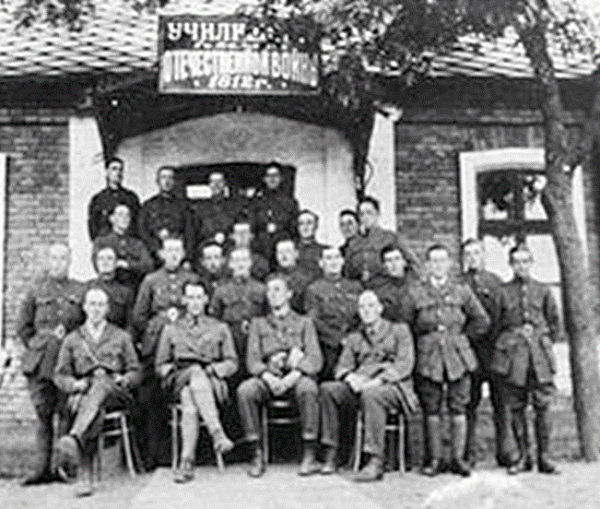
Officers and men of the ACEF in Vladikavkas, southern Russia, in August 1916.
Archie had died there the previous month. Oliver Locker-Lampson, Commander
of the ACEF, is seated second left and Ted Lockie is standing on the far right
(Photo: Rushden Research)
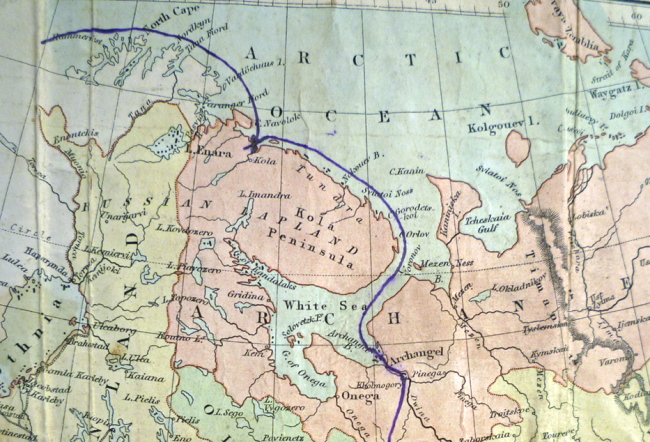
Tom Garner’s map showing the route taken by the Armoured Car Expeditionary
Force to Russia on SS Umona in December 1915. The port of Alexandrovsk
(later Murmansk) is marked with a cross (Olney & District Historical Society)
Another member of the expedition, Tom Garner, who knew Archie Johnson, kept a diary of his time in Russia. The entries for the period spent in Moscow state:
6 June 1916 Go into city. Everybody looking at us. Cannot stand still as a huge crowd gathers round us and [people] feel our clothes. Terribly hot. Meet two people who speak English and go home with them.
7 June 1916 See our friends again and go shopping. Visit a music shop where the ‘Old Boy’ plays all the English tunes he has on the pianola and gramophone and we have to sing Tipperary. Go to a nice cafe for dinner and in the afternoon see the Kremlin, Big Bell Czar’s Chapel, Ball Room, Throne, etc.
8 June 1916 March through the city to the English Church with the band leading us and Cossacks each side. Flags out and people cheering as we pass along. Terribly hot, fellows dropping out as we go. Have a service in the church and then march back to the station.
On 10 June, the ACEF, now under the command of the Russian Army, left Moscow by train for Vladikavkaz (then spelt Vladikavkas), some 1,100 miles south in the foothills of the Caucasus Mountains. (Today, Vladikavkas is the capital of the Russian Republic of North Ossetia-Alania.) Tom Garner’s diary tells the story of the journey, of the sickness that struck the party, and of Archie Johnson’s death:
12 June 1916 Very nice country. Heaps of flies and mosquitos. Have a swim in the [River] Don. One of our fellows drowned. Arrive at Rostov [670 miles south of Moscow]. Grand reception. Lovely town and people. March through the streets strewn with roses to open air gardens. Have a swell feed which was provided by the people of the town. Sit in open air theatre and hear ladies sing and see a lot of Cossack dances. Given cigarettes and march back to train loaded with flowers.
14 June 1916 Arrive at Vladikavkas in the Caucasus [430 miles south of Rostov] where a Cossack band leads the procession to the Kardetski Korpus, a fine boarding college for officers, 5 miles away. [The Division was comfortably quartered in the Patriotic Warrior of 1812 Officer Training College.] Have a good wash and then get on the trams which were decorated for the occasion and are taken to the Banqueting Hall. After leaving that and feeling happy and contented go into the park and on the lake in boats.
15 June 1916 Sleep in sheets for the first time since leaving England.
16 June 1916 Review by a Russian General. Very hot. Can see Mount Kazbek in the distance with snow on its peaks.
18 June 1916 Terribly hot, nearly everyone sick. Hospital full up with dysentery cases.
23 June 1916 Bendixen dies of dysentery. [Petty Officer Mechanic C.C. Bendixen, who, like Archie Johnson, was buried in Vladikavkaz Hospital Cemetery.]
25 June 1916 Funeral, I am one of the firing party.
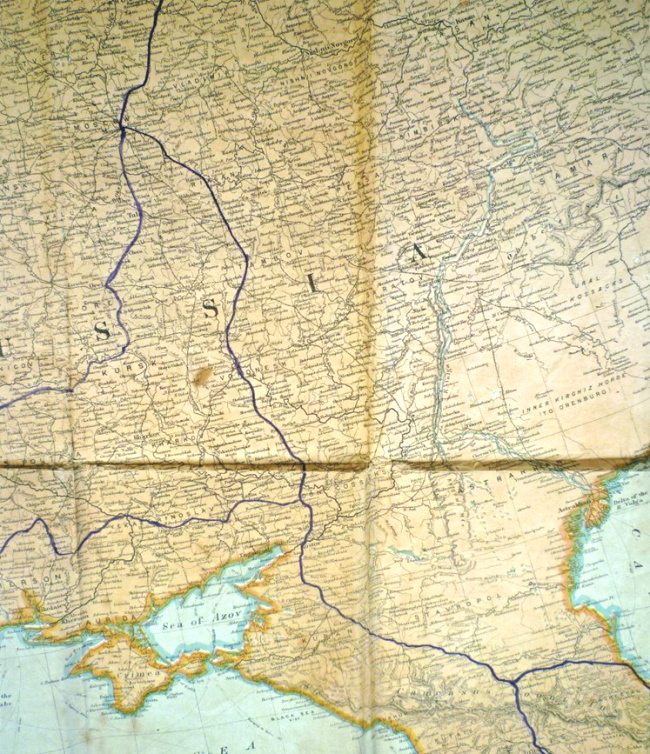
Tom Garner’s map showing the route taken by the ACEF from Moscow to
Vladikavkas where Archie Johnson died in July 1916. The other routes trace the
subsequent progress of the ACEF until it left Russia following the Bolshevik
Revolution of October 1917 (Olney & District Historical Society)
27 June 1916 Go for a route march in our shirts and shorts.
8 July 1916 Go for another route march and sleep out the night.
9 July 1916 Our fellows give a concert in the theatre for Red Cross.
10 July 1916 In hospital. On low diet. Breakfast, two cups of che [tea]. Dinner, one plate of soup. Tea, egg and milk.
14 July 1916 Mail arrives, great excitement.
17 July 1916 Out of hospital. Sea Base Arrive. Firing practice with 3 PR [pounder]. Johnson dies.
According to Tom Garner, Archie died on 17 July 1916. His Navy records give the same date but other sources state 18 July. His death in Vladikavkaz Hospital aged 27 was due to ptomaine poisoning caused by bacteria in tinned food. Although he had been with the ACEF for seven months, Archie never saw action. (Following Archie’s death, the ACEF operated in Asia Minor, Romania, Austria and Russia itself, fighting against Turks, Kurds, Bulgarians, Germans and Austrians. The men served with Cossacks and Siberian Army Regiments. Once back in England, many of the men transferred to the Motor Machine Gun Corps and were sent out to Baku on the Caspian Sea under General Lionel Dunsterville to defend the oilfields there.)
Family after the Great War
Archie’s mother Alice continued to live at 11, Newburgh Street after the Great War. Her daughter Florence was also living in the house in 1939 together with her husband Joseph Hayter, who she had married in Winchester ten years earlier. Alice died in 1947, aged 90, and was buried in Magdalen Hill Cemetery. Joseph, who ran a dry stores business, died in 1951. Florence, who is not believed to have had any children, was still at 11, Newburgh Street when she died in 1982, aged 87. She was buried in the same plot as her mother (and presumably her father and husband).
It is not known whether Archie Johnson’s brother Ernest served in the Great War. Ernest had married Maud De La Saux Simmonds in London in 1914. Maud had been born on Jersey in 1883 and worked as a dressmaker before marrying. She and Ernest had a daughter, Muriel, who was born in Camberwell, London, in 1915. The family remained in Camberwell and in 1939 Ernest was working there as a builder and decorator. Maud Johnson died in 1951 and Ernest four years later. Muriel, who married in Camberwell in 1954, died in 1990.
Medals and Memorials for Archibald Leonard Johnson
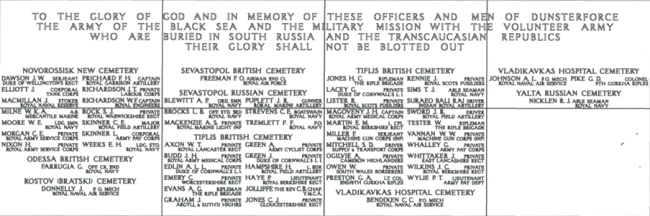
CWGC document showing the addition of names to the Haidar Pasha Memorial.
Archie Johnson’s name is in column four
Petty Officer Motor Mechanic Archibald Leonard Johnson was entitled to the 1914-15 Star, the British War Medal and the Victory Medal. He was buried at Vladikavkaz Hospital Cemetery, Vladikavkaz, Beslan, South Ossetia-Alania, Russian Federation. After the war, the CWGC planned to erect a headstone stating that Archibald Johnson was ‘buried near this spot’, but as relations with the Soviet Union deteriorated the Commission felt that any grave was unlikely to be maintained. For this reason, Archie is commemorated on the Haidar Pasha Memorial (Panel 12) in Istanbul, Turkey, along with other servicemen whose graves could no longer be maintained in the southern parts of the former Russian empire (see below). His name also appears on the church memorials at St Paul’s and St Matthew’s churches, Winchester.
CWGC document showing the addition of names to the Haidar Pasha Memorial. Archie Johnson’s name is in column four
Additional sources
- Rushden Research. Wm ‘Ted’ Lockie’s War Service. Researched by Derek Savory, 1997-8. https://www.rushdenheritage.co.uk/war/lockieWm-serviceWWI.html
- Olney & District Historical Society. Tom Garner’s First World War Diary. http://www.mkheritage.org.uk/odhs/tom-garners-first-world-war-diary-preface/
- Alston, Charlotte. Encounters on the Eastern Front: The Royal Naval Armoured Car Division in Russia 1915-1920. (War in History, 25 (4). pp. 485-510.) Accessed via http://nrl.northumbria.ac.uk/32425/1/Armoured%20Cars%20WIH.pdf