

Private SIDNEY GEORGE INGE
Venclyst, 90, Fairfield Road, Winchester
Service number 3818. 2nd Battalion, Lancashire Fusiliers (Previously 37549, The Royal West Kent Regiment)
Killed in action, France, 3 September 1918
Family Background
Sidney George Inge was born in late 1885 in Canterbury, Kent, the seventh of the nine children of May and Amelia Inge. Sidney’s parents had both been born in Kent in 1845.
According to census records from 1881 and 1891, Sidney’s father worked as a grocer in Canterbury, employing two men and a servant. By the 1901 Census, he was still in Canterbury but working as a brick merchant. Meanwhile, Sidney had left school and was employed as an ironmonger`s assistant.
May Inge’s change of occupation appears to have led him and the family to move to Winchester during the early 1900s because in the 1911 Census they were recorded living at Holbury, 8, Hatherley Road with May listed as a brick maker. Two children had died by this time and three daughters had married. This left Bessie (born 1878), Percy (1884) and Harry (1887) living at home. By 1912 Sidney’s brother Percy had moved a few doors along the road and was living at 20, Hatherley Road.
In 1915 May and Amelia moved to Venclyst, 90, Fairfield Road, Winchester, which is the address given for Sidney in the Winchester War Service Register (WWSR).
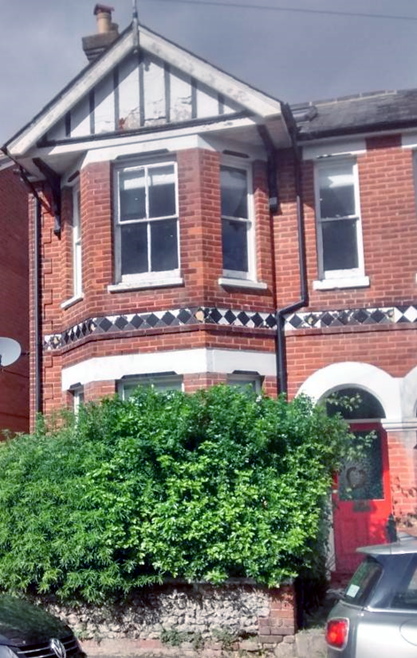
90, Fairfield Road, Winchester - Sidney Inge’s
parents moved here from Hatherley Road in 1915
However, Sidney was not living in Winchester when the Great War broke out; in fact, he was not even in the country. At some point before 1911 (he is not listed in that year’s census) he is believed to have emigrated to South Rhodesia. We know this because Commonwealth War Graves Commission (CWGC) records state that he travelled from there to join the Army in England in 1916.
Great War Record
Sidney enlisted at Herne Bay, Kent, on 31 October 1916 but it is not clear which Regiment he joined. According to the WWSR it was the Royal West Surreys, while Soldiers Died in the Great War states that he joined the Queen’s Own (Royal West Kent) Regiment. Given Sidney’s affiliation with Kent and the fact that he enlisted there, it is more likely to have been the latter.
In early 1918 Sidney transferred to the 2nd Battalion, Lancashire Fusiliers. The British Army disbanded many under-strength battalions at this time, redeploying the troops with other units and this is probably what happened to Sidney’s battalion. The 2nd Lancashire Fusiliers, who came under the command of 12th Brigade, part of the Army’s 4th Division, fought at the Battle of the Lys (7-29 April 1918) during the German Spring Offensive. They helped to ensure that the Germans did not break through to the strategically important Allied railhead at Hazebrouk in Flanders.
Later that summer, Sidney would have taken part in the Second Battle of the Somme (21 August-2 September 1918), part of the Hundred Days Campaign, in which Allied forces retook most of the territory captured by the Germans in their spring offensives.
On 2 September 1918, the 2nd Lancashire Fusiliers formed part of an assault by the British 4th Division and Canadian 4th Division on the Drocourt-Queant Line, an 11-mile-long German trench system which made up part of the Hindenburg Line. The system incorporated numerous fortifications including concrete bunkers, machine-gun posts and deep belts of barbed wire. It is believed that Sidney was killed on 3 September, the second day of the attack. He was 33 years old.
Family after the Great War
On 17 November 1919, the Army sent May Inge, Sidney’s father, a payment of £19 16s 3d in respect of his son’s effects and back pay. A war gratuity of £8 10s was also sent on 19 December 1919. May applied for Sidney’s medals in April 1921.
Percy and Harry Inge, Sidney’s brothers, both fought in the Great War and survived. Percy went on to marry and his children, Robert James (Jimmy), Eric and Kathleen all became dental surgeons working in City Road, Winchester. Harry Inge married and later became an optician, also working in City Road.
Sidney’s father May died in 1925, aged 80, and his mother Amelia the following year, aged 81. Percy Inge passed away in 1957 at the age of 73 and Harry in 1967, aged 80.
Medals and Memorials for Sidney George Inge
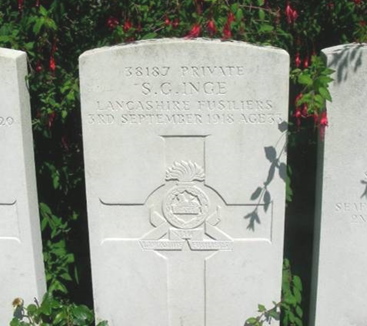
Sidney Inge's grave in Eterpigny British Cemetery, Pas de Calais, France
Private Sidney George Inge was entitled to the British War Medal and the Victory Medal. He was buried (grave pictured right) in Eterpigny British Cemetery, Pas de Calais, France (GR. A. 5). He is mentioned on the memorials at St Matthew’s and St Paul’s churches, Winchester, and also on the memorial at St Peter Street Methodist Church, Winchester.