

Private THOMAS WILLIAM ILLINGWORTH
86, Brassey Road, Winchester
Service number 36708. 10th (Service) Battalion, The Gloucestershire Regiment
Died of wounds, France, 18 November 1916
Life Summary
Thomas Illingworth was born in Hornchurch, Essex, in 1892, the youngest of Henry and Jane Illingworth’s seven children. Thomas moved to Winchester shortly before the Great War to work as a dental assistant. He enlisted with the Gloucestershire Regiment in 1915 and died the following year from wounds received while fighting at the Battle of the Somme.
Family Background
Thomas’s father was born in Hoxton, Middlesex, in 1850. His mother was born Jane Bolas in Bethnal Green in London’s East End. Besides Thomas, Jane gave birth to three other sons and three daughters. They were: Elizabeth (born 1873); Herbert George, born in south London in 1878; Gwenfrewi (1881); Olivia (1884); Oswald Walter, in Beckenham, Kent, in around 1885; Charles (1887).
Henry Illingworth’s earliest listed occupation is bootmaker. In 1881 he and his family were living at the Boot Shop, 183, Old Kent Road, south London. Ten years later they had moved to Tindall Villas, Brentwood Road, Hornchurch, with Henry working as a travelling draper. Thomas was born the following year. The 1901 Census records the Illingworths living 19, Tilia Road, Lower Clapton, Hackney, London. By then Henry was employed as an insurance agent. The elder children were also working - Herbert as a waiter, Gwenfrewi as a dressmaker and Oswald was an errand boy. Thomas and Charles were both at school.
Thomas’s father died sometime before 1911. That year’s Census showed his widow Jane was still at Tilia Road with Herbert working as a hotel waiter, Oswald as boot and shoe salesman and Thomas as a dental assistant. All the Illingworth daughters had left home, along with son Charles who was a furniture salesman in Walthamstow, east London, where he lived with his wife Nellie and baby son.
The dental profession that Thomas Illingworth worked in was quite unlike that of today. The biggest difference was that most dentists were unqualified. Indeed, it was not until 1921 that dentists were legally required to undergo a period of formal training. In the years before the Great War they increasingly used foot-operated drills which made the process of filling much quicker than previously. For those needing false teeth, the development of vulcanite dentures ensured a far better fit.
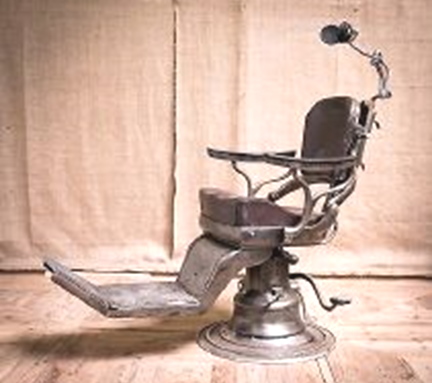
An early 20th Century dentists’ chair – this
would have been a familiar sight to Thomas Illingworth
Thomas married in Clapton on 3 August 1913. His bride, Constance, was the daughter of pawnbroker Joseph Long and his wife Susan. Constance, known as Connie to family and friends, had been born in Islington, London, in early 1891. On their wedding certificate she and Thomas were recorded living together in Clapton, but within a year the couple had moved to Winchester where Thomas had found work.
The Warren’s Winchester Directories of 1914 and 1915 show him as the householder for 86, Brassey Road (the address then and now).
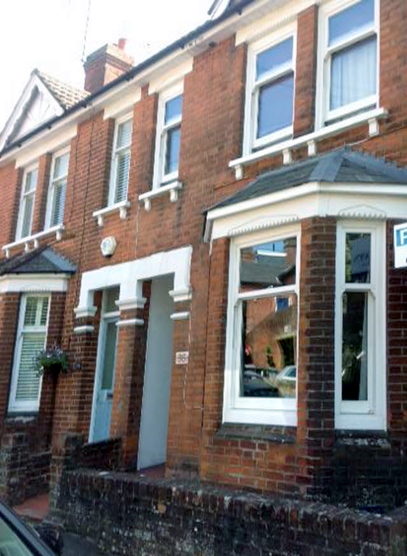
86, Brassey Road, Winchester – Thomas and Connie Illingworth
lived in the house after moving from London in 1913 or 1914
Great War Record
Thomas is thought to have joined the Army as a volunteer in 1915. He enlisted in Winchester with the 10th Battalion, The Gloucestershire Regiment – commonly referred to as The Glosters - and was assigned the service number 36708. The battalion had been raised in Bristol in September 1914 as part of Lord Kitchener’s massive expansion of the British Army following the outbreak of war. It was initially attached to 26th Division.
After two periods of training on Salisbury Plain the battalion moved to France in August 1915 where it joined 1st Brigade in 1st Division. Thomas was not with the 10th Glosters at this stage as his Medal Index Card shows that he did not arrive on the Western Front until 1916. The 1st Division was at the forefront of fighting at the Battle of Loos in September and October 1915 and it remained in the Loos sector until early 1916 when Thomas Illingworth joined up with the 10th Glosters.
The 10th Glosters fought several actions during the Somme Offensive. On 23 July, during the Battle of Pozieres, the battalion attacked the German line east of the village and it was involved in two further attacks in the same area in August. Its final action of the Somme campaign came on 9 September in a failed assault on High Wood in which it lost 122 men killed, missing and wounded. Thomas died of wounds near Becourt, close to High Wood, on 18 November 1916. He was 24 years old. He probably received the wounds in the attack of 9 September. The 10th Glosters saw no fighting in 1917 and were disbanded in February 1918.
Family after the Great War
After her husband’s death, Connie Illingworth continued to live at 86, Brassey Road until 1921 when her name disappears from the Winchester electoral records. No trace can be found of her after that date. It is not known whether she and Thomas had any children. Connie was probably responsible for her late husband’s name appearing on the Fulflood and Weeke church memorials. However, Thomas’s name does not figure in the Winchester War Service Register, which is somewhat surprising given that Connie was still living in the city when it was being compiled in the early 1920s.
Oswald Illingworth, Thomas’s brother, joined the Royal Army Medical Corps in 1917 at the age of 31. He is believed to have survived the war.
Medals and Memorials for Thomas William Illingworth
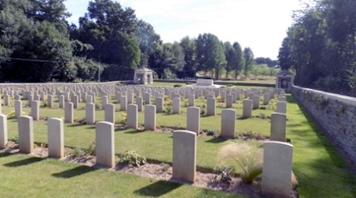
Becourt Military Cemetery, Becordel-Becourt, Somme, France
Private Thomas William Illingworth was entitled to the British War Medal and the Victory Medal and is buried at Becourt Military Cemetery (right), Becordel-Becourt, Somme, France (GR. I.F.14.). His name appears on the memorials at St Matthew’s and St Paul’s churches, Winchester.