

Gunner GEORGE HORACE HOUNSLOW M.M.
30, Brassey Road, Winchester (was 57, North Hill Terrace)
Service number 24461. 3rd Siege Battery, Royal Garrison Artillery
Died of wounds, France, 5 August 1917
Life Summary
George Horace Hounslow was born in Wareham, Dorset, in 1887, the eldest of the three children of William and Florence Ann Hounslow. The family moved to Winchester in around 1900 and a few years later George joined the Army as a gunner with the Royal Garrison Artillery. During the Great War he fought in France and Flanders and died of his wounds at the start of the Third Battle of Ypres (better known as the Battle of Passchendaele) in August 1917.
Family Background
George’s father William was born in Ashfield, near Romsey, in 1867 to George Hounslow, a painter’s labourer, and his wife Jane (née Archer). Jane gave birth to two more children – Harry, in 1871, and Horace George in 1874. (Predictably, there is much confusion between George Horace and his uncle Horace George). In the 1881 Census, the Hounslows were recorded still living in Ashfield. Jane Hounslow died in 1889.
George’s mother was born Florence Judd in Starcross, near Exeter, Devon, on 3 November 1859. Her father, Charles, had been born in the village of Winterslow, near Salisbury, and he worked as an agricultural labourer. Her mother Mary was also born in Starcross.
George’s parents are thought to have married in Wareham, Dorset, in October 1886. George was born the following year and shortly afterwards the family moved to Wellow, near Romsey, where a second son, Frank, was born on 24 October 1890. (Interestingly, the parents of the pioneering nurse Florence Nightingale lived in Wellow and she was buried in the churchyard there in 1910. It is possible that young George Hounslow knew Florence from her visits to the village.) A daughter, Winifred Florence, was born in Winchester on 4 November 1894.
School records suggest that the Hounslow family spent a short time living in Basingstoke before moving to Winchester. The family were living at 8, St Cross Road in 1900, the same year that George’s nine-year-old brother Frank was admitted to St Thomas Church of England Boys’ School.
By the 1901 Census, the Hounslows had moved again – to 6, Westgate Lane, Winchester. William, aged 38, was working as a domestic coachman while 13-year-old George, who had left school, was a milk boy, sorting out the bottles for the milkman. Frank and Winifred were both at school.
The 1911 Census records the Hounslows living at 57, North Hill Terrace, Brassey Road, Winchester. William was still working as a coachman with Frank, 20, employed as a house carpenter and 16-year-old Winifred as a milliner’s apprentice. George was not with the family; he had enlisted with the Royal Garrison Artillery and was stationed in Portsmouth. His Uncle Horace had served in the same unit. By 1913 57, North Hill Terrace had been renumbered 30, Brassey Road which remains the address today.
Great War Record
George was 27 years old when the Great War broke out in August 1914. At the time, the Royal Garrison Artillery (RGA) largely comprised fortress-based heavy guns located on the British coast. Among these were Fort Nelson and Fort Southwick on Portsdown Hill overlooking the naval base of Portsmouth and this is probably where George was stationed early in his Army career.
The British Army possessed little heavy artillery in 1914, but the demands of trench warfare on the Western Front meant that it quickly grew in importance. The Army eventually acquired huge numbers of heavy guns and howitzers of immense destructive power. These were positioned some way behind the front line. Siege batteries of the RGA were equipped with heavy howitzers, which fired large calibre high explosive shells in a high trajectory. The usual armaments were 6-inch, 8-inch and 9.2-inch howitzers, although some batteries had huge railway or road-mounted 12-inch howitzers. All were capable of firing shells many miles. As British artillery tactics developed, the siege batteries were most often used to destroy or neutralise enemy artillery, as well as putting down destructive fire on strongpoints, supply dumps, stores, roads and railways behind enemy lines.
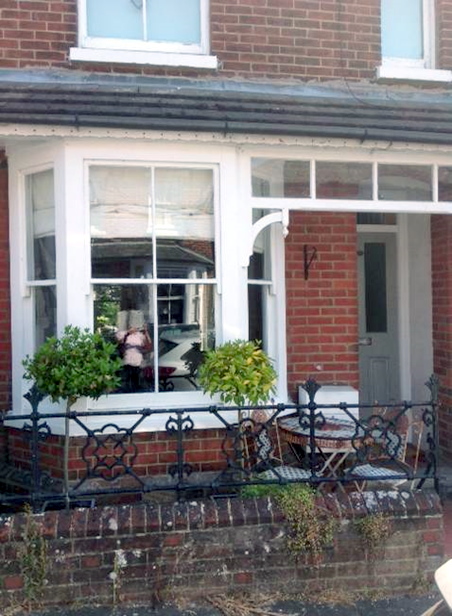
30, Brassey Road, Winchester – George Hounslow’s
family home at the outbreak of war in 1914
A heavy artillery battery would typically be made up of five officers and 180 other ranks, more than 100 horses (mainly heavy draught), three two-horse carts and ten four-horse wagons. The battery would normally be teamed with three others under the command of a Siege Brigade.
The 3rd Siege Battery went out to the Western Front on 17 September 1914. However, George’s Medal Index Card shows that he did not enter a theatre of war until 20 May 1915, so it is possible that he was not originally part of 3rd Siege Battery.
Sometime during 1916 George was wounded – probably during the Somme Offensive - and awarded the Military Medal. He was wounded again at the Battle of Pilckem Ridge, the opening phase of the Third Ypres campaign (31 July-10 November 1917) and died on 5 August 1917 at 22nd General Hospital in Etaples, northern France. He was 30 years old.
Family after the Great War
On 8 December 1917, the Army sent George’s father William a payment of £24 15s 6d, probably in respect of his son’s effects and back pay. William also received a war gratuity of £17 10s on 10 November 1919.
George’s family remained in Winchester after the war. In 1920, his brother Frank was registered on the Electoral Roll living with his parents at 30, Brassey Road. George’s father William died in Winchester in 1934, aged 77, and his mother Florence in 1943 at the age of 83.
George’s sister Winifred married Maurice Brewer in Winchester in 1922. She died in Devizes, Wiltshire, in 1985, aged 90. Brother Frank married Mable Newman in Winchester in 1943, the same year that his mother died. Frank died in Winchester Hospital in 1962, aged 71. He was living at 1, Trussell Crescent, Weeke, at the time of his death.,/p>
Medals and Memorials for George Horace Hounslow
Gunner George Horace Hounslow was entitled to the 1914-15 Star, the British War Medal and the Victory Medal. He is buried at Etaples Military Cemetery (right), Pas de Calais, France (GR. XXV. L. 4A) with the following inscription on his headstone:
GONE BUT NOT FORGOTTEN.
He is also mentioned on the memorials at St Matthew’s and St Paul’s churches, Winchester.