

Captain NICHOLAS WEATHERBY HILL, M.C.
Butts Close Cottage, Weeke
2nd Battalion, The Oxford and Buckinghamshire Light Infantry
Killed in action, France, 16 January 1917
Family Background

Captain Nicholas Weatherby Hill
Nicholas Weatherby Hill was the only son of Henry L.G. Hill, an architect based in Winchester from 1894 to 1917, and his wife, Mary. Nicholas was born in Weeke - then just outside Winchester - on 7 August 1896. The first mention of his father in Winchester is in the Warren’s Winchester Directory for 1894 when a Hill is listed living at the Manor Farm House in Weeke, and the Winchester architect B.D. Cancellor was recorded taking on a Mr Hill as a partner. Their offices were in Jewry Street and the partnership lasted until 1910. The Farm House remained Henry Hill’s home address until 1898.
Henry had married Mary in about 1895. She had been born in Bayswater, London, in around 1858. Six of her brothers had gone to Winchester College which strongly suggests that she was from a wealthy background. Nicholas, the couple’s only child, was born while they were living at the Farm House. By 1899, according to the Warren’s Winchester Directory, they were living at ‘the Cottage Weeke’, later described as Butts Close Cottage. The house was designed by Henry Hill in the Arts and Craft style and it features in the Hampshire volume of Nicholas Pevsner’s Buildings of England series. Henry Hill is also mentioned in Pevsner as the architect of the Science School at Winchester College.
Butts Close Cottage was subsequently divided into two with the right wing, formerly the servants’ quarters, known as Butts Cottage, while the Hill family’s part of the house was called Butts House. In the 1901 and 1911 Censuses, the Hills employed three servants.
In about 1903, at the age of seven, Nicholas went to Horris Hill Preparatory School in Newtown, Hampshire, just south of Newbury. The school had strong connections with Winchester College which it retains today. Nicholas was obviously a very able child as he was placed high up on the roll to attend Winchester College in two successive years, but he elected to take an Exhibition rather than the Scholarship entrance exam. This entitled him to live in a Commoner’s House which in his case was Culverlea Boarding House or House G (now Serjeant’s and familiarly known as Phil), accessed today from Romans Road.
Nicholas arrived at the College in 1909 and was at his boarding house at the time of the 1911 Census. He displayed a great variety of talents whilst at Winchester. He possessed a strong feeling for art and played the piano with great ability. He displayed his leadership by becoming Senior Commoner and therefore Joint Head of School alongside a Scholar. Had he remained at the College rather than leave early to join the Army then he would almost certainly have been made captain of the cricket team, as he had already played for the First XI in the two summers prior to leaving.
Great War Record
Nicholas won a Classical Scholarship to New College, Oxford, which he was scheduled to take up in the autumn of 1916. However, in 1915, with the Great War almost a year old, he opted instead to leave Winchester to go to Sandhurst Military College. After completing his officer training there, he was gazetted on 19 October 1915 as 2nd Lieutenant in the 2nd Battalion, The Oxfordshire and Buckinghamshire Light Infantry (OBLI). This had been the old 52nd Regiment, which, on the initiative of John Colborne, a Wykehamist, had attacked the flank of Napoleon’s Old Guard at Waterloo in 1815, a turning point of that battle. Was Nicholas inspired by this famous Wykehamist to join his former regiment? (A statue of Sir John Colborne, later Lord Seaton, has stood outside the Rifles Museum in Peninsula Square, Winchester, since the 1990s.)
By October 1915, 2nd Lieutenant Hill was on active service in France. Early in 1916, the 2nd OBLI were moved to the area of Notre Dame de Lorette, north of Arras, to relieve French troops who were required for the defence of Verdun. They then moved south to take part in the Battle of Albert (1-13 July 1916), the opening phase of the Somme Offensive. The battalion was in action again on 30 July, during the second phase of the campaign, attacking from Delville Wood towards Guillemont and Ginchy.
Despite appalling weather and a battlefield turned into a sea of mud, the Somme campaign continued through the autumn of 1916. On 13 November, the 2nd OBLI went over the top once more at the start of the Battle of the Ancre, the final British assault of the campaign. The battalion attacked German trenches north of the village of Beaumont Hamel and suffered heavy losses among officers and men. It is believed that this was the occasion mentioned in the Winchester War Service Register when Nicholas was injured, as well as the action in which he won the Military Cross. The citation for the M.C. in the London Gazette in February 1917 reads:
2nd Lt. (Actg. Capt.) Nicholas Weatherby Hill, Oxf. and Buck. L.I. For conspicuous gallantry in action. He assumed command of his company in the attack with marked courage and ability. Later, although wounded, he continued to encourage his men.
The OBLI won battle honours for their actions at the Battles of Albert, Delville Wood and the Ancre. It is not known whether Nicholas had sufficiently recovered from his wounds to spend Christmas 1916 with his battalion, which had a period of rest and training near the forest of Crecy under something approaching peacetime conditions, or even whether he got home on leave.
Nicholas probably won promotion to Acting Captain because of his bravery at the Battle of the Ancre. In January 1917, the 2nd OBLI, presumably with Nicholas among their number, returned to the scene of the July 1916 Somme fighting, and for many weeks, and under appalling conditions, held a line of posts along the Albert-Bapaume road.
In his history of the regiment, the 2nd OBLI’s Commanding Officer at the time, Lieutenant-Colonel Richard Crosse, said the battalion suffered:
… very severe winter weather with little protection from shell fire and none from the wet and cold, and with only such cooking in the forward posts as was possible with a short allowance of solidified alcohol.
On the night of 16 January 1917 Nicholas Hill was killed by shellfire near the village of Courcelette while making his way to the frontline trenches. Hopefully, his Commanding Officer had told him before his death that he was being put forward for a Military Cross and that Nicholas was then able to let his parents know.
Family after the Great War
Nicholas’s father, Henry, also served in the war. He worked for the War Office in the Directorates of Recruiting and Mobilisation, reaching the rank of Major. He was awarded the O.B.E. for his services.
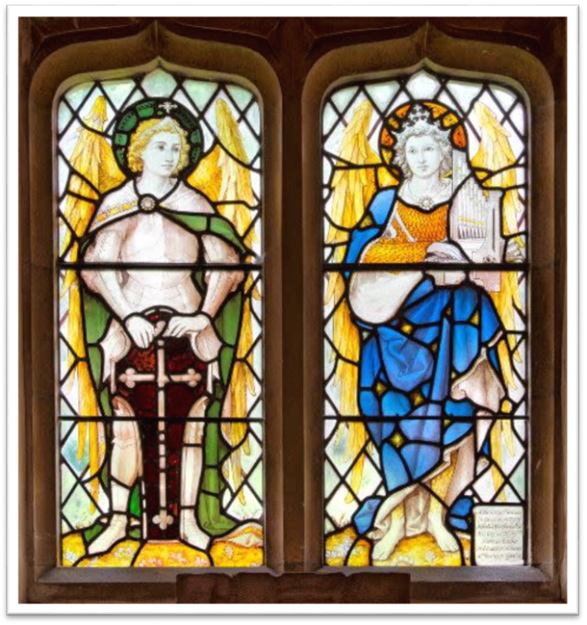
The memorial window to Nicholas Hill in St Matthew’s Church, Weeke.
It was designed by his father Henry (Photo: Simon Newman)
On Saturday 17 February 1917, a memorial service was held for Nicholas at Winchester Cathedral, attended by many of the ‘Gentlemen of the College’. Given the ethos of the time, he would have been an inspirational figure to them.
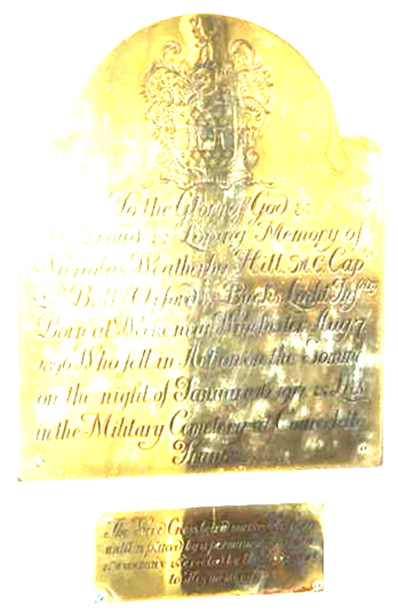
The brass memorial plaque to Captain Nicholas Hill, in St Andrew’s Church,
Donhead, near Salisbury, Wiltshire. The plaque inscription reads:
‘To the Glory of God and in Proud and Loving Memory of Nicholas
Weatherby Hill MC Captn 2nd Battn Oxford & Bucks Light Infty Born at Weeke
near Winchester Aug 7 1896 Who fell in Action in the Somme on the night of
January 16 1917 and lies in the Military Cemetery at Courcelette France’

The original wooden cross placed on his grave in France,
now in St Andrew’s Church, Donhead, near Salisbury
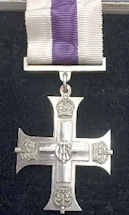
A Military Cross which Nicholas
was awarded posthumously in February 1917
By early 1917, Henry and Mary Hill had left Butts Close Cottage in Weeke and moved to Donhead, near Salisbury, where they arranged for a large brass memorial to Nicholas to be erected in the local church. However, they did not forget Nicholas’s birthplace and his father designed a memorial window which can still be seen in St Matthew’s Church today.
Medals and memorials for Nicholas Weatherby Hill
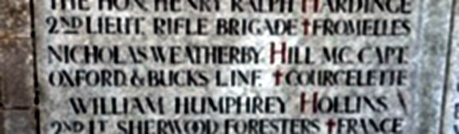
Nicholas is listed on the walls of Winchester College War Cloister
Captain Nicholas Weatherby Hill was entitled to the British War Medal and the Victory Medal. He is buried in Courcelette British Cemetery, Somme, France (GR. I. D. 13). Nicholas is remembered in St Matthew’s, Weeke, with a window on the south side dedicated to him and his name is among those in the church’s Memorial Book. Nicholas is also listed on the Memorial Boards at St Paul’s Church, Fulflood, and Horris Hill School. He is listed on the walls (Outer F1) of Winchester College War Cloister (above) and there is a brass plaque dedicated to him, together with the wooden cross from his initial grave in France, in St Andrew’s Church, Donhead, near Salisbury, Wiltshire.
Additional sources
- Winchester College website: www.winchestercollegeatwar.com/archive/nicholas-weatherby-hill/
- Crosse, R.B. A Short History of the Oxfordshire and Buckinghamshire Light Infantry, 1741-1922 for the Young Soldiers of the Regiment (Gale & Polden, 1925).
- The Oxfordshire & Buckinghamshire Light Infantry, The Great War 1914 – 1919, 2nd Battalion (52nd Light Infantry). Website created by Mr. Tobin. https://oxandbuckslightinfantry.weebly.com/1st--2nd-battalions-in-the-great-war.html
- Information from Mr and Mrs Somerville, the current owners of Butts Close.
- Hampshire Observer, 17 February 1917.