

Rifleman ARTHUR SAMUEL HILL
Service number R/31897. 17th (Service) Battalion, The King’s Royal Rifle Corps
9, Union Street (NLS) (and 69, Fairfield Road), Winchester
Missing, believed killed, Belgium, 3 August 1917
Family Background
The entry in the Winchester War Service Register (WWSR) for Arthur Samuel Hill reads:
+ HILL, ARTHUR S. (69, Fairfield Road) K.R.R.C., July 1916, Rfn. Flanders. Missing (believed killed), Aug. 3, 1917.
It is the address ‘69, Fairfield Road’ that links Arthur to the parish of St Matthew’s with St Paul’s. However, as will become clear below, it has not been possible to confirm that he lived at the address or, indeed, anywhere else in the parish before, during or after the Great War. For that reason, the presence of his name on the two church memorials remains a mystery requiring further research.
Arthur was born in Winchester in about 1888, the sixth child of Edwin and Elizabeth Hill. His father was a bootmaker who was born in Portsmouth in about 1852 and his mother, whose maiden name was Youren, was born in Southampton in about 1857. Her family were originally from Cornwall. The couple married in 1877 and their first three children, Stephen, (his mother was only 16 when he was born), Blanche and Violet were born in Southampton.
By 1881, the family had moved to Winchester and were living at 42, Upper Wolvesey Terrace in the parish of St Peter’s, Cheesehill. By 1886, they had moved to Union Street, at the eastern end of North Walls, living initially at No. 26. In 1888 and 1889 they were at No. 35, but by 1890 Edwin and Blanche (that seemed to be her preferred Christian name) had settled at 9, Union Street where they lived for the next 33 years. (All Hill family addresses in Union Street were demolished, mainly in the Friarsgate redevelopment of Winchester in the 1960s and by the creation of the one-way road system.) By 1891, they had four further children. Lily was born about 1883, whilst they were still at Upper Wolvesey Terrace, Edwin Jnr in 1886, by which time they had moved to Union Street, Arthur in 1888 and Ada who was less than one year old in the 1891 Census.
Lily, Edwin Jnr, Arthur and Ada would have gone to the local infants’ school, Holy Trinity - Lily and Ada to the girls’ section in the building which still stands in Upper Brook Street behind Holy Trinity Church, and Edwin and Arthur to the boys’ school in Cossack Lane. This had formerly been St Maurice’s School and it, too, was subsequently demolished during the Friarsgate development. (Cossack Lane survives today as the street forming the entrance and exit to the Middle Brook Street car park and the school was on the north-east corner of it.)
In 1901, Edwin Hill was working as a self-employed bootmaker at home with his son, Edwin Jnr, aged 15, helping him. Arthur, then aged 12, and ten-year-old Ada would have been at elementary school. Their four eldest siblings, Stephen, 26, Blanche, 23, Violet, 21, and Lily, 18, appear to have left home. In 1906 Blanche married Albert Chapman in Winchester and five years later the couple were living at 36, Union Street, with Albert working as a baker. After the war they moved to 8, Union Street, which may have been even closer to her parents’ address. In 1909 Violet married Charles Hart and they went to live in Ipswich, where a daughter was born the following year.
According to an advertisement in the 1910 Warren’s Winchester Directory, the Hill shoe and boot making business was established in 1895. However, the first reference to it is in the 1903 edition of Warren’s when the business was based at 19, Union Street. In 1905, the entry in Warren’s trade section proudly reads ‘Hill & Son’ in enlarged and bold lettering and it is still at No. 19.
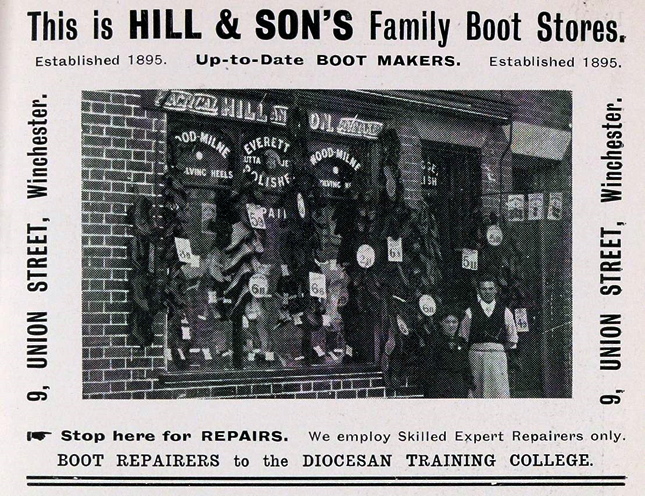
The advertisement for Hill & Son bootmakers in the 1910 Warren’s Directory.
Edwin and Blanche Hill are pictured outside 9, Union Street (Photo: Hampshire Record Office)
The move to combine home and residence at 9, Union Street occurred by 1909. With fewer children at home - possibly only Edwin Jnr as Arthur and Ada may have left by then - there would have been more space at 9, Union Street and it must have made economic sense.
Arthur’s eldest brother Stephen may have already left home by 1891 as he was not at 9, Union Street on the census night of that year. By 1901 Stephen was married, working as an agricultural labourer and living in a cottage in Stockbridge Road, King’s Somborne, near Winchester, with his wife Jane and the first three of their children.
A return to the countryside may suggest that this is not the right Stephen Hill, but their children have so many Hill-Youren Christian names that it does seem likely. In the 1911 Census, Stephen, by then aged 36, was back in an urban environment, working as a general labourer and living at 20, Mortimer Road, Itchen, Southampton, together with Jane and their six surviving children.
Edwin Jnr, Arthur’s elder brother, married 21-year-old Margaret Roberts in 1910 in South Stoneham, near Eastleigh, and in the 1911 Census they were living at 37, Brassey Road, Winchester. Margaret’s occupation was dressmaker, working on her own account. By 1912, the couple had moved a short distance to 1, Cranworth Road where they remained for many decades. Meanwhile, Arthur’s youngest sister Ada was recorded in 1911 working as an assistant in a Bournemouth draper’s business.
Arthur himself had also left home by 1911 and cannot be found in Winchester. However, there was an Arthur S. Hill, born in Winchester and of the right age (23), boarding at 56, Great College Street, Camden, London. He was single and his occupation was given as a printer. He appears to have remained single as no marriage record can be found for him.
Great War Record
Arthur Hill enlisted (he was probably conscripted) in the district of St Pancras, London, in July 1916 when he was still living in Camden. He was assigned to the 17th (Service) Battalion, The Kings Royal Rifle Corps (KRRC) as a Rifleman, with the service number R/31897. The 17th KRRC had been formed by the British Empire League in 1915 as part of Lord Kitchener’s New Armies. It came under the orders of 117th Brigade, itself part of 39th Division. The battalion arrived in France in March 1916 and were in support during the Battle of the Ancre (13-16 November), the final major British assault of the Somme campaign. Arthur probably just missed the battle as he would have had to complete his 13 weeks’ basic training before joining his battalion late in 1916.
Although 1917 was a year of bitter fighting on the Western Front with major British offensives at Arras and Messines in the spring and early summer, for 17th KRRC the first six months were relatively quiet. The Regimental Chronicle of 1917 reported that the period prior to the launch of the Third Battle of Ypres (or Passchendaele) on 31 July saw few casualties among the battalion which was based in the Ypres area of Flanders:
The routine work was fairly dull, but undoubtedly good training for a comparatively young Battalion, and by the end of June we knew all there was to know about trench warfare... [In July] For the first time for many months we left the neighbourhood of Ypres for a few days and carried out special training over a model course at St. Omer. We returned to E Camp (by bus) on July 21st, and on the 28th moved up to our battle front, in the left portion of the Hill Top sector, having two companies in the front line and two in support.
Led by Lieutenant-Colonel A.P.H. Le Prevost, 17th KRRC took part in the Battle of Pilckem Ridge (31 July-2 August 1917), the opening engagement of the Third Ypres campaign. The battalion formed up for the attack in trenches on the extreme left of the 39th Division, by then part of XVIII Corps of the Fifth Army. The Rifles had five objectives with the overall aim of breaking through the German front-line system in their sector. The Regimental Chronicle described the beginning of the assault:
At zero minus 5 minutes, the attack was opened at 3.50am by a deluge of oil drums which made matters remarkably unpleasant in the German’s front trenches. This was followed by a terrific barrage of all-calibre guns and the assaulting waves moved forward as the barrage lifted.
The German front-line trench, the first objective, was captured by 4.20am. All the other objectives were also achieved, in the process of which the battalion captured two German officers, 64 other ranks and one machine gun. The 17th KRRC lost one officer and eight men killed, one officer and 60 men wounded and eight missing.
However, it was not until 5 August when the battalion was withdrawn from the front line that the final casualty list was established. At that stage four men were still missing, among them Arthur Hill, who was aged about 29. There are conflicting reports as to how he died with some sources saying he died of wounds. Perhaps his comrades saw him go down wounded but could not stop to give him aid. It did not help that on 2 August the weather turned very wet and it rained continuously for the next three days. According to the Regimental Chronicle ‘[t]he men had for the most part been knee deep in water and mud’ before they were relieved on 5 August. Arthur’s body was probably lost in the churned-up battlefield. He was formally reported missing, believed killed in action.
The WWSR of 1921 creates a conundrum with references to two Hills who served in the war. In the Register, Arthur Hill’s address is given as 69, Fairfield Road while Stephen R. Hill, who could be Arthur’s brother, is listed at No. 67. However, according to the Warren’s Directories, there was no Arthur Hill or Stephen Hill based in Fairfield Road before, during or after the war. One possibility is that Arthur had returned from London shortly before the outbreak of war and lodged with Edward Williamson, who lived at 69, Fairfield Road from 1914 until 1920. Perhaps he had then returned to Camden and enlisted from there in 1916? Without an August 1914 Winchester address, Arthur Hill should not have been in the WWSR. It is only the Fairfield Road address that links ‘A. S. Hill’ on the St Matthew’s and St Paul’s memorials to the parish and his entitlement to be in the Register.
The Warren’s Directory does show an Edward Hill living at 69, Fairfield Road from 1921 until 1923. If he were a relative of Arthur’s this would give the WWSR address some credibility as Edward Hill may have wanted his relative commemorated in his local church. However, there is an obvious problem with these two theories: why did the WWSR give Arthur’s address as Fairfield Road and not his parent’s address in Union Street? As yet, there is no satisfactory answer to this question.
Family after the Great War
What of Stephen R. Hill whose name also appears in the WWSR? Was he Arthur’s brother? That, too, remains unclear. The Register states that Stephen had already been in the Royal Army Service Corps and re-joined the Army in September 1914 as a Private in the Royal Engineers. He served in France and Italy, rose to be a Corporal and survived the war. Unfortunately, it has not been possible to find a service number or any details of Stephen’s military service other than those given in the WWSR. Neither the 1901 nor 1911 Censuses indicate that Stephen Hill served in the forces.
The next mention of the Stephen Hill who definitely was Arthur’s brother is in the 1939 Register, when he was living with his wife Jane at 17, Pound Road, now in King’s Worthy but then in the Rural District of Winchester. Aged 65, he was working as a plumber’s mate. Stephen died in Winchester in June 1949, aged 74.
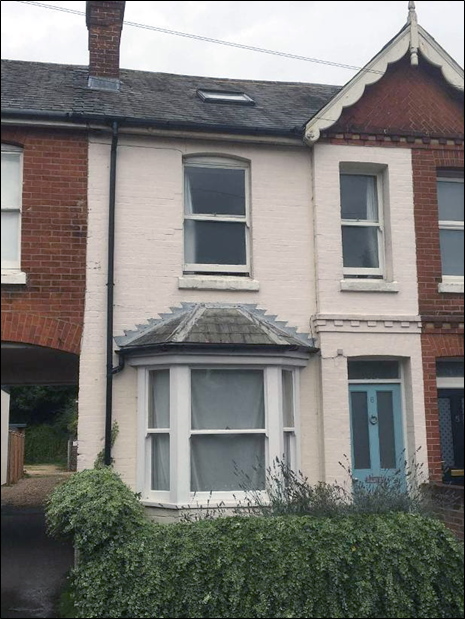
6, Cranworth Road, Winchester, the home of Arthur Hill’s parents,
Edwin and Blanche, from 1925 to 1940
Edwin Hill Jnr, Arthur’s brother who had gone into the family bootmaking business, seems to have had no interest in remaining in it once his father had retired. The business is believed to have been sold to an R. Jackson in the early 1920s and there are no further E. Hills listed as bootmakers in Warren’s Directories after 1923. Edwin Jnr and his wife Margaret had been living at 1, Cranworth Road since 1912 and by 1925 his parents had moved just a few doors away to No. 6. This terraced house still survives with an archway alongside, which in those days led to a workshop area.
In the 1927 Warren’s Directory, Edwin Jnr is described as a motor haulage contractor and he used the yard behind his parents’ house nearby as a garage until 1938. This is the last mention of Edwin Jnr being a motor haulage contractor and in the 1939 Register he was a taxi driver/owner. By then he was 53 years old and whether the change of career was for health or financial reasons is not known. He retained the garage behind 6, Cranworth Road even after the deaths of his parents in Winchester in 1940, his father at the age of about 88 and his mother at 82. Edwin Jnr himself died in Winchester in 1966, aged 80.
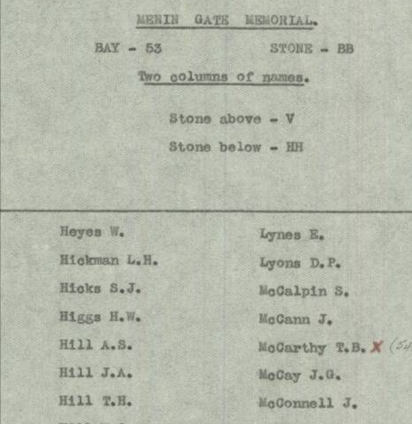
Arthur Hill’s name on the Commonwealth War Graves Commission’s
original typed list of names for inclusion on the Menin Gate (Photo: CWGC)
Of Arthur’s older sisters, Blanche appears to have remained in Winchester with her husband Albert and she died in the city in 1970. It is not known whether Lily married or not, nor when she died, while Violet died in Ipswich in 1972. Arthur’s younger sister Ada was living in Bournemouth when the 1939 Register was drawn up. There is no mention of a husband, but her status is ‘married’. Her occupation is given as a demonstrator of a Welgard Cleaner. Perhaps her stay there was only temporary. Her husband died on 11 September in 1966 in Croydon, Surrey. That was in the same quarter of the year that her brother Edwin’s death was registered in Winchester. Ada’s death was registered in Croydon in 1977. She would have been the last member of her generation to have known Arthur alive.
Medals and Memorials for Arthur Samuel Hill
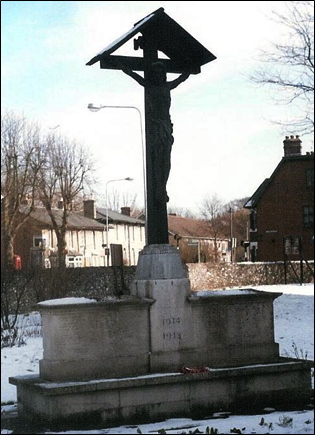
Memorial in the churchyard of Holy Trinity, on North Walls,
Winchester

The Ypres (Menin Gate) Memorial, Belgium
Rifleman Arthur Samuel Hill was entitled to the British War Medal and the Victory Medal. He has no known grave and is commemorated on the Ypres (Menin Gate) Memorial, Belgium (PR. Panel 51 and 53) and in the churchyard of Holy Trinity, on North Walls, Winchester (photos left and above). It is believed that he is the ‘A.S. Hill’ on the memorials on the memorials at St Matthew’s and St Paul’s churches, Winchester.
Additional sources
- The Kings Royal Rifle Chronicle 1917.
- Hare, Major-General Sir Steuart. The Kings Royal Rifles Annals (Vol. IV).