

Petty Officer FRANK JOSEPH HEAD
14, Romsey Road, Winchester
Service number 214768. HM Submarine C34, Royal Navy
Killed in action, North Sea, 21 July 1917
Life Summary
Frank Joseph Head was the second of six children born to William James and Eliza Ellen Head. A Winchester boy, he joined the Royal Navy in 1902 at the age of 14 and served on battleships, cruisers and destroyers before transferring to submarines. He was killed in 1917 in the North Sea after his submarine was torpedoed and sunk by a German U-Boat.
Family Background
Frank was born on 2 March 1888 although he gave his year of birth as 1886 when he enlisted in the Royal Navy, presumably so he could sign up earlier. His father William was a farmer who was born on 6 April 1860 in Chenole, near Sherborne, Dorset. William’s father, Joseph (born 1808), had also been a farmer. Joseph was married to Mary Head, who had been born in 1821.
Frank’s mother was born Eliza Elston in New Cross, Deptford, south London, in 1862. She and William married in the mid-1880s and moved to Winchester where Eliza gave birth to six children - Ethel (born 1886), Frank (1888), Ada (1889), Harry (1892), Mabel (1895) and Arthur (1896). The 1891 Census showed the Heads living at 37, Parchment Street with William working as a tailor. The family were still there in 1901.
On 31 January 1902, Frank joined the Royal Navy as a Bugler and Boy 2nd Second Class even though he was at least a year under-age. He did his training at the Royal Naval Boys Training Establishment HMS St Vincent in Gosport, near Portsmouth, where he remained until 23 March 1904. The main qualifications for acceptance as a boy sailor were the parents’ signed permission, the ability to read and write, a character reference from a professional person and a clean record. The boy also had to pass an academic assessment, be of a certain height and pass a thorough medical examination. Only around one in four applicants was successful.
On 2 April 1904 Frank (service number 214768) was rated-up to Ordinary Seaman and his Navy career began in earnest. His early training would have involved a study of basic seamanship skills such as ropes, knots and splices, sailing small boats, gaining familiarity with dropping and recovering an anchor and parade ground marching. He served on a range of ships as shown in the table below.
Great War Record
Frank’s career as a submariner began in 1910 when he entered the Royal Navy’s Torpedo School at HMS Vernon, a shore establishment in Portsmouth. Founded in 1876, HMS Vernon pioneered the development of underwater weapons such as the torpedo and the depth charge and it is likely that it was also a centre for submarine training.
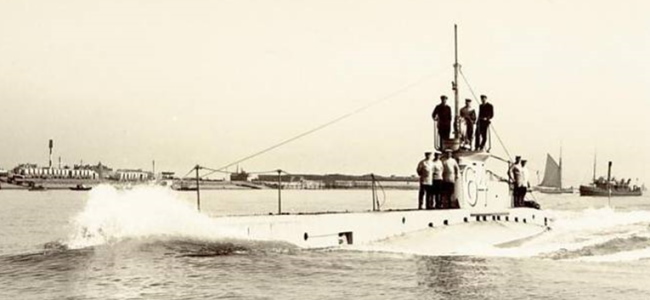
A C-class submarine like that on which Frank Head was serving
when it was sunk by a German U-boat in 1917. Life on board for the crew
was hot, cramped and dangerous
Petty Officer Frank Head’s Navy record 1904-1917
| Name of Ship | Date Joined - Date Left | Class of Ship |
| Formidable | 15/11/1904 | Battleship |
| Formidable | 26/06/1905 - 01/10/1906 | |
| Venomous | 02/10/1906 - 04/05/1907 | Destroyer |
| Victory 1 | 05/05/1907 - 01/06/1907 | |
| 02/06/1907 - 21/09/1907 | ||
| Victory | 22/09/1907 - 22/11/1907 | |
| Crescent | 23/11/1907 - 11/01/1908 | |
| King Alfred | 12/01/1908 - 24/05/1910 | Cruiser |
| Victory | 25/05/1910 | |
| Vernon | 04/09/1910 - 13/05/1911 | Torpedo school Portsmouth |
| Mercury | 14/05/1911 - 30/06/1911 | Training ship Chatham |
| Arrogant | 01/07/1911 - 13/07/1911 | Depot ship |
| Bonaventure | 14/07/1911 - 14/10/1912 | Depot ship |
| Maidstone | 15/10/1912 - 26/02/1913 | Depot ship |
| 27/02/1913 - 19/03/1913 | ||
| Rosano | 20/03/1913 - 12/03/1915 | Depot ship |
| Dolphin | 15/03/1915 - 13/08/1915 | Depot ship |
| Maidstone | 14/08/1915 - 07/11/1915 | Depot ship |
| Arrogant | 08/11/1915 - 27/11/1916 | Depot ship |
| Dolphin | 28/11/1916 - 31/03/1917 | Depot ship |
| Maidstone | 01/04/1917 - 30/06/1917 | Depot ship |
| Lucia | 01/07/1917 - 21/07/1917 | Depot ship |
Frank then served a short spell at HMS Mercury which could have been to bring him up to date with signalling practices. In July 1911 he transferred to HMS Arrogant, one of four submarine depot ships he served on between 1911 and 1917, and on 4 March 1913 he passed his Petty Officer exams. Frank was passed professionally competent for Petty Officer rank on 5 February 1914.
As Frank’s naval career blossomed, his family continued with life in Winchester. They had moved to 29, Staple Gardens by 1907, the same year that Arthur, the youngest son, entered St Thomas Senior Church of England Boys’ School. By 1911 the Heads had moved again and were living at 14, Romsey Road, on the very edge of the parish. William Head was still working as a tailor while Ada was a dressmaker, Harry a house painter, Mable a draper’s assistant and Arthur a builder’s apprentice. Ethel and Frank had left home.
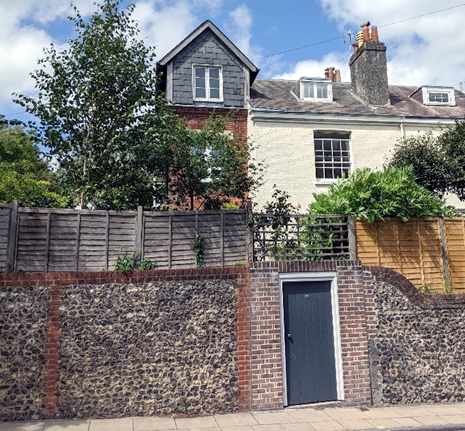
14, Romsey Road, Winchester - Frank Head's family home
in 1914 at the start of the Great War
At just 5ft 4ins tall, Frank was the ideal stature for the Navy’s cramped and claustrophobic submarines. It is not known when he joined the crew on submarine C34, but the vessel was attached at various times to the depot boats that Frank served on – HMS Dolphin in November 1916, HMS Maidstone in 1917 and HMS Lucia in July 1917.
Life aboard a submarine of the Great War period was extremely hard. There were no showers or air conditioning and the smell of diesel was all-pervasive. The vessel constantly sprang leaks and there was rarely any realistic means of escape if it was sunk. Privacy, too, was non-existent. Comfort on the C Class submarine was sacrificed to its most essential equipment – the engines, hydraulic systems, torpedo tubes and depth and directional control gear.
So, what tempted sailors to volunteer? There was the novelty factor, plus extra pay for being a member of the submarine service and extra pay for each night spent on board (which earned it the nickname ‘hard lying allowance’). Promotion within the service was also a little faster than in the general service Royal Navy. At sea, the men passed the time playing cards, sleeping, knitting and on watch duty.
In 1915, C34 moved to Harwich from where it was sent out on ‘U-boat Trap’ patrols to try to disrupt the German submarines then causing mayhem in the North Sea. The trap involved a ‘bait’ vessel, usually an armed trawler, towing a submerged submarine. When challenged by a U-boat, the trawler alerted the submarine which then slipped its tow and attempted to torpedo the U-boat.
On 21 July 1917, a torpedo fired from the German submarine U52 near Shetland struck C34, sinking it with the loss of all but one of the 18-man crew. The sole survivor was picked up by the U-boat and taken to Germany as a prisoner of war. Among those killed was 29-year-old Frank Head who was third in command of C34.
Family after the Great War
After the war Frank’s parents William and Eliza moved to 59, Milverton Road, Winchester, which is his address in the Winchester War Service Register. This biography, however, uses 14, Romsey Road, the family’s home in 1914 and one that Frank would have known well.
Ada Head, Frank’s sister, went on to marry Theodore Matthews, a master coach builder, and in 1939 they were living with her parents at 15, Eastgate Street, Winchester. William died in 1940 at the age of 80. It is not known when Eliza or Ada died.
Medals and Memorials for Frank Joseph Head
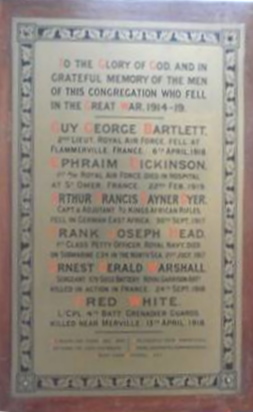
Great War memorial at the United Church,
Jewry Street, Wnchester
Petty Officer Frank Joseph Head was entitled to the 1914-15 Star, the British War Medal and the Victory Medal. He is commemorated on the Portsmouth Naval Memorial (PR. 24) and on the memorials at St Matthew’s, St Paul’s and St Thomas’s churches, Winchester. His name also appears on the Great War memorial (right) at the United Church, Jewry Street, Winchester.