

Lieutenant CHARLES WILLIAM SEYMOUR HAWKER
Arnwood, Weeke, Winchester (house no longer stands)
13th (Service) Battalion, The Hampshire Regiment
Died of illness contracted during war, Switzerland, 13 March 1918
Life Summary

Lieutenant Charles William Seymour Hawker
Charles William Seymour Hawker was born in Newtown, near Wickham, Hampshire, on 26 February 1889. Although English by birth, Charles’s immediate roots lay thousands of miles away in South Australia where, in 1840, his grandfather and great uncles had arrived as settlers from England. Tough, resourceful men, the Hawkers adapted well to pioneer life, becoming wealthy outback sheep farmers and then influential politicians. Charles’s father later returned to England, bringing with him a share of the family fortune. This enabled his son to enjoy a gilded Edwardian upbringing – fine houses, servants and governesses and a Winchester and Oxford education. Charles enlisted with the Public Schools Battalion on the outbreak of war in 1914 but transferred to the Hampshire Regiment after obtaining a commission. He does not appear to have served overseas and was discharged from the Army in 1916 before dying two years later. His name does not appear in the Winchester War Service Register.
Family Background
Charles’s father, Frederick Hawker, was born on 6 December 1851 in Adelaide, South Australia, the son of Charles Hawker (1823-1861) and his wife Emma. Charles Hawker Snr and his brother George (1818-1895) were the sons of Admiral Edward Hawker (1782-1860) who lived in Petersfield and who was godfather to one of Jane Austen’s nieces. In 1840, armed with a small amount of capital, they and another brother emigrated to the Colony of South Australia, eventually establishing a sheep station north of Adelaide which came to be known as Bungaree.
George Hawker eventually bought out his brothers and extended his land until he had some 80,000 acres. He paid much attention to the breeding of his sheep, and his wool gained a high reputation. In 1858 George entered the South Australian House of Assembly and two years later was elected Speaker. He retired from Parliament in 1865 but returned in 1874 and was a member until his death. He also added the posts of Chief Secretary of South Australia and Treasurer to those he held during his long political career. A follower of cricket and horse racing (the town of Hawker still holds an annual Hawker Cup), George was due to be knighted, but died before he could receive his award. However, his wife – by whom he had 12 children - was known as Lady Hawker until her death.
After being bought out by his brother, Charles Hawker returned to England in 1850 and married Emma Digby. He later returned to South Australia where he founded the Anama sheep stud. He died in Adelaide in 1861 as he and his family, including 10-year-old Frederick, were preparing to return to England.
On 10 November 1874 Frederick Hawker married Blanche Bridger at St John’s Church in Paddington, London. Blanche, the daughter of William Bridger, had been born in London in 1849. No record can be found of her mother. In 1876 Blanche gave birth to twins, Arthur and Blanche, in Winchester.
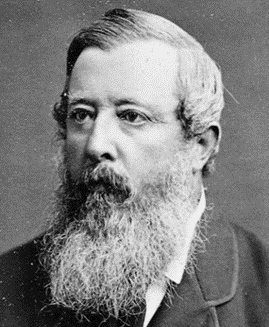
Charles Hawker’s great uncle George who set up
the Bungaree sheep station in South Australia
which was the basis of the family wealth. He later
served in the state parliament

Lincolnville, the house in Cheriton Road where
Charles’s mother lived from around 1920
By 1881 the family were living at Wood End House, Newtown, near Wickham, Hampshire. Built in the late 18th Century, the property was enlarged in the mid-1800s, probably before the Hawkers moved there. It still stands today. In the 1881 Census Frederick Hawker is described as a landowner. The family employed five servants, including a nurse, a nursemaid, a domestic maid, a footman and a cook.
Arthur Hawker died in 1886, aged 10. However, in 1888 Blanche and Frederick had a second daughter, Irene, born in Winchester. Charles was born the following year, probably in Wood End House. The Hawkers were still living in the house in 1891 and were employing even more servants, including two nursemaids and a school governess who would have tutored the younger children.
Frederick Hawker, Charles’s father, died at Bembridge, on the Isle of Wight, on 1 June 1893, aged just 41. Probate records show that he left £2651 11s 11d to his widow. He is buried in St Nicholas churchyard, Wickham. Blanche did not remarry following her husband’s early death, but she did move to Winchester with her children. In 1901 she was living at Kingsmead, a house in Kingsgate Street. She continued to employ servants although their number had been reduced to four, including a governess.
In the late 1890s Charles Hawker attended Eagle House School in Sandhurst, Berkshire, one of the country’s oldest preparatory schools. In 1901, aged 13, he entered Winchester College where he was in E House. He remained at the College until 1905 when he went up to Oxford.
By 1911, Charles, then aged 21, had left home and was boarding in the home of retired farmer Henry Westbrook, in the hamlet of Standon, near Winchester. The house may have been Standon Farmhouse, which still stands on the junction of Sparsholt Road and the A3030, just north of Hursley. Charles is recorded as living on his own means, so he may not have been working. Sharing the house with him was 21-year-old Geoffrey Corbett. He, too, was of independent means so it is possible that he and Charles were friends. Charles’s mother, meanwhile, had moved to Arnwood, a 13-room house at the top of Cheriton Road in Weeke where she was living with her younger daughter Irene and three servants. The house no longer stands.
Great War Record
In 1914 Charles was learning estate management, but when war broke out that August he enlisted with one of the Public Schools Battalions. These ‘Pals’ battalions were raised as part of Kitchener’s New Armies and were originally made up exclusively of former public schoolboys. After being taken over by the British Army they formed battalions of the Middlesex Regiment and the Royal Fusiliers.
Charles spent just one month with his Public Schools Battalion. In September 1914 he gained a commission with the Royal Hampshire Regiment and joined the 13th (Service) Battalion which officially came into being the following month. The 13th Hampshires were formed on the Isle of Wight as a battalion in Fourth Army, but in April 1915, they became a Reserve battalion and were posted to Wareham, Dorset. In September they moved to Bovington and from there to Wool in September 1916. The battalion then converted into the 34th Training Reserve Battalion of 8th Reserve Brigade.
For much of this period Lieutenant Charles Seymour acted as battalion transport officer; he was later appointed transport officer at Brigade Headquarters at Wool. However, in January 1916 he was invalided out of the Army, suffering from illness contracted on service. It is unclear what illness Charles was suffering from, but just over two years later, on 13 March 1919, he died in Switzerland where he may have been sent to recuperate.
Family after the Great War
Charles’s sister Irene served as a Red Cross Volunteer in Winchester Hospital during the war. She died in 1919, possibly from Spanish flu, aged 31. After Irene’s death, Charles’s mother Blanche moved into a smaller house, Lincolnville, which was situated further down Cheriton Road between Western Road and Fordington Road, and which still survives. She was still there in 1939, dying early in 1940 at the age of 91.
Charles cousin, Charles Allan Seymour Hawker, also served in the Great War. A grandson of George Hawker and the son of the manager of the family sheep stations in South Australia, he was studying at Cambridge when war broke out. He enlisted on 11 August 1914 and was commissioned as a temporary Lieutenant in the 6th (Service) Battalion, The Somerset Light Infantry on 1 August 1915. He saw action in Flanders and was injured on 11 August 1915 and again on 24 September at the Battle of Loos when he lost an eye. Despite his injuries, Charles Allan returned to the front in May 1917 with the rank of Captain. He was wounded again on 4 October 1917 during the Passchendaele campaign and paralysed from the waist down. However, after a series of operations and rehabilitation, he was able to walk with two sticks, although his legs remained in surgical irons for the rest of his life.
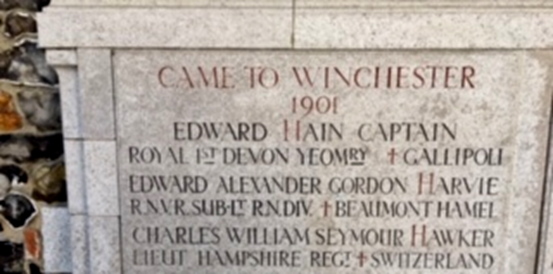
Charles Hawker’s name on the Winchester College War Cloister
Charles Allan returned to South Australia in 1920, resumed his studies and became involved in family agricultural holdings. He also enjoyed a distinguished political career before he was killed in air crash in 1938. The Canberra suburb of Hawker is named in his honour.
Medals and Memorials for Charles William Seymour Hawker
It is thought that Lieutenant Charles William Seymour Hawker was not entitled to any medals because he never served in a theatre of war. He was buried at Vevey (St Martin’s) Cemetery, Switzerland (GR. 1A.) and is mentioned on the memorials at St Matthew’s and St Paul’s churches, Winchester. Charles’s name also appears on the Winchester College War Cloister (Outer C1). At St Nicholas Church, Wickham, there is a brass memorial which reads:
‘In ever loving memory of Frederick Arthur Hawker of Wickham, died June 1st 1893 aged 42 [sic], also of his elder son Arthur F.B. Hawker died September 29th 1886 aged 10 and of his younger son C.W. Seymour, Lieutenant, Hampshire Regiment, died of illness contracted during the War, March 13th 1918 aged 29, also of his younger daughter Irene Laura Maud Hawker died April 9th 1919’