

Private CHARLES WALTER HAMMOND
Kingscote, 36A Clifton Road, Winchester (37, Clifton Road today)
Service numbers 2157 and 200333. 1/4th Battalion, The Hampshire Regiment
Died in Turkish captivity, Mesopotamia, August 1916
Life Summary
Charles Walter Hammond was born in Orpington, Kent, in January 1897, the son of John Lovick Hammond and his wife, Elizabeth. Charles’s father was a career soldier and his grandfather may possibly have had military links in India. Charles joined the Hampshire Regiment as a Territorial in 1913 and served in India and Mesopotamia in the Great War. He died in Turkish captivity in 1916 after being taken prisoner at the siege of Kut-al-Amara.
Family Background
Charles’s father John was born in Romford, Essex, in 1853, the son of Cornelius Hammond, an agricultural labourer and Louisa, a dressmaker. John worked briefly as a groom before enlisting in the Army on 24 January 1871. When his 12 years’ service expired, he signed up again and rose to become a Company Quarter Master Sergeant in the Durham Light Infantry. He served in India where he met Elizabeth Neville. Elizabeth had been born in 1862 in Bengal which suggests that her father may have had military connections.,/p>
John and Elizabeth married in Bombay on 4 September 1876. Elizabeth gave birth to two daughters, Alice and Ellen, in India, in 1879 and 1885 respectively. By the time that their first son, Thomas, was born in 1889 the family were back in England living in Army barracks in Newcastle upon Tyne. In 1892 a third daughter, Ada, was also born in Newcastle, followed three years later by Charles in Kent.
John Hammond left the Army in April 1894 and took his Army pension. However, he retained strong military ties and became a messenger for the War Office. In June 1900 he successfully applied for a one-year Short Service Attestation, becoming a Quarter Master Sergeant in the Royal East Reserve Regiment.
By the following year, when Charles was four years old, the Hammonds had moved again and were living in Gresham Road, Shenfield, Essex. John was approaching the end of his short commission while 15-year-old Ellen was a pupil-teacher at a local school. On 26 June 1903, Elizabeth gave birth to another son, Eric, in Brentwood, Essex.
By the time of the 1911 Census, the Hammonds had moved to the Winchester area and were living at Armagh, a five-room property in the village of Littleton. John was an Army pensioner, but also working as a clerk. The Census does not state whether 14-year-old Charles was working or still at school – in fact, nothing is known about his education. Intriguingly, however, it shows that his mother had given birth to a total of eight children, of whom six had survived. No record can be found of John and Elizabeth’s other two children.

37, Clifton Road, Winchester – this was No. 36A when
Charles Hammond and his family lived here in 1914
The Warren’s Winchester Directory of 1914 reveals that the Hammonds were living at Kingscote, 36A, Clifton Road, Winchester. The house was later renumbered 37, Clifton Road and still stands today.
Great War Record
Charles Hammond’s service number 4/2157 indicates that he enlisted with the 4th Battalion, The Hampshire Regiment at some point in 1913. He was 17, old enough to join the Territorials but too young to serve overseas (the lower age limit for foreign service was 19).
Charles is believed to have been with the 4th Hampshires for their annual summer training camp on Salisbury Plain in late July and early August 1914. The camp took place against the backdrop of the European crisis which followed the assassination of the Austrian Archduke Franz Ferdinand in Sarajevo on 28 June. The 4th Hampshires were still at camp when Britain declared war on Germany on 4 August and mobilisation began.
When the surge of recruits led to the 4th Battalion splitting in two, Charles was assigned to ‘A’ Company in the 1/4th Battalion. He volunteered for service overseas and in October sailed to India, arriving the following month. The 1/4th Hampshires spent just four months in India before being ordered to Mesopotamia. They arrived at Basra on 18 March 1915.
Charles took part in the Hampshires’ early forays against the Ottoman Turks – first in Arabistan, then along the Tigris and Euphrates rivers before helping to capture Nasiriyah in July 1915. The latter operations were carried out in the inhospitable creeks and marshes of the Euphrates delta and many men fell victim to the intense heat and disease.
In December 1916, Charles Hammond was part of the contingent of 1/4th Hampshires that became cut off in the British garrison of Kut-al-Amara. Besieged by the Turks for five months, the garrison finally surrendered on 29 April 1916 and Charles and his comrades were marched off into captivity along with thousands of other British and Indian troops. (For details of the Kut siege and its aftermath, see Kut.)
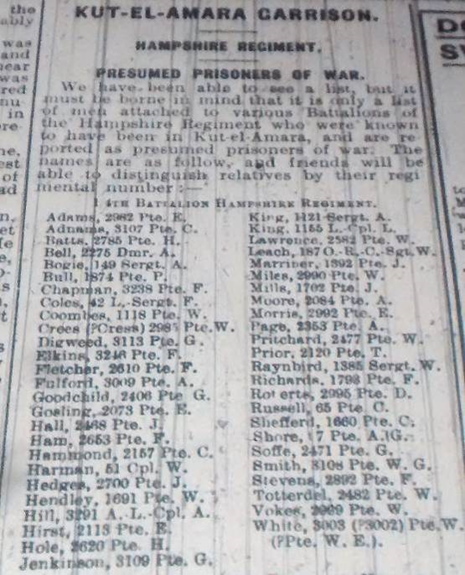
Charles Hammond’s name appeared in the Hampshire Chronicle on 10 June 1916
when the newspaper published the list of Hampshire Regiment men
who had been taken prisoner at Kut. Note the other Fulflood and Weeke names
– Andrew Bogie, Frank Chapman, Frank Coles, Fred Richards, Cecil Shefferd,
George Soffe and William White. All died in captivity
and are mentioned on the parish memorials
It is unlikely that Charles ever made it to a Turkish prisoner-of-war camp. His name appears on a list of Hampshire Regiment prisoners taken at Kut published in the Hampshire Chronicle on 10 June 1916, but it seems he may already have been seriously sick or wounded when captured. According to Mrs Esme Bowker, who established a Comforts Fund for the Hampshire Regiment prisoners, Charles was sick and in a field ambulance when the prisoner column reached Shumran, a short distance from Kut. Regimental Sergeant Major William Leach, a fellow prisoner, wrote that Charles died in hospital at Shumran.
The precise date of Charles’s death is not known. The Commonwealth War Graves Commission and Soldiers Died in the Great War both state that it was on 20 September 1916, but this seems too late given the observations of RSM Leach and Mrs Bowker. The Winchester War Service Register simply says August 1916 and that is probably about as accurate as it is possible to be. Charles was 19 years old.
Family after the Great War
John and Elizabeth Hammond moved to 54, St Catherine’s Road, Bar End, Winchester, but at some stage they moved away from Winchester. In 1939 the couple were living together in Wandsworth, south London. John died in Surrey in September 1949, aged 96. It is not known when Elizabeth died.

The wedding of Charles Hammond’s sister Ada and Captain Montague Atkinson in
India in 1925. Charles’s father, Sergeant Major John Hammond
(front row), cuts an imposing figure with his sword and medals
Charles’s sister Ada married Captain Montague Parker Atkinson – who had spent his early years in St Mary Bourne, near Andover – on 21 September 1925 in Shillong, Bengal, India. In December 1934, Ada and Montague travelled to Canada and the United States, with her husband described on the shipping line’s records as ‘Officer Commanding British Forces, Peshawar, India’. Ada died in April 1979 in Poole, Dorset, aged 86, and Montague in Alton, Hampshire, in 1990, aged 95.
Eric Hammond, Charles’s brother, went on to become a professional soldier like his father. He married in 1929 and died in Broadstairs, Kent, in September 1978, aged 75. It is not known what became of Charles’s other siblings.
Medals and Memorials for Charles Walter Hammond
Private Charles Walter Hammond was entitled to the 1914-15 Star, the British War Medal and the Victory Medal. He is commemorated on the Basra Memorial, Iraq (Panel 21 and 63), and on the memorials at St Matthew’s and St Paul’s churches, Winchester.