

Private HAROLD CHARLES HALLS
95, Greenhill Road, Winchester
Service number 203628 6th (Service) Battalion, The Dorsetshire Regiment (also 2021 Hampshire Carabiniers Yeomanry and 100737 East Yorkshire Regiment)
Died in France, 25 October 1918
Life Summary
Harold Charles Halls was born in Southbourne, near Bournemouth, in 1897, the eldest child of Henry and Minnie Halls. Harold’s ties to Winchester were not close. His parents moved to the city in around 1910 after his father retired from the Coastguard Service, but Harold himself was away at school in London until about 1912. He enlisted in 1915 and served on the Western Front for nearly three years before dying shortly before the Great War ended.
Family Background
Henry Halls, Harold’s father, was born in Middlesex on 27 March 1868. His parents, James (born 1844) and Jane (1838), were Londoners and Henry spent his early life in the East End. In 1871 James Halls was working as an ale cellar man in Mile End. Twenty years later he and Jane had moved to 16, George’s Street, West Ham, with James employed as a painter and decorator. Henry’s two brothers, Thomas and James Jnr, were also living in the house. James, however, was not and it is possible that he had joined the Royal Navy.
Harold’s mother was born Minnie Carver on 9 September 1874 in Shenfield, Essex. Her father, Thomas, had been born in 1845 in Finchingfield, Essex, and her mother Emma in Bocking, Essex, in 1841. In 1881 the family were living at Rose Valley, Shenfield, with Thomas working as a market gardener. By 1891, Minnie had left home to work as a maid for the Rector of Little Oakley, Clacton, Essex.
Henry and Minnie married in 1895 in Billericay, Essex, but they moved shortly afterwards to Southbourne when Henry joined the Coastguard Service. Harold was born there in 1897. In the 1901 Census his father is recorded living at Coastguard Station 1, Southbourne. The cottages, on Hengistbury Head, still stand today.
Coastguards were normally recruited from the Royal Navy and the service was viewed as an auxiliary to the Navy. All personnel were required to practise gunnery and signalling while life-saving was regarded as a secondary role. Coastguards were not encouraged to become too friendly with the local people (a legacy from the smuggling days) and consequently they were transferred frequently. Henry was soon moved to the Isle of Wight where Minnie gave birth to two sons, Victor in Newport in 1902, and Cecil three years later in East Cowes.
Sometime between 1905 and 1910, Harold obtained a place at the Royal Hospital School in Greenwich – presumably as a result of his father’s work for the Coastguard Service. Seafaring traditions were an important element of the school’s life and Royal Navy uniforms (sailor suits) were issued to all pupils and used for ceremonial and formal events. Harold was listed living at the school in the 1911 Census. His parents, meanwhile, had moved to 48, Greenhill Road, Winchester, following Henry’s retirement from the Coastguard Service. By then Henry was working as a chauffeur while sons Victor and Cecil were both at school locally. The house at 48, Greenhill Road became No. 95 when the street was renumbered in around 1913.
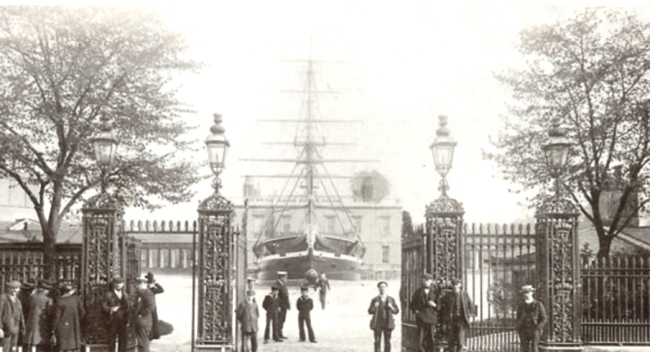
The entrance to the Royal Hospital School in Greenwich in 1905. Harold Halls,
the son of a coastguard, was a pupil there at around this time
Harold probably left the Royal Hospital School in about 1912, when he was 14. He must have returned to live with his parents in Winchester because at some point before the Great War – and despite being under-age - he joined the Hampshire Carabiniers Yeomanry (service number 2021). This unit formed part of the Territorial Force and had detachments in Winchester, Portsmouth, Bournemouth and Southampton.
Great War Record
Harold did not become old enough for military service until 1915, at which point he enlisted with the East Yorkshire Regiment (service number 100737). He then transferred to the 6th (Service) Battalion, The Dorsetshire Regiment (service no. 203628), but it is not known precisely when. The identity of the East Yorkshire Regiment battalion he served in is also not known for certain, but it may have been the 7th as this was in 50th Brigade, part of 17th Division, the same as the 6th Dorsets.
Given this, Harold probably served with 50th Brigade during the war which makes it possible to establish a chronology of events. Harold did not serve overseas in 1915 because he was not entitled to the 1914-15 Star. However, if he was in France in time for the start of the Somme Offensive (1 July-15 November 1916) then he would have taken part in the capture of the village of Fricourt on 1 July and then in the bloody fighting around Mametz Wood and in Delville Wood.
In 1917, 50th Brigade moved north and saw action in the First and Second Battles of the Scarpe and in the capture of Rouex during the Arras Offensive (9 April-16 May 1917). In the autumn, the Brigade fought in the First and Second Battles of Passchendaele at the end of the Third Ypres campaign (31 July-10 November 1917). The Brigade spent the early part of 1918 resting after the battles of the previous year. However, its battalions were heavily engaged during the German Spring Offensive, followed in the autumn by the Battle of Epehy and the Battle of Cambrai, both part of the British Army’s attempt to break through the German Hindenburg Line.
Once through these formidable defences, the Allied armies found themselves fighting in open country on the Western Front for the first time since 1914. The retreating Germans attempted to make stands along a series of rivers in northern France and Belgium and it was at one of these, the Battle of the Selle (17-25 October 1918), that Harold Halls was killed.
The battle opened on 17 October with the British Fourth Army forcing crossings over the River Selle. By nightfall, German defences on most of the ten-mile front had been shattered and the town of Le Cateau captured. Fighting continued on 18-19 October as Fourth Army advanced more than five miles, pushing the Germans back towards the Sambre-Oise Canal. A surprise night attack on 20 October by the British Third Army secured the high ground east of the river and the momentum was maintained on 23 October with a combined assault by the Fourth, Third and First Armies.
Nothing is known of Harold’s death, at the age of 21, on the last day of the battle. His Medal Index Card does not even state whether he was killed in action or died because of sickness.
Family after the Great War
Harold’s father Henry served at sea as a Petty Officer in the Great War and survived. He and Harold’s mother remained at 95, Greenhill Road until 1927 when they left Winchester to return to Essex. In 1939 they were living in Ilford where Henry died in 1946, aged 78, and Minnie in 1958 at the age of 84. Harold’s younger brother Victor also went to live in Ilford.
Medals and Memorials for Harold Charles Halls
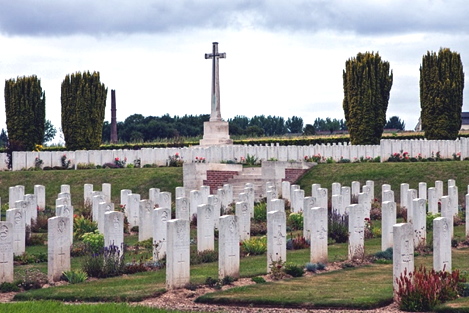
Abbeville Communal Cemetery Extension, Somme
Private Harold Charles Halls was entitled to the British War Medal and the Victory Medal. He was buried at Abbeville Communal Cemetery Extension (above), Somme (GR. IV. J. 20.) with the following inscription on his headstone:
SLEEP DEAR ONE TAKE YOUR REST WE MISS YOU MOST WHO LOVED YOU BEST.
His name also appears on the memorials at St Paul’s and St Matthew’s churches, Winchester. (His initials are A. C.)