

Signaller FRANK ARTHUR FRASER
Culduthel, Links Road, Winchester
Service number 5795. 18th Battalion, Australian Infantry Force
Killed in action, Belgium, 9 October 1917
Life Summary
Frank Arthur Fraser was born in Notting Hill, west London in 1882, the third of the four sons of Charles and Margaret Fraser. Frank served in the Royal Navy before emigrating to Australia and is not thought to have ever lived in Winchester. However, his parents moved to the city in around 1910 and they are thought to have been responsible for his name appearing on the memorials at St Matthew’s and St Paul’s. Frank was killed at the Third Battle of Ypres (Passchendaele) in 1917.
Family Background
Frank’s father was born in Wimborne, Dorset in 1855. In August 1874, aged 18, he joined the Scots Guards in Wimborne but left in September 1878. The same year, he married Margaret Griffiths in Surrey. Margaret, the daughter of a bootmaker, had been born in Beaumaris, on the island of Anglesey, North Wales, in 1854. She worked as a domestic servant before marrying.
The Frasers moved to London where, for the next 20 years, Charles worked as a coachman, living at various mews houses in Kensington, Paddington and Chelsea. The couple’s three other sons, William, Charles and Richard, were born in London in 1878, 1880 and 1886 respectively.
In 1900 Frank Fraser joined the Royal Navy, enlisting for 12 years. He would have spent much of that period overseas – in the 1911 Census he was recorded serving as a Leading Signalman aboard the cruiser Grosephine (Josephine). The ship was stationed in the East Indies, but in port at Aden at the time of the Census.
The same Census showed that Frank’s parents had moved to Winchester. Charles was no longer a coachman but working instead as the publican of The Queen inn in Kingsgate Street. The couple’s nine-year-old grandson, William, was living with them on the premises. He was possibly the son of Frank’s older brother, William, who had married Florence Tebbut in Northamptonshire in 1900.
Frank Fraser left the Navy in 1912 and emigrated to Australia where he worked as a clerk, living in Darlinghurst, a suburb of Sydney, New South Wales. Frank enlisted as an infantryman with the Australian Imperial Force at Victoria Barracks on 8 May 1916. After completing his basic training, he left Australia by troopship on 7 October 1916, arriving at Plymouth on 21 November. For his military training, he was assigned to the 5th Training Battalion based in Rollestone, Wiltshire. He then embarked at Folkestone for the Western Front on 14 June 1917, arriving at Le Havre the next day.
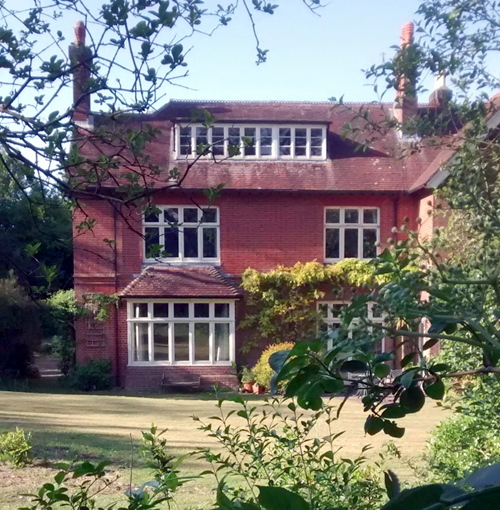
Culduthel in Links Road is Frank Fraser’s address in the WWSR.
It was owned by Ada Fraser, possibly a relative who allowed Frank’s parents to lodge there
Great War Record
On 3 July 1917 Frank joined the 18th (New South Wales) Battalion, the Australian Infantry Force (AIF) in France. His brief entry in the Winchester War Service Register states that he served as a Signaller. The 18th NSW Battalion, which came under the orders of 5th Brigade, part of the Australian 2nd Division, had suffered heavy casualties at Gallipoli in 1915 and then again during the Somme Offensive in 1916, particularly at the Battle of Pozières which raged from late July to early September. (Charles Bean, the Australian official historian of the Great War, wrote that the Pozières ridge ‘is more densely sown with Australian sacrifice than any other place on earth’.) In early 1917 the battalion was in action at Warlencourt during the German army’s retreat to the Hindenburg Line and then, in late spring, at the Second Battle of Bullecourt, part of the Arras campaign.
Frank Fraser’s first experience of combat is thought to have been at the Battle of the Menin Road Ridge (20-25 September 1917), part of the Third Ypres campaign in Flanders. The attack aimed to capture sections of the curving ridge, east of the town of Ypres. It saw the first involvement of Australian units in the Third Ypres campaign and was successful on its entire front. Advancing under an intense supporting artillery barrage, the troops overcame formidable German defensive positions which included concrete pill-box strongpoints. The two AIF divisions suffered 5,013 casualties.
After a fortnight’s rest - during which time Australian troops spearheaded further successes at Polygon Wood and Broodseinde - Frank was back in action on 9 October at the Battle of Poelcapelle (also called the First Battle of Passchendaele). The objective was to capture the ridge on which the village of Passchendaele stood.
The plan was similar to that used at the Menin Road battle: British and Australian troops would secure a series of intermediate objectives under the protection of a heavy artillery barrage before seizing the ridge. However, rain had turned an already poorly drained battlefield into a quagmire which meant that not enough heavy guns could be brought within range. The infantry attack bogged down in the mud and although the Australians managed to secure some of their objectives for a short time, they were eventually forced to withdraw.
The 2nd Australian Division sustained 1,250 casualties at the Battle of Poelcapelle. Frank Fraser was among those killed on the opening day. He was 35 years old.
Family after the Great War
Frank’s military records list his mother Margaret as his next of kin. She applied to the Australian government for her son’s medals on 12 December 1921. Her address in Frank’s records is given first as Culduthel, Links Road, Winchester, and then as 35, Monks Road, Winchester. The Winchester War Service Register gives Frank’s address simply as Links Road.
Culduthel, which still stands, is a large house and one that would have been beyond the means of Frank’s parents. In fact, the householder during the war was Ada Albinia Fraser, widow of Colonel Alexander Fraser, formerly of the Hampshire Regiment who had died in 1901. (In the 1911 Census Ada was listed as the householder for Winnall Manor.) Although a Scot by birth, it seems likely, given the surnames, that the Colonel was related to Frank Fraser. If so, then it is possible that his widow may have allowed Frank’s parents to lodge at Culduthel. The arrangement would have ended when Charles and Margaret Fraser moved to 35, Monks Road – this is Charles’s address in the Electoral Registers of 1920 and 1921.
Frank’s brother, Charles Jnr, also served in the Great War. Commissioned into the Royal Army Service Corps in 1915, he later transferred to the City of London Yeomanry, a cavalry unit known as the Rough Riders which had taken its name from the volunteer horsemen who had fought under Colonel (later President) Theodore Roosevelt in the Spanish-American War of 1898. Charles, who ended the war as a Lieutenant, saw action in France and Belgium. His address in the WWSR is also given as Links Road.
Two of Ada Fraser’s sons fought in the war and survived. Major Alexander Fraser served with the Royal Berkshire Regiment and was wounded twice. He won the Military Cross and was twice Mentioned in Dispatches. Francis Fraser was a Staff Officer. Wounded once, he won also won the Military Cross as well as the Distinguished Service Order and was Mentioned in Dispatches.
Charles Fraser, Frank’s father, died at 35, Monks Road in 1922. His mother died there in 1931. Of Frank’s brothers, William worked as a coachman in London all his life. He married and raised a family before his death in 1951, aged 81.
Charles Jnr never married and died in Winchester in 1933 at the age of 53. He was living at 37, Monks Road at the time of his death. The youngest brother, Richard, also worked as a coachman before joining the Dragoon Guards in 1909. He, too, is believed to have fought in the Great War. It is not known whether he married.
Medals and Memorials for Frank Arthur Fraser.
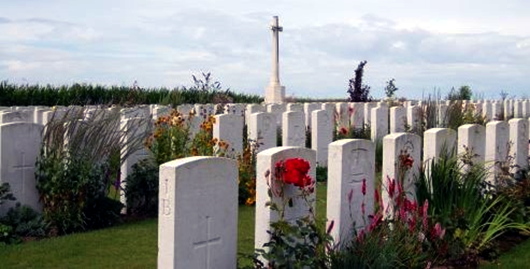
Dochy Farm New British Cemetery, West Flanders, Belgium
Signaller Frank Arthur Fraser was entitled to the British War Medal and the Victory Medal. He was buried at Dochy Farm New British Cemetery (above), West Flanders, Belgium (GR. VIII. D. 17) and his name appears on the memorials at St Matthew’s and St Paul’s churches, Winchester. He is also commemorated on the Australian Roll of Honour.