

Major HAROLD THOMAS FORSTER (or FOSTER) DSO and Bar, MC and Bar
14, Avenue Road, Winchester
Service number 5670. 1st Battalion, The Royal Berkshire Regiment (Attached to 2nd Battalion, The Northamptonshire Regiment)
Died of wounds, France, 29 May 1918
Life Summary
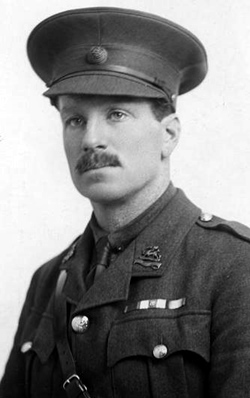
Harold Thomas Forster
Harold Thomas Foster was born in the Winchester parish of St Faith on 14 November 1878, the son of William Earle and Lydia Foster. Intriguingly, the family changed their surname to Forster around 1890 and inverted their Christian and middle names. Hence Harold’s name appears as Forster in many of the census and Army records. A remarkably brave soldier, he was awarded the Distinguished Service Order and Bar and the Military Cross and Bar during the Great War. He was also a talented sportsman and played first-class cricket for Hampshire.
Family Background
Harold’s father, William, was born in 1848 in Pimlico, London, the son of a builder also called William. Harold’s mother was born Lydia Lloyd on 19 March 1848 in Westminster, London. Her father, James Lloyd, worked as a coachman. Lydia’s mother was born Mary-Ann Williams in Winchester in June 1816. William and Lydia married in Twickenham, Middlesex, on 22 August 1869. William was a joiner at the time. The following year, when the couple were living at 61, Swinbroke Road, Kensington, west London, Lydia gave birth to a daughter called Lydia Annie. Their first son, Percy, was born in Paddington, west London, on 17 October 1874.
Sometime between 1871 and 1878 the Fosters moved to Winchester where Harold and twins Edith and Ernest (1881) were born. The 1881 Census shows Lydia and the children living at 20, North View. William Foster, however, was recorded living as a boarder at 92, Broad Street, Portsmouth, and working as a furniture packer. It is believed he moved there for work while the family remained in Winchester. Shortly afterwards Lydia moved to Portsmouth to join her husband, but it is possible that the three older children, Lydia Annie, Percy and Harold, remained behind to continue their schooling.
Tragedy struck the family in 1883 when two-year-old Ernest Foster, Harold’s younger brother, died of burns after his nightshirt caught fire. At the inquest William’s employment was listed as builder’s foreman. The same year Lydia gave birth to another son, Sidney, in Portsmouth.
According to family memory, William Foster spent time in Winchester Prison during 1886 and Lydia moved back to the city, presumably so that she could visit him more easily. It is not known why William was jailed. Lydia’s parents had moved to Winchester from London by this time and were living at 14, Queen’s Road, so it is possible that she lived with them.
On his release from prison, William was apparently set to be immediately rearrested on a theft charge, but the prison authorities did not want him back in jail, so they handed him over into the care of his wife. However, the spell in prison appears to have affected William’s health because in 1887 he died of tuberculosis, aged 39. To compound the tragedy, Harold’s youngest brother Sidney died in the same year.
By 1888, Lydia’s parents, James and Mary-Ann Lloyd, had moved to 10, Arbor View, Fulflood. Mary-Ann died the following year. In the 1891 Census, Lydia was living with her father and children at 32, Clifton Road. The census also reveals how members of the family had changed their names – Harold, for example, had become Thomas H. Forster while his sister Edith became Mary E. Forster. Why they did this is unclear, but perhaps it had something to do with the shame of William Foster being sent to prison.
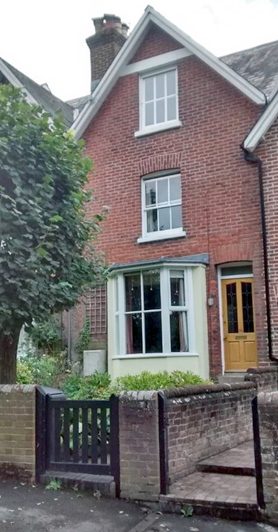
32, Clifton Road, Winchester –
Harold Forster’s home at the start of the Great War.
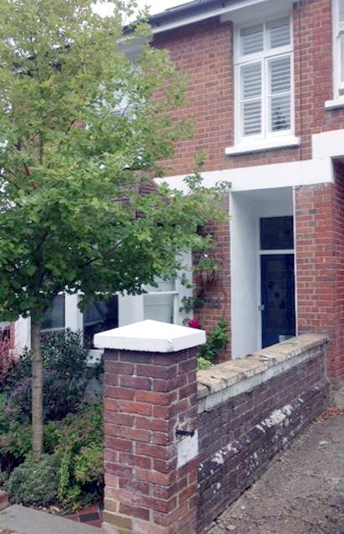
14, Avenue Road, where Harold Forster
and his wife Ethel moved in 1917 or 1918
By 1895 Harold’s mother Lydia was living at 15, Romsey Road. Two years later she remarried. Her new husband, Edwin Jeffery, had been born in Winchester in 1841. In the 1901 Census the couple were recorded as living at 9, Avenue Road, Fulflood, with Edwin working as a grocer’s warehouseman. Lydia and Edwin remained at the address until 1909 when they disappear from the Warren’s Directory.
Harold Forster attended St Thomas Church of England Senior Boys’ School before enlisting with the Royal Marines Light Infantry in 1897 when he was 19. Two years later, however, he bought himself out and joined the 1st Battalion (Princess Charlotte of Wales), The Royal Berkshire Regiment as a Private, initially serving in Ireland. In 1905 Harold married Ethel May Smith in Dublin. They had three sons together. William and Victor are both believed to have been born in Ireland. The third son, Owen, was born in Winchester in 1918, but sadly Harold was killed in action the same year and never met him. In 1908 Harold’s mother died of cancer in Winchester, her death being recorded by Harold who must have come over from Ireland.
By 1911 Harold and his family had moved back to England and were living at military quarters at Fort Burgoyne in Dover. The census of that year also showed that his brother Percy had married and was living with his wife Beatrice and two daughters in Willesden, London. Percy was employed as a railway coachmaker.
Harold’s prowess as a cricketer shone through when he made his first-class debut for Hampshire against MCC in May 1911. A left-arm slow-medium bowler, he took 5 for 38 in the MCC’s first innings and finished with match figures of 9 for 92. In all, he played five first-class matches for Hampshire that season. Later in the year he also played hockey for his battalion.
Great War Record
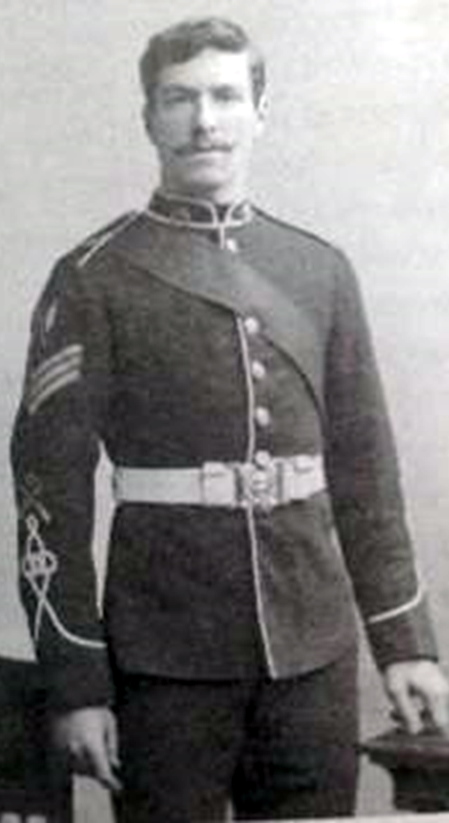
Harold Forster while he was a Sergeant Major
in The Royal Berkshire Regiment
At the start of the Great War in August 1914, Harold was a Company Sergeant Major (CSM) with the 1st Royal Berkshires. The battalion quickly mobilised and on 13 August arrived in France where, as part of 2nd Division, it took part in the Battle of Mons (23-24 August) and the subsequent retreat (24 August-5 September). Harold is also believed to have seen action at the First Battle of the Aisne (12-15 September) before being wounded on 30 October.
Harold was sent to England to convalesce before returning to the front. Commissioned on 15 June 1915, he was posted to the 2nd Battalion, The Royal Berkshire Regiment, part of 8th Division, and promoted to Lieutenant on 28 December. In June 1916 he was Mentioned in Dispatches and on 19 August he was awarded the Military Cross for bravery. The award was backdated and referred to his time as a Company Sergeant Major. His citation read:
Coy S./M. (now 2nd Lt.) Harold Thomas Forster, R. Berks. R.
For gallantry and devotion to duty. A very gallant warrant officer, he has maintained the same standard in the performance of his duties.
Harold fought at the Battle of Albert (1-13 July 1916), the opening phase of the Somme Offensive, and on 22 October he became the battalion’s Adjutant - a staff officer who advised the Commanding Officer. He was Mentioned in Dispatches for a second time on 25 May 1917.
During the Third Ypres (Passchendaele) campaign between July and November 1917, Harold saw action at the Battle of Pilckem Ridge (31 July-2 August) and the Battle of Langemarck. On 26 September he was awarded a Bar to his Military Cross and the Distinguished Service Order (DSO). He was Mentioned in Dispatches again on 21 December. The citations for the DSO and the Bar to the MC followed on 9 January 1918. The citation for his Bar to the MC read:
Lt. Harold Thomas Foster, M.C. R. Berks. R.
For conspicuous gallantry and devotion to duty. He took over command of his battalion when his colonel had become a casualty, and led them with great skill to their objective, twice changing direction in order to avoid hostile barrage. He then made a personal reconnaissance and ascertained the position of the enemy, after which he formed a defensive flank, and was able to re-establish his line when it had been driven back by determined hostile counter-attacks. He remained perfectly cheerful throughout, showing a fine example of fearlessness and contempt for danger.
The citation for his DSO read:
Lt. Harold Thomas Forster, DSO, MC, R. Berks. R.
For conspicuous gallantry and devotion to duty during an attack. He performed invaluable work as Adjutant throughout the day, rallying and controlling the men and showing great grasp of the situation. He set a fine example of courage and resource to all.
In April 1918 Harold was attached to the 2nd Battalion, The Northamptonshire Regiment (also in 8th Division) as an Acting Major and Second-in-Command. He wrote several letters home to his wife Ethel during this period, including this one:
My Own Darling Girl,
Just received your letter and very pleased to get it. The weather appears to have changed there as it has here. Yes Kiddie, you must tell Gash that he cannot have the ground after Xmas as we want it ourselves, then next year we can plant nearly all of it with potatoes which should keep you going as the back garden does not appear to be any good. As you say he had a cheek, but I know him. He would soon collar the lot if he had a chance.
I do hope you won’t have any bad weather when Percy is there, perhaps you would get him to put some winter cabbages in which will come in very handy to you.
I wish I could get home for a time to square up things a bit but if I do, I don’t want anyone else staying there. I want you and the boys all to myself. If I am lucky enough to get leave soon I expect you will be on your own, all the visitors will have gone. As we shan’t be out of here till the 1st I wonder if Joe will manage to come down or not.
We have the parson to tea in the trenches too, but he is a jolly fine chap.
Now my darling girl I will close, kiss the boys. With all my love to my darling girl.
I remain your loving husband
Harold Forster
Another letter gives an idea of conditions in the trenches:
My Darling Kid,
I was looking forward to a letter today but there is no mail, so we are all disappointed. Never mind, perhaps we shall do better tomorrow. It’s been raining nearly all the time since I wrote yesterday and the place is awful. We had a dugout fall in on three men this morning owing to the rain, but we dug them out in time. The trenches are rotten today.
We have had some good news today so altogether we are doing grand. Our new armoured cars are doing well evidently.
Well I have no news Kiddie dear.
Kiss Vic for me.
With all my love to you.
Your loving husband
Harry
Harold took over command of the 2nd Northamptonshires when the CO was killed on 24 April at the Second Battle of Villers-Brettoneux during the German Spring Offensive. Today the battle is notable for being the first occasion that tanks fought against each other. In May 1918, 8th Division was sent south to the River Aisne area to rest and recuperate having suffered heavy casualties during the early spring fighting. There, however, the Division inadvertently found itself in the path of another major German attack (Operation Blucher, 26 May-3 June) against French forces on the Aisne.
Harold died on 29 May 1918 after a shell exploded beneath his horse at Bouleuse Ridge, near Ventelay. He suffered chest and face injuries and was taken to a field dressing station after which there was confusion about what had happened to him. Harold’s wife Ethel still believed him alive months later, but in March 1919 the Army concluded that he had died on 29 May. His grave was not located until sometime later.
On 16 September 1918, more than three months after his death, Harold was awarded a Bar to his DSO for the first few days of his command of the 2nd Northamptonshires. The citation read:
Lt. (A./Maj.) Harold Thomas Forster, DSO MC, R. Berkshire Regiment attd North’n R.
For conspicuous gallantry and devotion to duty. He assumed command of his battalion when his colonel was killed, and by his coolness and skill extricated it from a critical situation and formed a defensive flank of the utmost importance. For three days and nights, by his pluck and energy, he set an example to his men of inestimable value under adverse conditions of heavy and continuous shellfire.
Family after the Great War
At some point in 1917 or 1918 Harold and Ethel had moved to 14, Avenue Road, Fulflood. As it has not been possible to pinpoint where Harold’s family were living in 1914, this biography uses the house in Avenue Road as his address. Ethel remained at the property until 1923 (she is listed as Foster in Warren’s) when she moved to 3, Stuart Crescent, Stanmore, Winchester, which was a new estate at the time. She was still living there in 1931. Harold’s brother Percy remained in the east London area after the war.
Medals and Memorials for Harold Thomas Forster.
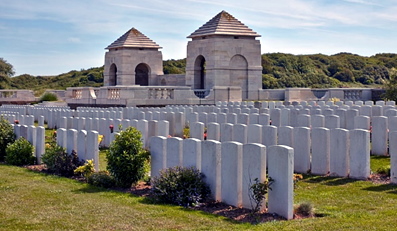
Terlincthun British Cemetery, Wimille, Pas de Calais, France
Beside his DSO and Bar and MC and Bar, Major Harold Thomas Foster was also entitled to the 1914 (Mons) Star, the British War Medal and the Victory medal. He is buried at Terlincthun British Cemetery (above), Wimille, Pas de Calais, France (GR. VII. A. C. 12.) and is mentioned on the memorials at St Matthew’s and St Paul's churches, Winchester. His name also appears on the St Thomas Church of England Boys’ School memorial, now held at Kings School, Winchester, and the memorial at the Aegis Cricket Bowl, Southampton.
Additional sources
- N. McCrery: Final Wicket: Test and First-Class Cricketers Killed in the Great War (Barnsley: 2015).
- Renshaw (ed.): Wisden’s Lives Cricket’s Fallen, 1914-1918. (London: 2014).