

Private JOHN FORBES
25, Sussex Street, Winchester (no longer stands)
Service number S/9037. 8th (Service) Battalion, The Seaforth Highlanders
Killed in action, France, 19 August 1916.
Life Summary
John Forbes was born in Dalry, Edinburgh, in 1879, one of 12 children. A stone cutter by profession, he is believed to have moved to Winchester for work in the 1890s but returned to Scotland to enlist in a Highland Regiment when the Great War broke out. He was killed in 1916 during the Battle of the Somme.
Family Background
John’s father, Alexander Forbes (1844-1907), was born in Cullen, Banffshire, in around 1844 and was one of nine children. He worked as a stonemason and, like his son, appears to have travelled around the country for work because when he died in 1907, he was living in Wandsworth, south London. Alexander’s father, William, was also a stonemason and he lived and worked in Cullen. William Forbes and his wife Helen married in around 1830.
John Forbes’s mother was born Eliza Constant or Cousant in 1848. The census entries for her place of birth are very vague – ‘from England’. Although mostly a housewife, she did leave home to work as a nurse in Aberfoyle, Perthshire, in the early 1900s.
Alexander and Eliza married on 15 October 1866 in Cullen and their first son, William, was born there in 1867. Three more children, twins Alexander and Ellen (1868) and Eliza (1870), were born in Aberdeen. The remaining children were all born in Edinburgh – Mary (1875), Catherine (1877), John (1879), Thomas (1881), Margaret (1882), James (1884), Peter (1886) and Robina (1891).
By 1901 John had moved to Winchester and was living at 4, Tower Street. His occupation on that year’s census was stone cutter. John married Ethel Bubb in Winchester in 1906. Ethel had been born in the city on 4 April 1882 and she lived with her parents at 25, Sussex Street (the house no longer stands). Her father, Charles, born in Porton, Worcestershire, in 1849, worked as a coachman and fly driver. (A fly was a one-horse, two-wheeled light carriage.) Ethel’s mother, Esther, had been born in Sparsholt, near Winchester in 1857. Her brother Walter worked as a hairdresser in Winchester.
John and Ethel had one daughter, Marjorie, who was born in Winchester in 1907. They continued to live at 25, Sussex Street with Ethel’s parents for many years so money may have been tight. Either that or John had to travel a lot to find work.
Great War Records
In 1915, the second year of the Great War, John returned to Edinburgh where he enlisted with The Seaforth Highlanders (Ross-shire Buffs, Duke of Albany's). He was assigned to the 8th (Service) Battalion, formed mainly of volunteers, with the service number S/9037.
The 8th Seaforth Highlanders had been raised at Fort George, Inverness, in September 1914 as part of Lord Kitchener’s Second New Army. The battalion came under the command of 44th Brigade in the 15th (Scottish) Division. The 8th Seaforths moved to Aldershot for training and from there to Petersfield in November 1914. On 22 January 1915, the 15th Division was inspected by Lord Kitchener himself. The following month they were at Chisledon Camp on Salisbury Plain and then moved to Tidworth in May for final training. In July, the battalion sailed for France with the rest of 15th Division.
Private John Forbes arrived in France on 12 October 1915, towards the end of the Battle of Loos (25 September-15 October 1915). The 8th Seaforths had been in the first wave of troops to attack on 25 September and captured the town of Loos itself early on before being pushed back. The battalion suffered 502 casualties in the battle, around half its total strength, so John was probably sent out as a draft, or reinforcement.
John would have been with the 8th Seaforths when the Germans launched two gas attacks on 15th and 16th Divisions at Hulluch, near Loos, on 27 and 29 April 1916. The first gas cloud – a mixture of phosgene and chlorine - and accompanying artillery bombardment were followed by raiding parties which led to the temporary capture of sections of the British line. In the second attack, two days later, the wind turned and blew the gas back over the German lines, causing heavy casualties. The PH gas helmets worn by many British troops performed badly during the attacks. As a result, production of the more effective Small Box Respirator was accelerated.
On 11 May 1916, the Germans launched a massive artillery bombardment on 15th Division positions near Loos known as the Kink Salient. Specially trained assault teams rushed the survivors and captured the British front and second lines. Among those taken prisoner were British tunnellers trapped underground. The Germans repulsed a series of hasty counter-attacks by the British who eventually withdrew and consolidated a new, less exposed, line further back.
John Forbes was killed in action on 19 August 1916 at the Battle of Pozieres (23 July-3 September) during the Somme Offensive. The fighting for Pozieres and nearby Mouquet Farm was among the bloodiest of the entire Somme campaign, particularly for the Australians who suffered 23,000 casualties.
Family after the Great War
John Forbes was 37 years old when he died. His body was never found. After his death, his widow Ethel continued to live at 25, Sussex Street until 1918 when she moved the short distance to No. 47. She died in Winchester in 1940, aged 58.
Medals and Memorials for John Forbes
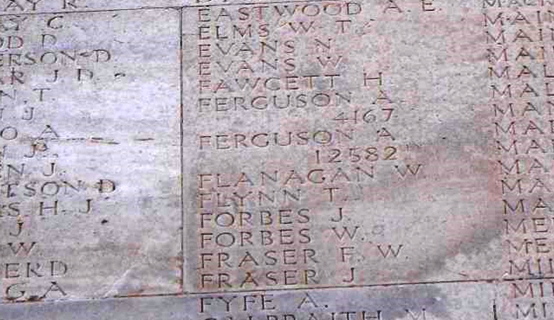
Thiepval Memorial showing John Forbes
Private John Forbes was entitled to the 1914-15 Star, the British War Medal and the Victory Medal. He has no known grave, but his name is listed on the Thiepval Memorial (above), Somme, France (Pier & Face 15C) and on the memorials at St Matthew’s and St Paul’s churches, Winchester.