

Private THOMAS HAROLD DRAKE
Wyke Hill House, Weeke, Winchester
Service number 125. The East African Mounted Rifles
Killed in action, East Africa, 3 November 1914
Life Summary
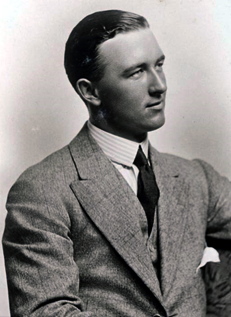
Thomas Harold Drake
Thomas Harold Drake was born in Stratford, east London, on 2 December 1883. He came from a prosperous family background: his father was a doctor and his grandfather a gentleman farmer and brewer. Thomas attended Marlborough College before emigrating to East Africa in the early 1900s. He joined the East African Mounted Rifles when Britain went to war in August 1914 and was killed in action near Mount Kilimanjaro two months later.
Family Background
The Drake family came from Kingsclere, near Newbury, on the Hampshire-Berkshire border. Thomas’s father Arthur (1849-1895) and grandfather William (1803-1881) were both born there as were his uncles and aunts. William Drake was a master brewer and farmer who, in the 1851 and 1861 Censuses, lived with his wife Sarah at The Brewery in Duke Street, Kingsclere. Sarah had been born in Barton Stacey, near Winchester, in 1809.
In 1861 William’s farm amounted to 250 acres and he employed seven labourers and three boys. Two of his sons, William Jnr and Edward, were also in the brewery trade while a third, Thomas, had qualified as a doctor in 1861 but was not practising. Arthur was at school.
Thomas’s mother was born Emily Courtney in Woodmancote, near Basingstoke, in 1858. Little is known of her early life or of her parents, William and Mary-Ann Courtney.
In 1871, most of the Drake family were still living in Duke Street, Kingsclere. William Snr’s farm had expanded to 280 acres and he employed nine men. Arthur Drake, although just 22, had qualified as a surgeon while his brother William Jnr was running 490-acre Dummer Down Farm, near Basingstoke.
Arthur married Emily Courtney in Winchester in 1879, around the time that his parents moved to 12, Southgate Street, Winchester, where William Snr died in 1881, aged 78. That year’s census shows, rather oddly, that Arthur was living with his widowed mother in Southgate Street while Emily was with her parents a short distance away at 10, St James’s Villas.
However, this appears to have been a temporary arrangement because a few months later, on 7 September 1881, Emily gave birth to a son, Arthur Edward, in West Ham, East London. The couple had presumably moved to the area because of Arthur’s work as a doctor. In 1883, Emily and Thomas – probably twins - were born in Stratford.
The 1891 Census shows the family living in Romford Road, West Ham, with Arthur working as a medical practitioner. However, while his siblings were at home, eight-year-old Thomas was boarding at a small school run by his aunt, Charlotte Drake, in Swan Street, Kingsclere. The school also had an assistant teacher and the students were predominantly siblings from various families, aged between seven and 11.
The same census reveals that William Drake Jnr, Thomas’s uncle, was running the 1100-acre New Down Farm at Micheldever, near Winchester. Two of Thomas’s other uncles and aunts were Winchester residents: Elizabeth Drake was at Fernlea, St Thomas Street, and living off her own means (her mother Sarah had died in 1886), while Thomas was a doctor and living at 44, Hyde Street.
Thomas’s father Arthur died in Nursling, Southampton, in 1895. The same year, Thomas enrolled at Temple Grove School, East Sheen, Surrey, where fellow pupils included the composer Sir Sydney Nicholson, who founded the Royal School of Church Music, and Sir Ronald Storrs, the first British governor of Jerusalem.
In 1897 Thomas was admitted to Marlborough College where he remained until leaving at Easter 1901, aged 17. It is thought that his brother, Arthur Jnr, also went to Marlborough before going on to Cambridge to study medicine. In 1911 Arthur Jnr was working as a physician and surgeon and living in Rochester, Kent, with his wife Ethel and their young son.
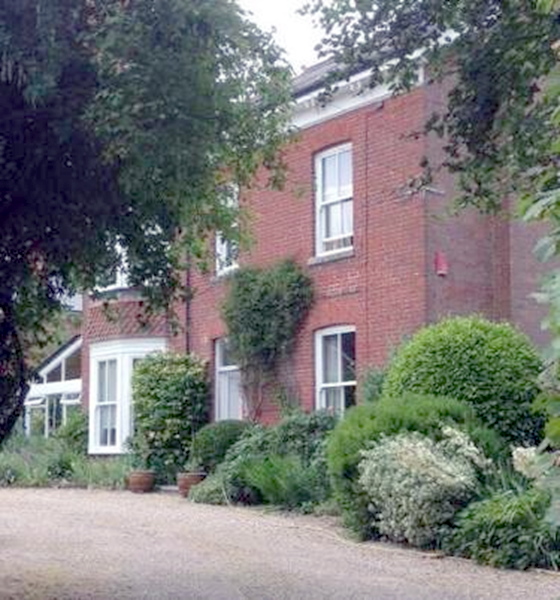
Wyke Hill House, Weeke – Thomas Drake’s mother moved here in around 1900
shortly before he emigrated to East Africa
Sometime before 1901, Thomas’s mother moved back to Winchester to live at Wyke Hill House, Weeke.
Around 1902, Thomas Drake emigrated to British East Africa (later Kenya) where he settled and farmed in Molo, a fertile area in the south-west of the country. The British government offered leases of up to 999 years as well as exemption from land tax to encourage settlers to move to East Africa. The incentives worked. In 1903 there were fewer than 400 European settlers in British East Africa; by 1912 the figure had risen to 1,000.
Great War Record
Shortly after the Great War began in August 1914, British East Africa found itself threatened by German East Africa (now Tanzania), the neighbouring colony to the south. German raiding parties ambushed British detachments and attacked the Uganda Railway. In response, many young settlers and coffee planters joined the East African Mounted Rifles (EAMR), a corps raised in Nairobi on 5 August 1914.
By the end of the month, the EAMR ranks had swelled to more than 400 volunteers. Most were expert riders and crack shots with the advantage of knowing the country and Swahili. They knew little and cared less about formal soldiering and they were somewhat taken aback when they found themselves being issued with regulation uniforms and expected to undergo formal training. However, as they prepared for war in August, the EAMR developed into a more uniform and disciplined unit - the only concession to individuality being to allow the members of ‘Bowker’s Horse’ – a detachment which included Thomas Drake - to retain the letters BH on their helmets.
At the end of October, the 4,000-strong British Indian Expeditionary Force ‘C’, commanded by Brigadier General J. M. Stewart, gathered near the border with German East Africa ahead of a two-pronged invasion of the colony. The first thrust involved attacks on the port of Tanga and the German settlement at Longido on the slopes of Mount Kilimanjaro. On 3 November 1914, some 1,500 Punjabis of the British force advanced at night up the slopes near Longido. However, when daylight came, they were caught in the crossfire of a strong German defensive position and suffered heavy casualties.
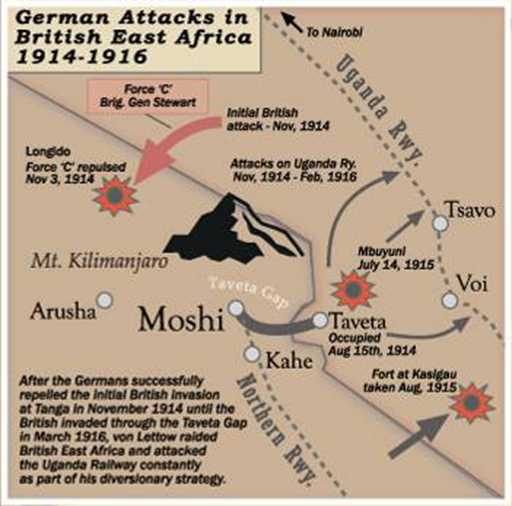
Thomas Drake was killed in action at Longido on 3 November. His friends buried him where he fell, together with seven other men who lost their lives. Following the battle, British troops became widely scattered and commanders, deciding that their position was hopeless, pulled out and marched back to British East Africa, having accomplished nothing.
Family after the Great War
Thomas’s brother Arthur served as a doctor and surgeon in the Great War. He enlisted in 1914 and became a Captain with 28th Hospital Unit, 25th Casualty Clearing Station, Royal Army Medical Corps, attached to 86th Brigade, Royal Garrison Artillery. At some point after the war he and his wife Ethel move to Chesterton, Cambridgeshire, where he worked as a physician and surgeon.
Thomas’s mother Emily continued to live at Wyke Hill House in Weeke after the war and would have been responsible for her son’s name appearing on the memorial at St Paul’s. She died in Winchester in 1926, aged 68.
Medals and Memorials for Thomas Harold Drake
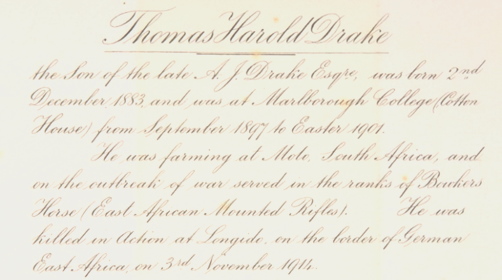
Thomas Drake's entry in the Marlborough College Roll of Honour
Private Thomas Harold Drake was entitled to the 1914 Star, the British War Medal and the Victory Medal. His remains were later removed from Longido to Dar es Salaam War Cemetery, Tanzania (GR. Coll. Grave 8. E. 6-13.). The inscription on his headstone reads:
KILLED TRYING TO RESCUE.
Thomas is commemorated on the Marlborough College War Memorial and in its Roll of Honour. His name also appears on the memorials at St Matthew’s and St Paul’s churches, Winchester.