

Private CHARLES EDWIN GARDINER DOUGLAS
22, Cheriton Road, Winchester
Service number 2147. 1/4th Battalion, The Hampshire Regiment
Died of disease, Mesopotamia, 12 June 1915
Life Summary
Charles Edwin Gardiner Douglas, the elder son of Charles Henry and Elizabeth Douglas, was born in Winchester on 23 May 1895. Charles appears to have come from a comfortable background. His father was a cabinet maker and, although not wealthy, provided a stability which enabled his family to thrive. Charles won a place at Peter Symonds School before becoming a clerk with Hampshire Council. He died from disease in 1915 while serving with the Hampshire Regiment in Mesopotamia.
Family Background
Charles’s father was born in January 1866 in South Stoneham, near Eastleigh, the son of James Douglas (1824-1896) and his wife Ann (1829-1898). James, who worked for much of his life for the Ordnance Survey in Southampton, had been born in Ireland. Ann (née Clay) was born in Portsmouth.
Charles’s mother was born Elizabeth Gregory in Toxteth Park, Liverpool, in November 1866. Her parents were photographer Charles Gregory and his wife Agnes. In the 1881 Census Elizabeth was listed as a visitor at 148, High Street, Southampton, the home of John and Lydia Sewell, a family of outfitters and tailors. Presumably, she and Charles’s father met in Southampton and they married in the city in 1889.
By 1891 Charles and Elizabeth Douglas had moved to Winchester and were living at 36, Western Road, Fulflood, where they remained for more than 50 years. The house stood in what is now Cheriton Road, a few doors up from the Fulflood Arms. It was renumbered 22, Cheriton Road in 1914.
In 1892 Elizabeth Douglas gave birth to a daughter, Ada, who died sometime before 1911. After Charles Jnr’s birth in 1895, his parents had to wait another nine years for their third child, Frank, who was born in Southampton in 1904.

22, Cheriton Road, Winchester
- Charles Douglas’s home from 1895
Charles attended Western Infants School in Elm Road, Fulflood, before enrolling at St Thomas Church of England Senior Boys’ School in February 1903. He was clearly an above average scholar because five years later he moved to Peter Symonds Boys’ Grammar School which had opened in 1897.
The Peter Symonds Admissions Register shows that Charles entered the school on 21 September 1908, aged 13. He received a grant covering his fees from St John’s Hospital, Winchester, so his family did not have to pay for his education. The grant was initially for two years, but later extended to cover the three years that Charles spent at the school. He left on 27 July 1911, aged 16, to become a clerk with Hampshire County Council.
As a Symonds pupil, Charles would have had experienced the eccentric ways of Telford Varley, the school’s first headmaster. Ordained as a priest in 1908, Varley was held in awe by the boys. He was prone to fearsome outbursts of temper and for designing strange punishments for those who misbehaved. He memorably caught one boy climbing through a classroom window and invited him to climb in and out of it 50 times after school while he himself sat in the room marking.
All Symonds boys were required to join the school’s Officer Training Corps which provided basic military training and was a natural conduit into the Army. In 1913 Charles, then aged 18, enlisted as a Territorial soldier with the 4th Battalion, The Hampshire Regiment with the service number 2147.
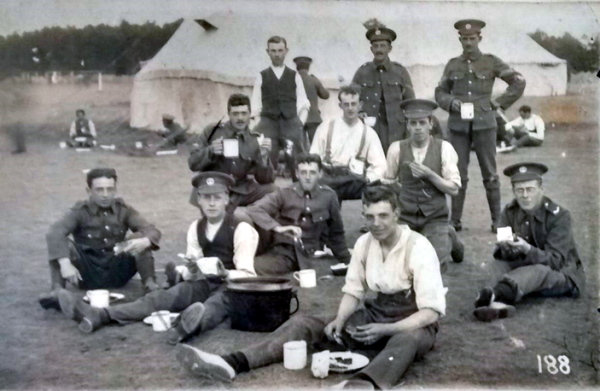
Soldiers of the 1/4th Hampshires at the battalion’s annual camp on Salisbury Plain
in the summer of 1914. Charles Douglas would almost certainly have been at the
camp which coincided with Britain declaring war on Germany on 4 August
(Photo: Royal Hampshire Regiment Museum)
Great War Record
In the summer of 1914 Charles would have travelled to Salisbury Plain with the 4th Hampshires for the battalion’s annual camp. The men were still at camp on 4 August when Britain declared war on Germany and mobilisation began. Charles was assigned to the 1/4th Hampshires which was created after the huge influx of recruits led to the battalion splitting into two. He volunteered to serve overseas and sailed for India with his battalion in October 1914, arriving the following month. (For details of the 1/4th Hampshires’ time in India see 4th Battalion, The Hampshire Regiment in the Great War).
In early March 1915, the battalion was sent to Mesopotamia, arriving at Basra in the middle of the month. Charles’s Army records show him entering a theatre of war on 18 March 1915. Charles, who served with ‘’A Company, was in Mesopotamia for just three months before he died. He would have taken part in operations against the Ottoman Turks aimed at securing British oil supplies in the region. These engagements took place in April on the lower Euphrates river and in Arabistan the following month.
The battalion was in action again in late May and early June, manning a flotilla of steamers and bellums – large, flat-bottomed boats – which were used to capture the town of Amara. However, these were exhausting operations, involving long marches in intense heat and fighting in mosquito-infested marshes. In his book The Royal Hampshire Regiment 1914-1918, the historian C.T. Atkinson describes how the fighting and the climate took its toll on the battalion:
By this time the climate and particularly the moist heat was making itself felt, sick in hospital were up to 180 by June 16th, half a dozen men had died [Charles Douglas was almost certainly one of them], mainly from heatstroke, and on June 17th 84 men were invalided to India.

An Army hospital boat on the River Tigris in Mesopotamia during the Great War
– Charles Douglas may have been evacuated to Basra on a vessel like this
after being taken sick (Photo: Royal Hampshire Regiment Museum)
Charles Douglas died of disease - or possibly heatstroke - in Basra on 12 June 1915, less than one month after his 20th birthday.
Family after the Great War
Charles’s parents continued to live at 22, Cheriton Road after the war. Elizabeth Douglas died in the city in 1944, aged 77, and Charles Snr in 1952 at the age of 86. Charles Douglas Jnr’s brother, Frank, married Violet Palfrey in Winchester in December 1934. The couple, who do not appear to have had any children, were living at 14, Cheriton Road, when Frank died on 1 February 1955, aged 53.
Medals and Memorials for Charles Edwin Douglas
Private Charles Edwin Gardiner Douglas was entitled to the 1914-15 Star, the British War Medal and the Victory Medal. He was buried in Basra War Cemetery, Iraq (GR. VI. B. 3.). Charles is mentioned on the church memorials at St Matthew’s and St Paul’s churches, Winchester, as well as those at Peter Symonds School and St Thomas School Church of England Boys’ School. The latter is now held at Kings School, Winchester. His name also appears on the Hampshire County Council memorial in Winchester.