

Private FRANCIS WILLIAM DOBSON
County High School for Girls, Cheriton Road, Winchester (now Westgate School)
Service number 11114. 1st Battalion, The Coldstream Guards
Killed in action, France, 22 December 1914
Life Summary
Francis William Dobson, the eldest child of Jesse and Ellen Dobson, was born in Winterbourne Bassett, near Marlborough, Wiltshire, on 24 September 1893. The family lived in Wiltshire and the New Forest area until shortly before the Great War when Francis’s father became caretaker/groundsman at the County High School for Girls (now Westgate School) in Cheriton Road, Winchester. In August 1914, Francis enlisted with one of the British Army’s elite regiments, but he was killed in action in December, less than a month after arriving on the Western Front.
Family Background
Jesse Dobson, Francis’s father, was born on 16 October 1867 in Winterbourne Bassett where his own father, Jeremiah, worked as a farm labourer. Jesse was listed as a plough boy on the 1881 Census. Francis’s mother, Ellen, born in April 1874, was the daughter of farm labourer William Decox and his wife Bertha. She and Jesse Dobson married in Hilmarton, near Calne, Wiltshire, on 15 July 1893, just two months before Francis’s birth.
In 1896, Francis, Ellen and Jesse were living in Woodborough, near Pewsey, Wiltshire. It was there that Ellen gave birth to three more children: Tom, on 23 March 1896; Violet, on 8 November 1899; and Stanley on 17 February 1902. The children all went to Woodborough School, with Francis enrolling there on 23 October 1898. Francis left Woodborough School on 1 May 1906 at the age of 13 having reached Grade V. The school logbook reveals that he was wanted at home, presumably to start work. The other children also departed the school in 1909 when the family left the village.
In 1911 the Dobsons, minus Francis and Tom, were living in Lymington, Hampshire, where Jesse was working as a groom and gardener. It is thought that Francis was working as one of a team of ten servants at Berry Court, a house in St Peter’s Road, Bournemouth.
Sometime before 1914, Francis’s parents moved to Winchester where his father had found work as the groundsman/caretaker at the County High School for Girls in Cheriton Road, Fulflood. It is not known whether Jesse ever lived there, but it was the address he gave when he joined the 1st Battalion, The Coldstream Guards in August 1914, shortly after the Great War broke out.
Great War Record
In 1914, new Army recruits would spend at least three months undergoing basic training before being sent into combat. The fact that Francis was immediately sent to the Western Front strongly suggests that he had previous military experience. This may have been as a Special Reservist – a part-time soldier similar to a Territorial – although no military record has yet been found to confirm this.
The Coldstream Guards were one of the seven regiments in the Household Division, the personal troops of King George V. The 1st Coldstream Guards, a Regular Army battalion, landed in France on 14 August, just nine days after Britain declared war. The battalion came under the orders of the 1st (Guards) Brigade, 1st Division and fought at the Battle of Mons (23-24 August) and the subsequent retreat, the Battle of the Marne (6-12 September) and the Battle of the Aisne (13-28 September). It was then virtually annihilated during the First Battle of Ypres (19 October-22 November 1914), losing all its officers. By 1 November, the battalion had been reduced to just 150 men and the Quartermaster. Francis joined the battalion on 26 November, shortly after its mauling at Ypres.
On 20 December the 1st (Guards) Brigade was ordered to the northern French village of Givenchy which, together with an important length of British front-line trenches, had been captured by the Germans. The Brigade, with the 1st Coldstream Guards and Cameron Highlanders leading, attacked the following afternoon in a heavy hailstorm and succeeded in retaking a line of old French trenches. A report of the 1st Coldstream Guards’ part in the fighting that followed stated:
Lieutenant Colonel John Ponsonby established his HQ in the end house of Givenchy village with a Company in trenches nearby. A patrol under 2nd Lieutenant Mills went forward to the end of Givenchy village and reported it clear of the enemy so far as the church. Attempts were made overnight to straighten up the line and get in touch with the Gloucesters on the left and the Cameron Highlanders on the right, but proper touch could not be obtained.
Lieutenant Colonel Ponsonby, assisted by Captain Daniels (15th Sikhs), made a reconnaissance and found a Company of the London Scottish on the left rear of No .2 Company of the Coldstream Guards which were almost immediately withdrawn. At 5.45am on the 22nd December the three Companies in the forward trenches attacked the German trench along the road leading from Givenchy to Chapelle St. Roche. [They] took it, but being without any support on their flanks, they were bombed out of it about 8am and retired to the north of the ruins of the church in Givenchy having lost over 50 per cent of their strength.
With the Scots Guards and the London Scottish holding the remaining parts of Givenchy, so began the daily routine of siege warfare in this area of Givenchy. At 9pm on the 22nd December the battalion was relieved by the Black Watch and marched back to billets in a village south of the canal at Pont Fixe.
Francis Dobson, aged 21, was almost certainly killed in this fighting, less than one month after he had arrived in France. He was listed as missing, believed killed, although his Medal Index Card states that he was killed in action. His mother Ellen was awarded a dependent’s pension of 5s a week after the war.
It is thought that Francis’s brother Tom fought with the West Yorkshire Regiment in the Great War. He survived and is believed to have gone on to become a police inspector in Portsmouth.
Family after the Great War
The County High School in Cheriton Road is thought to have been requisitioned by the Army during the war. In 1939, Francis’s mother, father and sister Violet were living at 1, Cheriton Road with Violet working as a short-hand typist. His father Jesse died in March 1942, aged 74, and was buried at Morn Hill Cemetery, Winchester. His mother Ellen passed away in Winchester in 1952 at the age of 78 and Violet in 1982, aged 82.
Medals and Memorials for Francis William Dobson
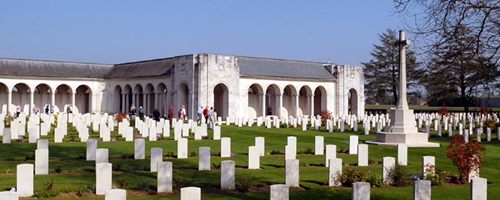
Le Touret Military Cemetery, Pas de Calais, France
Private Francis William Dobson was entitled to the 1914 (Mons) Star, the British War Medal and the Victory Medal. He is commemorated on the memorial to the missing at Le Touret Military Cemetery (above), Pas de Calais, (front panel 2 and 3) and on the memorials at St Matthew’s and St Paul’s churches, Winchester.