

Private FRANK DAWKINS
8, Greenhill Terrace, Winchester
Service numbers 72137 and 3972. 9th (Service) Battalion, The Cheshire Regiment (Transferred from Devon Yeomanry)
Killed in action, Belgium, 29 April 1918
Life Summary
Frank Dawkins was born in Winchester on 6 February 1899, the son of George and Emma Dawkins. One of five children, Frank left school just a year before the Great War broke out. He enlisted in 1917 and was killed the following year during the German Spring Offensive.
Family Background
Frank’s father George was born in Winchester in 1861 and grew up in a tenement in Middle Brook Street. He followed his father into the plumbing trade and was listed as a plumber’s assistant in the 1881 Census when he was living with his parents and siblings at 63, Middle Brook Street.
Frank’s mother was born Emma Mullins in Winchester in 1865. She was daughter of gardener Charles Mullins who was born in Winchester in 1832, and his wife Heneritte, born in Winchester in 1841. In 1881 Emma was living at St Peter’s Villa, St Peter’s Street, Winchester, where she was working as a domestic servant to nurseryman William Blackmore and his wife Elizabeth.
George and Emma married in Winchester in 1890 and their five children were all born in the city - George (1891), Bessie (1893), Agnes May (1896), Frank (1899) and Florence (1902).
The 1901 Census found the family living at 8, Greenhill Terrace, Fulflood, with George Snr working as a painter’s labourer. On 1 February 1906 Frank, then aged six, enrolled at St Thomas Elementary School, Winchester. The family were at the same address in 1911. Father George was a painter and George Jnr a gardener while daughters Bessie and Agnes May were working as housemaids. Frank left school on 21 March 1913, aged 13, and presumably went to work.

8, Greenhill Terrace, Winchester –
the house where Frank Dawkins grew up
Great War Record
Frank joined the Army in Winchester on 9 March 1917, shortly after his 18th birthday. He may have volunteered but was probably conscripted. What remains of his enrolment form (it was severely damaged in the Blitz in 1940) shows that he joined the Devon Yeomanry with the service number 3972. He then appears to have transferred to an infantry battalion of the Devonshire Regiment as a Private (service number 69344) before moving a final time to the 9th Battalion, The Cheshire Regiment (service number 71237).
Interestingly, the Cheshire Regiment’s Victory Medal and British War Medal Roll shows Frank’s name amid dozens of other former Devonshires. This suggests that Frank’s battalion was one of the many disbanded in early 1918 and amalgamated with other units.
Frank would almost certainly have been with the 9th Cheshires at the start of the German Spring Offensive on 21 March 1918. This massive assault on British positions in Picardy, northern France, was intended to drive a wedge between the British and French armies, capture the strategically important city of Amiens and bring Germany victory in the war.
The 9th Cheshires, who came under the orders of 56th Brigade in 19th Division, entered the fray on 22 March, taking up a defensive line at Delsaux farm, south of Beugny (a village to the north west of the town of Bapaume). A German attack on 24 March forced them back but the battalion then counter-attacked and regained some lost ground. They were then ordered back to a new line west of Bapaume, but before they could complete the move a further withdrawal to Grevillers was ordered. The Germans attacked again on 25 March forcing the Cheshires to pull back again at which point they were withdrawn into reserve.
All the available records and sources state that Frank Dawkins was killed in action on 29 April 1918 and buried in a military cemetery at Kemmel in Flanders. This was the region attacked by the Germans in their second spring offensive, the Battle of the Lys (9 April-29 April 1918).
However, there is no record of the 9th Cheshires, nor the 19th Division, fighting in the Lys area in April 1918. Of the Cheshire battalions, only the 10th and 11th were in action there at the time.
So, what happened? One clue is the place that Frank is buried. On the day that he died (29 April), British and French troops were fighting off a German assault against the Scherpenburg, a high point close to Kemmel. It is possible that Frank had been rushed to the area as a reinforcement to help stem the attack on the Scherpenburg, was killed and then buried at Kemmel.
Another possibility is that he was killed a few days earlier and, in the chaos of the time, the date of his death wrongly reported. This second theory does have some credibility. On 16 April, following a severe mauling at the hands of the Germans, the 10th Cheshires had been formed into a composite unit with other troops. Then, on 26 April, they took part in an attack on Kemmel which had been in German hands since the previous month. The attack failed and the 10th Cheshires lost 27 men killed. Could Frank Dawkins have been one of them? We will probably never know for certain.
Family after the Geat War
Frank was 19 years old when he died. His brother George served in the war as a Royal Navy stoker aboard HMS Constance and survived. Frank’s parents continued to live at 8, Greenhill Terrace after the war. George Snr died in Winchester in 1925 and Emma in 1950.
Medals and Memorials for Frank Dawkins
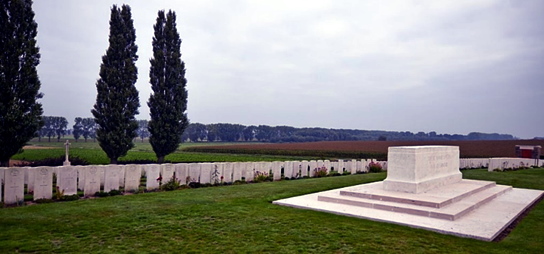
Klein-Vierstraat British Cemetery, Kemmel, West Flanders, Belgium
Private Frank Dawkins was entitled to the British War Medal and the Victory Medal. He is buried at Klein-Vierstraat British Cemetery, Kemmel, West Flanders, Belgium, (GR. V. D. 6.) and the inscription on his headstone reads:
SLEEP ON DEAR SON AND TAKE YOUR REST
WE MISS YOU MOST WHO LOVED YOU BEST
Frank’s name appears on the memorials at St Matthew’s and St Paul’s churches, Winchester, and on the St. Thomas School Memorial now held at Kings School, Winchester.