

Private SIDNEY JAMES COLES
68, Western Road, Winchester (No. 44 today)
Service numbers 4/3237 and 201057. 1/4th Battalion, The Hampshire Regiment
Killed in action, Mesopotamia, 21 January 1916
Life Summary
Sidney James Coles was born in Portaferry, County Down, Northern Ireland, in late 1894, the son of Thomas Henry and Rose Coles. His name is spelt Sydney in the Winchester War Service Register and on the memorials at St Matthew’s and St Paul’s, but his birth was registered as Sidney and that is how it appears on most official records. Part of a well-respected family with close connections to St Paul’s Church in Fulflood, Sidney enlisted with the Hampshire Regiment shortly after the outbreak of war. He was killed in Mesopotamia (modern Iraq) in 1916 during an attempt to relieve the besieged British garrison at Kut-al-Amara.
Family Background
Little is known of Sidney’s father except that he was born around 1870. Given Sidney’s birthplace, it is possible that Thomas Coles was a serving soldier - it would certainly help to explain his absence in the official census records. Sidney’s mother was born Rose White in Winchester in 1871 and was one of 11 children. Her father, George (1842-1905), was born in Micheldever, near Winchester, and worked as a carpenter. Her mother Mary, born around 1841, was from Fareham. In 1871 the family were living at 15, Upper High Street, Winchester. Ten years later they had moved to Western Road in Fulflood.
The 1891 Census shows Rose White working as a domestic servant for a family in Portsmouth. She married Thomas Coles in Winchester later that year. Sidney’s birth was registered in Downpatrick in the final quarter of 1894, but at some stage between then and 1901 his father died.
In the 1901 Census Rose and Sidney were living at her parents’ home at 68, Western Road. It is thought that they continued to live there until 1914, by which time the householder, according to Warren’s Winchester Directory, was Rose’s brother, Alfred White. The house became No. 44 when the street was renumbered after the war, and this is the address that appears in the Winchester War Service Register of 1921. However, this biography uses No. 68, the address when Sidney went to war in 1914.
By 1911 Mary White, Sidney’s grandmother, was also widowed. In that year’s Census his mother Rose was recorded working as an assistant wardress at HM Prison – presumably Winchester – while 16-year-old Sidney had left St Thomas Church of England Boys’ School and was working as a coach trimmer with Messrs Easther Ltd in Jewry Street. This was skilled work and involved making and fitting the leather upholstery to the interior of horse-drawn coaches.
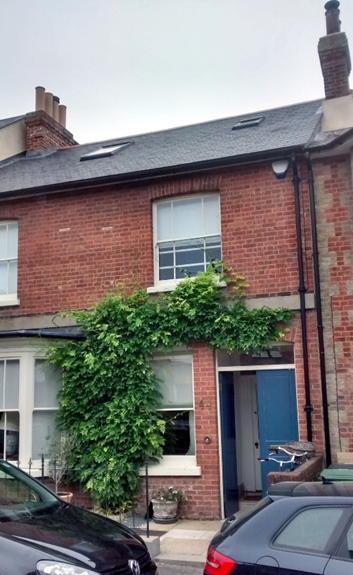
44, Western Road – this was No. 68
when Sidney Coles lived here from the early 1900s
The Census also reveals how the family was continuing to prosper despite the deaths of Sidney’s father and grandfather. His mother’s younger sister, Marian White, was working as an assistant schoolmistress while her younger brother, Alfred, had moved on from his job as a machinist in 1901 to become verger at St Paul’s Church. The Coles-White family had other links with St Paul’s – young Sidney was a chorister there and a member of the St Paul’s Amateur Dramatic Society. Clearly a young man of some promise, Sidney moved to a new job in Reading, Berkshire, sometime before 1914 to further his career.
Great War Record
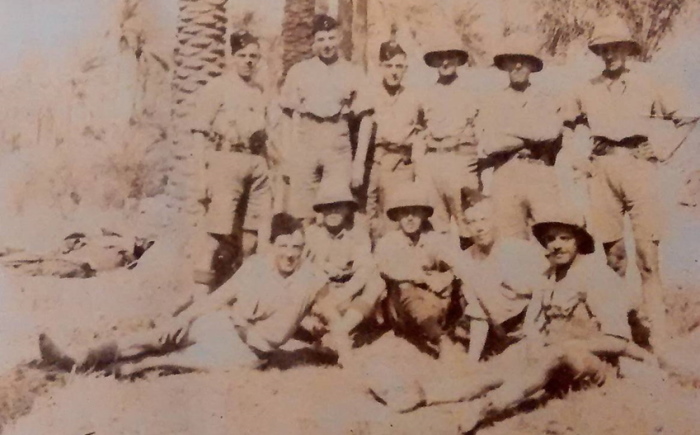
Soldiers of the 1/4th Hampshires at their first camp near Basra after arriving in
Mesopotamia in March 1915. Sidney Coles was with the battalion at this time,
but was killed ten months later at the Battle of El Hanna
(Photo: Royal Hampshire Regiment Museum)
Sidney enlisted with the 4th Battalion, The Hampshire Regiment in September 1914, a few weeks after the outbreak of war. From military records we know that he was 5ft 11½in tall, wore a size 9 shoe and a size 7 hat. He was given the service number 4/3237 and assigned to the 1/4th Battalion. Having volunteered for service overseas, Sidney sailed for India with his battalion in October 1914, arriving the following month. He had only been in India a matter of weeks when his mother remarried in Winchester. Her second husband was Robert Flitton and the couple set up home at 9, Gladstone Street, Winchester.
After four months of training in India Sidney was sent to Mesopotamia with his battalion. After arriving there on 18 March 1915, the Hampshires took part in operations against the Ottoman Turks around Basra, but at some stage Sidney contracted fever and was sent back to India to recuperate.
On returning to Mesopotamia, Sidney joined the relief force under General Fenton Aylmer as it attempted to break the Turkish siege of the British garrison at Kut-al-Amara where nearly 200 officers and men of the 1/4th Hampshires were among the 13,000 British and Indian troops trapped. (For details of the siege and of operations by the 1/4th Hampshires in 1915 see Kut.) On 21 January 1916, the remainder of the 1/4th Battalion joined an attack by 9th Brigade on Turkish positions at El Hanna on the north bank of the River Tigris which blocked the way to Kut. In his book, The Royal Hampshire Regiment 1914-1918, the historian C.T. Atkinson describes the early stages of the battle:
The Hampshires had been under fairly heavy long-range rifle fire even before ‘Zero’ and had had a few men hit … but directly the advance had begun rifles, machine-guns and field guns had opened a heavy fire, and with the ground flat and affording no cover casualties quickly mounted up… Before reaching [the battalion’s old front trench] Colonel Bowker [the battalion commander] had been hit, but pushed on nevertheless, to be hit again and killed.
The attack failed and when it was called off that night the Hampshires had lost 13 officers and 230 men killed, missing and wounded out of 16 and 339 in action. Among the missing was 21-year-old Sidney Coles whose body was never found. Also killed were the 1/4th Battalion’s Commanding Officer, Lieutenant-Colonel Francis Bowker, and 37-year-old Company Sergeant Major Eric Rule who lived in St Paul’s Terrace, Winchester (now St Paul’s Hill), a short distance from Sidney’s home.
Sidney’s mother waited nearly two years for news for her son before finally being informed that he was ‘presumed dead’. The Hampshire Regimental Journal of December 1917 states:
After an elapse of almost two years of anxious suspense, official news has been received of Pte Sidney James Coles, Hampshire Regiment (3237). He was reported as missing after an engagement somewhere in Mesopotamia on January 21st 1916, and no further tidings being received relative to him, the Army Council conclude his death must have taken place on that date. He was the son of Mrs. R. Mitten [sic], 9, Gladstone Street, formerly Mrs Coles, 68, Western Road, Winchester, and was apprenticed as a trimmer with Messrs. Easther, Ltd., Jewry Street (now Mr. F. J. Matthews), and afterwards secured a good position at Reading.
He went out to India in 1914 with the Regiment, under the command of the late Colonel Bowker and went with the first force to the Persian Gulf where he contracted fever and was sent back to India. After recuperating on the hills of Sabathe, he went to Quetta, and from there back to the Gulf, and was serving with the Kut relief force, under General Aylmer, up to the date he was reported missing. He was well known in the parish of Weeke, and as a boy was a chorister of St Paul 's Church choir. He was also a member of St Paul's Amateur Dramatic Society.
Family after the Great War
After the war, Sidney’s mother Rose continued to live with her husband Robert Flitton at 9, Gladstone Street. The couple were still there in 1927. Rose Flitton is believed to have died in Gosport in 1963, aged 93.
Medals and Memorials for Sidney James Coles
Private Sidney James Coles was entitled to the 1914-15 Star, the British War Medal and the Victory Medal. He is commemorated on the Basra Memorial, Iraq (PR. Panel 21 and 63) and on the memorials at St Matthew’s and St Paul’s churches, Winchester. He is also listed on the St Thomas Church of England Boys’ School Memorial, now held by Kings’ School, Winchester.