

Company Sergeant Major FRANK COLES
2, Andover Road, Winchester
Service numbers 4/42 and 200011. 1/4th Battalion, The Hampshire Regiment
Died in Turkish captivity, Mesopotamia, between 16 and18 September 1916
Life Summary
Frank Coles, the son of Charles William and Elizabeth Coles, was born in Alresford in the first quarter of 1885. Frank was a pre-war Territorial soldier with the 4th Battalion, The Hampshire Regiment and he worked as a printer’s compositor before joining his father’s tailoring business shortly before 1914. A respected figure in Winchester, Frank died a prisoner of the Turks after the fall of Kut-al-Amara in 1916.
Family Background
Frank’s father Charles was born in Chelsea, west London, in around 1861. No record can be found of Charles’s parents. Frank’s mother was born Elizabeth Camis in Hinton Ampner, near Winchester, in September 1860. Her father, Thomas, was born in Avington, near Winchester, around 1814 and worked as an agricultural labourer. Elizabeth’s mother, Mary, was born in nearby Kilmeston in around 1821.
Charles and Elizabeth married in Alresford in July 1882. On 7 June 1883 Elizabeth gave birth to a daughter, Daisy, in Alresford. Frank was born two years later and christened on 26 July 1885. The couple had two other children, but neither survived into adulthood. In 1891 the Coles family were living in a cottage in Cheriton with Charles working as a tailor. Frank and Daisy were both at school, presumably in the village, but no record can be found to confirm this. By 1901 the family had moved to Winchester and were living at 2, Andover Road. By this stage Charles was a self-employed tailor working from home. Frank, aged 16, was working as a printer’s compositor’s apprentice and Daisy as a parlour maid.
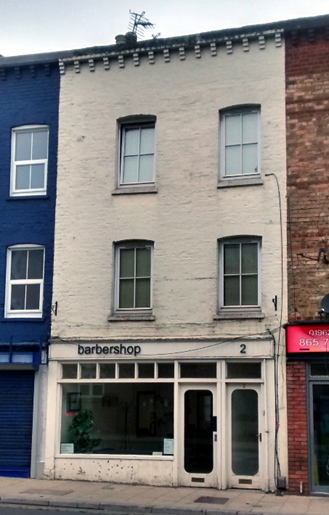
2, Andover Road, Winchester
– Frank Coles’s home from around 1900
In 1906 Daisy married George Mariner in Twyford, Hampshire, and she gave birth to a son, William, in 1909. By 1911 Frank was still living with his parents at 2, Andover Road and had qualified as a compositor. However, it appears that shortly afterwards he joined his father in the family tailoring business.
Great War Record
There are several inconsistencies in Frank’s military record. According to the Winchester War Service Register (WWSR) he did not join the Army until August 1914. However, his original service number 4/42 indicates that he was a pre-war Territorial soldier with the 4th Hampshires. Indeed, Frank comes so close to the start of the battalion numbering sequence that he must have been among the first to enlist with the unit when the Territorial Force was created in 1908.
Another clue that Frank had been a part-time soldier for some time before the war broke out is that he played in the Soldiers’ Home Band. Had he enlisted in August 1914 there would have been little chance to display any musical prowess since military training was the urgent priority for new recruits.
The other major discrepancy concerns Frank’s rank when he died. Most sources give it as Company Sergeant Major but some, notably the Commonwealth War Graves Commission, state that he had only reached Lance-Sergeant. This was an appointment given to a Corporal so that they could fill a post usually held by a Sergeant. The Hampshire Regimental Journal of July 1916 lists Frank as a Lance-Sergeant in its roll call of men taken prisoner at Kut, but then in a February 1917 obituary states that he was a Company Sergeant Major. This biography has opted for the more senior rank.
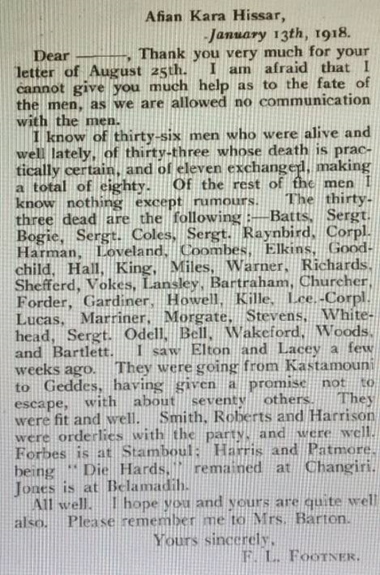
Major Foster Footner’s letter in the Hampshire Regimental Journal
of April 1918 confirming the death of Frank Coles. Note the inclusion on the list
of Andrew Bogie, Frank Richards, Cecil Shefferd and Francis Forder
whose names also appear on the memorials at St Matthew’s and St Paul’s
and whose biographies can be found in this book
In October 1914 Frank sailed to India with the 1/4th Hampshires and from there to Mesopotamia, arriving in a theatre of war on 18 March 1915. He served with A Company and was almost certainly already an NCO – Corporal or even Sergeant – so would have had been responsible for leading men during the battalion’s early encounters with the Ottoman Turks in the spring and summer of 1915 (Mission Creep).
In December 1915 Frank found himself among the 13,000-strong force trapped in the British-Indian Army garrison at Kut-al-Amara. This included nearly 197 officers and men of the 1/4th Hampshires. When the garrison fell to the Turks on 29 April 1916 after a five-month siege, Frank, together with the other 187 surviving Hampshire soldiers, was marched off to the notorious prisoner of war camp at Afrum Karra Hissa (modern day Afyonkarahisar) in Turkey. Frank’s name appeared in a list of men from the 1/4th Hampshires taken at Kut published by the Hampshire Chronicle on 10 June 1916.
The letters and records of Sergeant William Leach, a fellow 1/4th Battalion prisoner, reveal that Frank was sick when the convoy of prisoners reached the city of Mosul, north of Baghdad. Frank then had the misfortune to end up at a PoW camp that was presided over by a bullwhip-wielding commandant and widely regarded as the worst for Allied prisoners at the time.
Frank Coles died from dysentery at the camp in September 1916. He was 31 years old. The precise date of his death is unclear, with the CWGC giving 18 September and regimental and newspaper sources 16 September. An entry in the 1917 Hampshire Regimental Journal states:
COLES - Died from dysentery on September 16th, 1916, as a prisoner of war at Afrum Karra Hissa, Co Sergt. Major Frank Coles, Hampshire Regiment, only son of Mr C. W. Coles 2, Andover Road, Winchester.
On 3 February 1917, under the headline ‘Death of Sergeant Major Frank Coles’, the Hampshire Observer newspaper reported:
Many in Winchester will read with great regret the news of the death … on September 16 last, at Hissa, where he was a prisoner of war, of Sergeant Major Frank Coles, of the Hampshire Regiment. The deceased who succumbed to dysentery at the age of 31, was the only son of Mr C.W. Coles of Andover Road, Winchester. He assisted his father in his tailor’s business, was a member of the Soldiers’ Home Band and was much esteemed by all who knew him.
In April 1918 the Hampshire Regimental Journal published a letter from Major Foster Footner, the senior 1/4th Hampshire officer in Kut and a fellow prisoner at the Afrum Karra Hissa camp, in which he confirmed Frank’s death along with several more men whose names appear on the memorials at St Matthew’s and St Paul’s. In February 1918, the Army paid Charles Coles £35 2s 9d in respect of his late son’s effects and back pay. He also received a £10 war gratuity in October 1919.
Family after the Great War
Frank’s parents continued to live in Winchester after the war. Elizabeth died there in December 1925, aged 65, and was buried at Magdalen Down Cemetery. Charles died at St Catherine’s Lodge, Garnier Road, Winchester, in January 1940. He was 79 years old and was laid to rest with his wife at Magdalen Down (Ground 6, Section 3rd. Grave L3 77). Frank’s sister Daisy died in Bishopstoke on 10 September 1957, aged 74.
Medals and Memorials for Frank Coles
Company Sergeant Major Frank Coles was entitled to the 1914-15 Star, the British War Medal and the Victory Medal. After the war, his body was disinterred and reburied at Baghdad (North Gate) War Cemetery, Iraq (GR. XXI. K. 16.). He is mentioned on the memorials at St Matthew's and St Paul's churches, Winchester.