

Rifleman REGINALD JAMES CLARK
40, Fairfield Rd, Winchester
Service Number S/33649, 12th (Service) Battalion, The Rifle Brigade
and 0195193 Army Ordnance Corps
Killed in action, France, 30 November 1917
Family Background

Reginald James Clark
Reginald James Clark was born in Salisbury, Wiltshire, on 12 July 1884, the youngest child of Henry and Elizabeth Clark. Reginald’s father had been born in Wilton, near Salisbury, and worked as a carpenter. His mother was from Laverstock, near Salisbury. William Clark, Reginald’s eldest brother was born in 1875 in Wilton, followed by Thomas, Amy, Ethel, Beatrice and Reginald, all born in Salisbury.
By 1890, the family must have been living in Milford, then on the edge of Salisbury, as on 1 December of that year, six-year-old Reginald entered St Martin’s Church of England School. According to the 1891 Census, the family were living in Wellington Cottage, Southampton Road, Milford, although the school record gives Waterloo Gardens as the address. His three eldest siblings were already out at work - even 13-year-old Amy was recorded working as a dressmaker. Reginald progressed through Standard I-V and left in his Standard VI year, in October 1897, aged 13.
By the 1901 Census, the Clarks had moved to Portswood, Southampton, and were living at Primrose Cottage, Ash Tree Road. Only Amy, still a dressmaker, and Reginald, by then aged 16 and a builder’s clerk, were living at home with their parents.
However, by the time of the 1911 Census, Reginald also had flown the nest and was living at a boarding house at 17, Eastgate Street, Winchester (the property has the same number today). Besides the landlady, the household consisted of four young men and one single woman, a teacher at the Girls’ High School. Reginald was working as an ironmonger’s clerk and it was presumably here that he met his future wife, Millicent Cuell, known as Milly to her family and friends, who worked as a cashier for an ironmonger.
In the 1911 Census, Milly, then aged 22, was living with her parents, Henry and Rose Cuell at Rosebank, Worthy Lane (now Church Lane), in Easton, near Winchester. Intriguingly, her father had been an inmate in Winchester Prison in the 1901 Census, but it has not yet been possible to find out what crime he had committed. Milly’s elder sister, Ethel, had died aged 18 in 1905, just 13 days after marrying. Reginald’s eldest brother, Frederick (known as Jack), had left home in 1910 to join the Royal Navy. His four other siblings were still at home in 1911: Henry Jnr and Ernest were self-employed market gardeners while 11-year-old Albion (known as Alb) was at school. Gwen, aged two, was the baby of the family.

The Clark brothers (from left to right) – Thomas, William and Reginald.
The photograph is believed to have been taken shortly before
the Great War (Photo: Cuell family)

17, Eastgate Street, Winchester,
where Reginald Clark was lodging in 1911
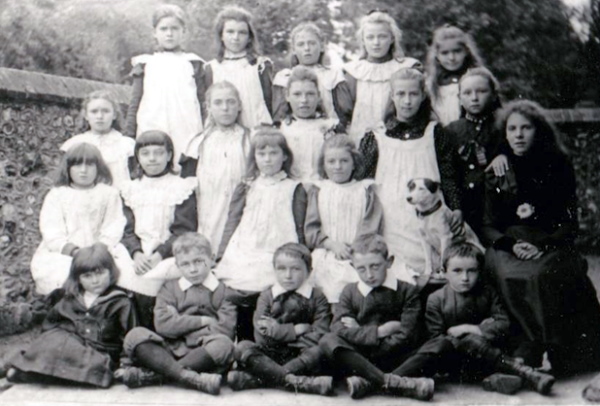
Reginald Clark’s future wife Milly Cuell (far right, second row down
in dark jacket), pictured at Easton School in 1898. Her brothers Frederick (known
as Jack) and Ernest are in the centre and on the far right of the front row
respectively (Photo: Cuell family)
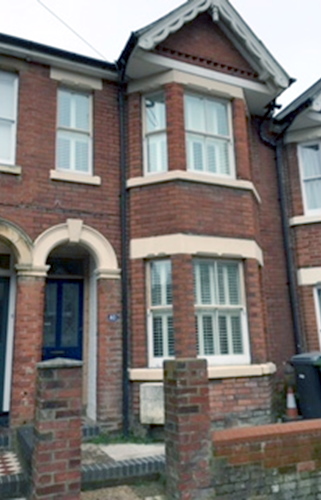
40, Fairfield Road, Winchester, where Reginald moved
with his wife Milly after they married in 1911.
Following Reginald’s death, Milly remained in the house
until 1921 when she moved back to Easton
Reginald Clark and Milly Cuell married towards the end of 1911, presumably at St Mary’s Church in Easton. By 1913 they were living at 40 (then and now), Fairfield Road, Winchester, within the parish of St Matthew’s and St Paul’s. Presumably, Reginald was still working in the ironmongery business.
Great War Record
Reginald was 26 when the Great War broke out in August 1914. For reasons that we will probably never know, he chose not to enlist as a volunteer even though others in his extended family did so. It may have led to a degree of social ostracism as there was pressure on all able-bodied men to answer the call to arms. Reginald was finally called up under conscription in June 1916, just a month after the Military Service Act of January that year was extended to include married as well as single men.

Milly Clark (front row, far left) with her father Henry and mother Rose (both front
row) at the wedding of her brother Henry Jnr and Ada Quick in 1912
Milly Clark was some four months pregnant when Reginald went off to war. On 28 November 1916 she gave birth to a son, Cyril Clive, in Marylebone, London. It is not known whether she had gone to London to see Reginald while he was on leave or whether they had set up a temporary home there. However, the Warren’s Winchester Directories show that their house at 40, Fairfield Road was held in the name of R.J. Clark from 1913 until about 1921. According to Milly’s descendants in the Cuell family, Reginald definitely met baby Cyril before he was killed in late 1917.
Reginald served initially as a Private in the Army Ordnance Corps (the Royal prefix was added in 1918) which dealt with the supply and maintenance of weapons, munitions and other military equipment. He received the service number 0195193. At some stage, however, he transferred to the 12th Battalion, The Rifle Brigade with the new service number S/33649.
The 12th (Service) Battalion, The Rifle Brigade had been raised in Winchester in September 1914 as part of Lord Kitchener’s Second New Army and was assigned to 60th Brigade in 20th (Light) Division. Sent to the Western Front in July 1915, it saw action at the Battle of Loos and then the following year at the Battle of Mount Sorrel and in several operations during the Battle of the Somme.
Given that Reginald served initially with the AOC after being conscripted, he would not have figured in the Somme fighting which ended in November 1916. Although the date of his transfer to the 12th Rifle Brigade has not been established, it is possible that he was with the battalion at the Third Battle of Ypres (Passchendaele) during the late summer and autumn of 1917. The 12th Rifle Brigade took part in some of the costliest fighting of the campaign at the Battle of Langemarck as well as the more successful Battles of the Menin Road and Polygon Wood.

The Cambrai battlefield showing the furthest extent of the British
advance and the German counter-attack. Reginald Clark was involved in fighting at
La Vacquerie on 20 November 1917 and was killed near Gonnelieu ten days later
The battalion – with Reginald Clark definitely among its ranks - next saw action at the Battle of Cambrai (20 November - 7 December 1917). The offensive towards Cambrai, a strategically important enemy supply point, some 30 miles east of Arras, was followed by the biggest German counter-attack against the British since 1914.
Today the Battle of Cambrai is remembered chiefly for seeing the first mass use of tanks in warfare although other developments which had been maturing since 1915, such as predicted artillery fire, sound ranging, infantry infiltration tactics and close air support, were actually more important to British success in the early stages of the fighting.
The battle began at dawn on 20 November, with a bombardment by 1,000 guns on German defences, followed by smoke and a creeping barrage to cover the first advances. The attacking force comprised six infantry divisions of the III Corps on the right and IV Corps on the left, supported by 437 tanks. Initially, there was considerable success: even the Hindenburg Line, previously believed to be virtually impregnable, was breached by tanks as the British advanced up to five miles. The 12th Rifle Brigade formed part of 20th Division’s attack, forcing a way through the village of La Vacquerie before digging in after achieving all its objectives. One company alone took more than 130 prisoners and captured a trench mortar and six machine-guns. The battalion’s losses for the day totalled one officer killed and 40 men killed or wounded – remarkably low by Great War standards.
The British made similar early gains elsewhere along the line, but a combination of German resistance and the unreliability and vulnerability of the tanks – 180 were out of action at the end of the first day – meant the advance gradually stalled. Between 21 and 27 November the 12th Rifle Brigade consolidated its defensive positions before going into reserve the following day in a captured stretch of the Hindenburg Line.
On 30 November, the Germans launched a massive and unexpected counter-attack, firing a short but intense artillery barrage and using infantry tactics that would be employed to devastating effect again in their 1918 Spring Offensive. The previous night the 12th Rifle Brigade had camped in Fifteen Ravine, near the village of Gonnelieu. They were woken by the German artillery barrage and as the men attempted to move into a nearby trench, they were strafed by machine-gun fire from more than 30 enemy aircraft flying low overhead.
All that morning panic reigned in the British lines as commanders tried to come to terms with the scale of the German assault. The 12th Rifle Brigade was first ordered to occupy the high ground between La Vacquerie and Quentin Mill and then, a short while later, to advance towards Gonnelieu. Here the battalion spent the remainder of the day attempting to repulse furious enemy attacks and it was possibly during this fighting that Reginald Clark was killed. Although his body was never found, and he was officially listed as ‘Missing’, it is likely that he was killed in action.
The Cambrai fighting continued for another week at which point the British withdrew, giving up most of the gains they had made in the battle. The British suffered some 40,000 casualties, of which the 12th Rifle Brigade lost 13 other ranks killed and four officers and 84 other ranks wounded. The number of men missing, presumed killed, totalled 32, including Reginald Clark.
Family after the Great War
Reginald’s mother, Elizabeth Clark, died in March 1918, only a few months after her son’s death. His father Henry died in 1929. Of Reginald’s siblings, his two brothers, William, a currier, and Thomas, a bootmaker, seemed to have stayed in Salisbury when their parents and younger siblings moved to Southampton. Both married and had families. Thomas died in Southampton in 1957. Amy and Ethel both married and had families and remained living in Southampton. Amy died there in 1967 and Ethel in 1972. Beatrice, the sibling nearest in age to Reginald, married and had family and by 1911 she was living back in Salisbury. She died in Surrey 1972.
Three of Milly Clark’s brothers also served during the war and all survived. ‘Jack’, who had joined the Royal Navy in 1910, fought at the Battle of Jutland in 1916 aboard HMS King George V. Ernest, meanwhile, appears to have volunteered in 1914 and served in the 9th Lancers and the Royal Field Artillery. Albion, who was not called up until May 1918, was assigned to the Royal Navy but never went to sea. Milly’s older brother, Henry Jnr, was a market gardener, which became a reserved occupation. He supplied produce to the army camps on Morn Hill, Winchester.
As for Milly herself, she returned to Easton in about 1921 with her son Cyril and went to live with her mother Rose at Rosebank. (Her father had died in 1916.) Cyril attended school at Easton, as his mother had done, along with his cousin Eddy, son of Henry George Jnr and his wife Ada. The two boys were the same age and lived next door to each other, Cyril in Rosebank and Eddy in Jasmine Cottage, both properties being owned by Rose Cuell. According to the family, Cyril and Eddy were like brothers and their friendship carried on into adulthood.
In 1925 Rose Cuell remarried and moved to West End, Southampton. That probably left Milly and Cyril with her younger brother Ernest at Rosebank. Ernest never married and, again from information supplied by the family, he acted as a father figure to Cyril. Ernest ran a garage in Easton which provided a coach, lorry and taxi service. The ‘family’ of three were still at Rosebank in 1939 according to the Register of that year which also stated that Cyril was working as a civilian engine fitter at HMS Kestrel at Worthy Down, near Winchester.
Milly Clark never remarried. She remained at Rosebank until she became seriously ill and went to a nursing home in Crawley, near Winchester, where she died in 1962, aged 72. She was buried in St Mary’s churchyard in Easton, but has no gravestone so she, like her husband, has no known grave. Ernest, her younger brother and surrogate father to Cyril, died in 1989, aged about 95. He would have been the last of Reginald’s generation to have known him. Cyril seems to have worked all his life as an air mechanic. He did marry but had no children and died in 2000 in Southampton, aged 83.

Elizabeth and Henry Clark’s grave in Salisbury (Photo: Geoff Cuell)

the inscription bearing their son Reginald’s name on the edging (Photo: Geoff Cuell)
Medals and Memorials for Reginald James Clark
Rifleman Reginald James Clark was 33 years old when he died. He was entitled to the British War Medal and the Victory Medal. He has no known grave, but is listed on the Cambrai Memorial at Louverval, Nord Calais, (PR. Panel 10 and 11). Reginald is remembered in the Memorial Book at St Matthew’s Church, Weeke, and on the Memorial Boards at St Paul’s Church, Fulflood. His name also appears on the edging of the grave of his parents, Elizabeth and Henry Clark, (Plot K573) in London Road Cemetery, Salisbury, Wiltshire. The inscription reads:
[TO THE MEMORY …. ]
AND OF THEIR SON REGINALD JAMES MISSING IN FRANCE NOV 30 1917
Additional sources
- Seymour, William: The Rifle Brigade 1914-1918, Vol II 1917-1918 (The Rifle Brigade Club Ltd, London, 1936).
- Interview with Geoff Cuell, great nephew of Millicent Clark (née Cuell).